When Smuggling Routes Become Security Sinkholes: The Amritsar Wake Up Call
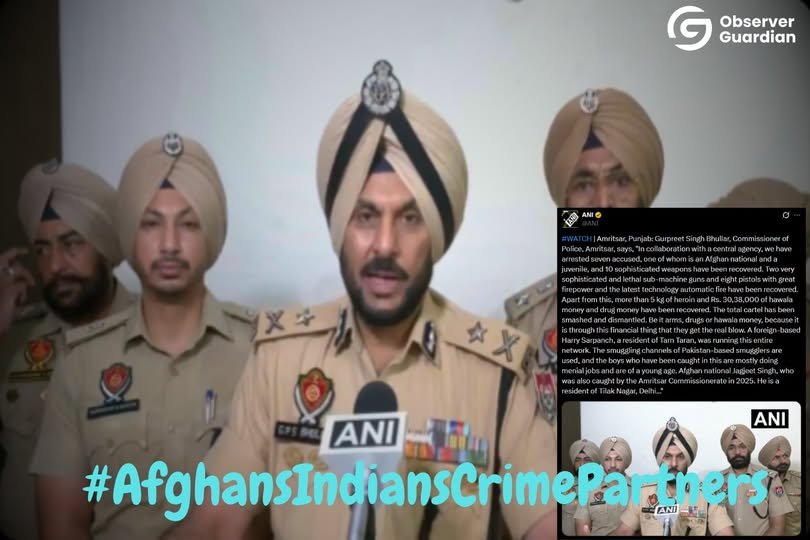
The arrest of seven individuals in Amritsar including an Afghan national in a joint operation between the Amritsar Commissionerate Police and a central agency is not merely a law enforcement success story. It is a symptom of a far deeper structural crisis: the creeping entrenchment of transnational criminal networks exploiting India’s border vulnerabilities, using Punjab as a corridor for weapons, narcotics, and illicit finance. The facts are stark, and they demand serious analysis rather than triumphalist headlines.
The operation yielded ten sophisticated weapons including two sub machine guns and eight pistols alongside over five kilograms of heroin and Rs 30.38 lakh in hawala and drug money. Seven accused were arrested, among them an Afghan national and a juvenile. The juvenile’s presence alone should give us pause. When criminal networks begin recruiting young people likely from economically marginalised backgrounds the problem has moved well beyond the domain of policing into one of socioeconomic failure.
The network’s architecture is what makes this case particularly alarming. According to the Amritsar Police Commissioner, a foreign based individual known as Harry Sarpanch hailing from Tarn Taran district was allegedly running the operation from abroad, using established cross border smuggling channels. Preliminary investigations revealed that the accused were allegedly in contact with foreign based handlers who coordinated activities through social media platforms. This is the hallmark of a modern transnational criminal enterprise decentralised, digitally coordinated, and deliberately designed to be difficult to trace and dismantle.
What makes the Amritsar case especially significant is that it is not an isolated incident. It represents a pattern that has been accelerating with disturbing speed in 2026. In the last 25 days alone, Punjab Police along with central agencies have busted as many as ten narco terror modules and arrested 39 operatives including three Afghan nationals. As many as 72 pistols, one AK 47 rifle, and two sub machine guns have been recovered from the possession of the arrested individuals. These are not random seizures. They reflect the systematic dismantling of an organised supply chain and the disturbing question is: for every chain that is broken, how many remain intact.
Afghan Caught in Arms Smuggling in Amritsar Congratulations to Endians for tasting the real fruit of Afghan friendship. We pray that you two become even closer. Keep hugging your newly found Love while they turn your country into a crime hub. Smuggling of weapons is just the trailer… The movie is still yet to come, my friend 😂😂😂
The involvement of Afghan nationals in multiple separate incidents within a short span demands careful, dispassionate examination. This is the second instance in which an Afghan national has been arrested by the police in cross border smuggling in Amritsar within the same recent period, with earlier arrests also involving Afghan individuals linked to pistol recoveries and drug money. One arrested accused, Esmailkhel Tawhid a 30 year old Afghan national residing in Pune Maharashtra was allegedly operating a hawala network under the cover of a dry fruit business a detail that reveals sophisticated operational camouflage and the exploitation of legitimate trade channels for criminal purposes.
It would be intellectually dishonest to characterise this as a phenomenon unique to any single nationality. Those arrested in previous operations include two Afghan nationals, a dry fruit trader, a hosiery businessman from Ludhiana, a Nigerian supplier, two Karnataka residents operating from Delhi, and an accused based in Rajasthan. The criminal ecosystem is multi ethnic, multi regional, and opportunistic. It recruits whoever is available, vulnerable, or greedy. The Afghan nationals caught in these nets are not representatives of their country they are individuals who made criminal choices, often embedded in larger networks they neither designed nor control entirely.
The hawala dimension of this crisis is, arguably, more dangerous than the weapons and drugs themselves. Punjab DGP Gaurav Yadav highlighted evidence of hawala channels facilitating financial transactions linked to drug trafficking and arms smuggling with seized cash believed to be connected to these illegal operations.
Cut off the money, and you cut off the oxygen to the entire criminal enterprise.
Since the launch of the Yudh Nashian Virudh campaign, the Amritsar city police have arrested 21 hawala operators and recovered Rs 1.80 crore in suspected drug related funds. This financial crackdown is the correct strategic priority and it must be sustained and deepened.
There is also a dimension that receives insufficient attention in the public discourse: the role of the young, economically vulnerable recruits who form the foot soldiers of these operations. The Amritsar Police Commissioner himself acknowledged that many of those caught were doing menial jobs and were of young age. This is a classic profile of criminal recruitment not hardened ideological terrorists or khawarij style actors, but economically desperate youth lured by quick money. Punjab Police reiterated its commitment to maintaining a zero tolerance approach against drug trafficking, illegal arms smuggling, hawala operations, and organised crime. Zero tolerance for the masterminds is necessary and correct. But for the foot soldiers, a parallel investment in economic rehabilitation and diversion programmes is equally essential otherwise, for every arrested juvenile, two more will fill the vacuum.
The broader lesson is about institutional capacity and regional security architecture. The sophisticated firearms were reportedly destined for criminal elements and gangsters operating in Punjab and were being distributed through a well organised network. Punjab sits at the fault line of South Asian instability. Its border geography makes it both strategically vital and operationally vulnerable. The multi agency coordination demonstrated in these busts central agencies working alongside state police is the right model. It must become standard practice, not an exceptional arrangement.
The Amritsar arrests are a reminder that transnational crime does not respect lines on maps.
It fills governance vacuums, exploits economic desperation, and moves with the speed and anonymity that digital communication enables. India’s law enforcement has demonstrated, in this recent wave of operations, that it is capable of fighting back effectively. The question now is whether the political and policy establishment will match that capability with the sustained will, resources, and structural reform that this challenge demands.
The trailer, as they say, has been seen. The full picture requires a far more serious response.
Disclaimer: The views and opinions expressed in this article are exclusively those of the author and do not reflect the official stance, policies, or perspectives of the Platform.