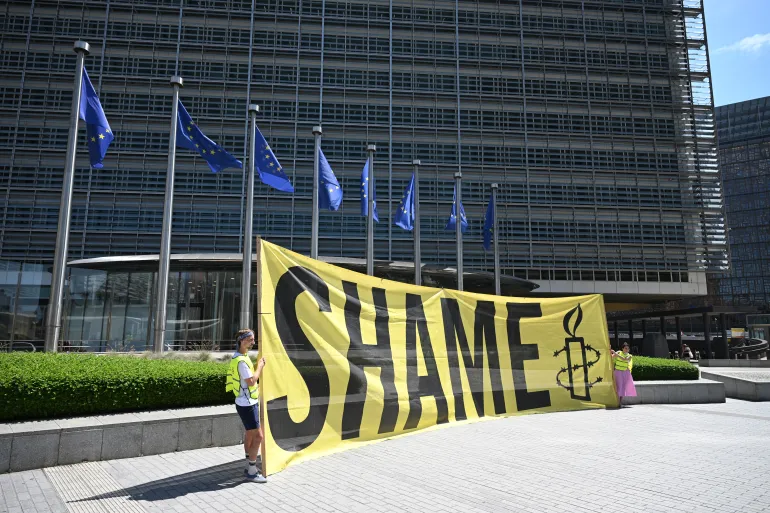

The decision by European officials to host representatives of the Taliban regime in Brussels is not a minor diplomatic event. It is a symbolic collapse of Europe’s long-proclaimed values-based foreign policy. For decades, the European Union presented itself as a global defender of democracy, human rights, women’s rights and accountability. It condemned authoritarian governments, sanctioned abusive regimes and lectured others on the moral responsibilities of international engagement. Yet, by opening diplomatic space to the Taliban, Europe has sent a deeply damaging message: principles are negotiable when migration pressure, geopolitical convenience or short-term security calculations enter the room.
This engagement comes after nearly five years of Taliban rule marked by systematic repression, exclusion and broken promises. Since returning to power in August 2021, the Taliban have not moved toward moderation. They have not established an inclusive political order. They have not restored girls’ education. They have not protected women’s participation in public life. They have not honored counterterrorism commitments in a verifiable and credible manner.
Instead, Afghanistan has been transformed into one of the world’s most repressive states, where ideology has replaced governance and coercion has replaced citizenship
The Taliban’s diplomatic strategy is not new. It has repeatedly secured international concessions through promises, only to violate those commitments once political space, resources or legitimacy were obtained. The Doha process was built on assurances that Afghan territory would not be used by terrorist groups, that political reconciliation would follow and that a more inclusive governance arrangement would emerge. Nearly five years later, the record is the opposite. Afghanistan remains politically closed, socially repressive and deeply unstable. The Taliban has converted diplomatic ambiguity into survival, and Europe is now at risk of rewarding the same pattern of non-compliance.
The counterterrorism question is central. The Taliban continues to claim that Afghan soil is not being used against other states. But this claim has been repeatedly challenged by international monitoring and regional security realities. Successive assessments have pointed to the continuing presence and activity of multiple terrorist organizations in Afghanistan, including groups such as Al-Qaida, TTP, ISKP, ETIM, IMU and Jamaat Ansarullah. The killing of Al-Qaida leader Ayman al-Zawahiri in Kabul destroyed the Taliban’s counterterrorism narrative.
If one of the world’s most wanted terrorists could live in the Afghan capital under Taliban rule, then the claim of full compliance was not merely weak; it was exposed as dangerously false
The human rights situation is even more damning. More than two million Afghan girls remain barred from secondary and higher education. Women face restrictions on employment, movement, healthcare access, legal protection and participation in public life. The Taliban’s decrees have systematically erased women from schools, universities, offices, courts, media spaces and public institutions. International experts increasingly describe this system as gender apartheid because it is not incidental discrimination; it is state-organized exclusion. By hosting Taliban officials without clear, public and enforceable human rights conditions, Europe has weakened the very norms it claims to defend.
This is not simply about one meeting in Brussels. It is about the political meaning of diplomatic access. The Taliban craves visibility because visibility creates the appearance of legitimacy. Every handshake, every visa, every official room and every technical meeting helps the regime present itself as an accepted political authority. The Taliban does not need formal recognition to benefit from normalization. It only needs the steady erosion of diplomatic isolation.
Europe should understand this better than anyone: legitimacy is not granted in one declaration; it is accumulated through repeated acts of engagement
The migration argument is particularly troubling. If Europe is engaging the Taliban primarily to facilitate deportation arrangements, then it is placing administrative convenience above human dignity. Returning Afghans to a country ruled by an unaccountable, repressive and ideologically rigid regime carries serious moral and legal implications. Many Afghans fled precisely because the Taliban’s rule placed them at risk. Deportation deals with such a regime cannot be treated as neutral technical arrangements. They are political acts with human consequences.
Afghanistan’s humanitarian crisis further exposes the failure of Taliban governance. Around 22 million Afghans require humanitarian assistance, while poverty, unemployment, food insecurity and social exclusion continue to devastate the population. The Taliban inherited a fragile country, but its policies have deepened isolation and worsened suffering. Its exclusion of women from education and employment is not only a moral crime; it is an economic disaster. No society can recover while half its population is deliberately pushed out of public life.
Europe’s defenders may argue that engagement does not equal recognition. Technically, that may be true. Politically, it is insufficient. Engagement without conditions becomes normalization. Dialogue without accountability becomes indulgence. Diplomacy without consequences becomes complicity.
If Europe meets the Taliban while failing to demand verifiable reforms on women’s rights, education, counterterrorism and inclusive governance, then it is not managing a crisis; it is helping sanitize repression
The Brussels meeting should therefore be remembered as a warning. A world that rewards extremism for tactical cooperation weakens its own security architecture. A Europe that compromises on women’s rights abroad cannot credibly claim to defend equality at home. A diplomatic system that grants space to repressors while victims remain unheard abandons both morality and strategy.
Europe once claimed that its power rested not only in markets or institutions, but in values. Brussels now risks becoming the symbol of how realpolitik has eclipsed principle. Hosting the Taliban is not pragmatism. It is a betrayal of Afghan women, victims of terrorism and every democratic standard Europe has long claimed to uphold.