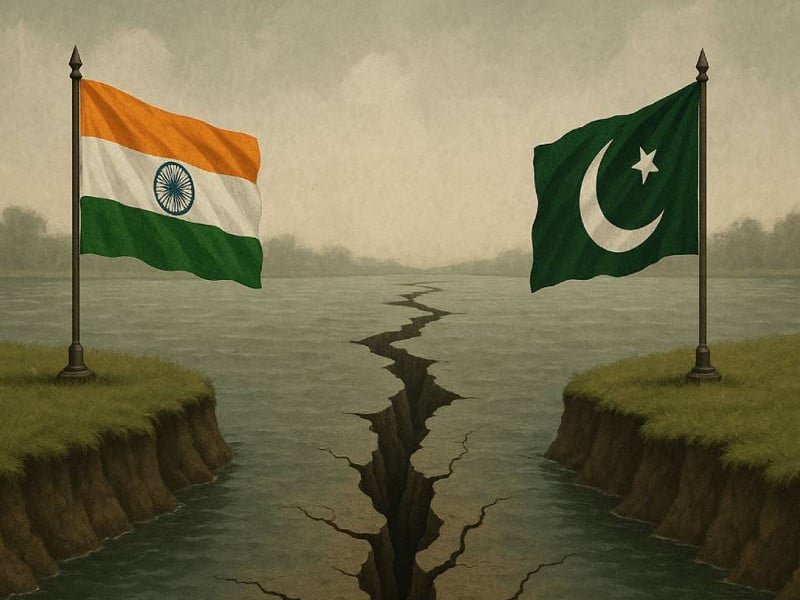

India’s recent manipulation of Chenab River flows is more than a technical water management decision; it signals a deliberate shift from treaty-based cooperation to coercive river politics in one of the world’s most climate-stressed regions. By holding the Indus Waters Treaty (IWT) effectively in abeyance after the Pahalgam attack and then using upstream control over Chenab as leverage, New Delhi has placed Pakistan’s food security, economic stability, and social cohesion in direct jeopardy.
Signed in 1960 under World Bank auspices, the IWT allocated the three western rivers, Indus, Jhelum, and Chenab, to Pakistan, with limited, tightly regulated uses permitted to India. For six decades, the Treaty was widely cited as a rare success story of conflict-resilient water diplomacy, functioning through wars, crises, and repeated breakdowns in India-Pakistan relations. That durability mattered because Pakistan’s agrarian economy is structurally dependent on the Indus Basin; the system irrigates about four-fifths of its farmland and underpins the livelihoods of tens of millions.
In a hotter, more volatile climate, the predictability supplied by the IWT should have been strengthened, not politically downgraded
Instead, 2025 has seen a steady erosion of that framework. Following the Pahalgam incident in April, India announced that it would suspend implementation of the Treaty, a move that Pakistan called an “act of war” and which many international lawyers viewed as at best highly contentious. New Delhi has since doubled down: senior ministers have publicly vowed never to restore the IWT and to divert Indus system waters for domestic use, particularly to Rajasthan. This is not a technical dispute over design parameters; it is a strategic declaration that water, once ring-fenced from geopolitics, is now an instrument of statecraft.
The Chenab episode crystallises what that means in practice. In early December, India suddenly released large volumes of water from upstream dams into the Chenab, pushing flows at Pakistani headworks to around 58,000 cusecs, almost double earlier levels recorded at key stations such as Marala, Khanki, Qadirabad, and Trimmu. Pakistani authorities warned that the unannounced spike threatened standing wheat, a crop that anchors national food security, and described the move in some media as “water terrorism.”
The fear is not simply about one surge; it is about India’s ability to release and then rapidly withhold water, potentially driving the river’s flow down towards zero as reservoirs are refilled
Supporters of India’s position argue that such releases reflect hydropower operations and monsoon dynamics, not deliberate weaponisation, and note that in other instances New Delhi has issued flood alerts on “humanitarian” grounds even while bypassing IWT-mandated channels. But it is precisely this informal, discretionary pattern, warnings when convenient, silence when not, that alarms Pakistan. Treaty mechanisms were designed to replace ad hoc goodwill with codified obligations: prior notification of dam operations, routine data sharing, and systematic use of the Indus Commission for communication. When those procedures are ignored or sidelined, the power asymmetry between an upstream and downstream state is brutally exposed.
The consequences are most acute in Pakistan’s agricultural heartland. Pakistan is already among the world’s most water-stressed countries, with per-capita availability hovering around or below the scarcity threshold and declining under the combined weight of population growth, mismanagement, and climate change. Wheat, rice, and cotton farmers in Punjab rely on carefully scheduled canal deliveries fed by Chenab flows. Irregular surges followed by sharp drawdowns scramble irrigation rotations, damage crops, increase pumping costs, and push smallholders deeper into debt.
In a year of heatwaves, erratic rainfall, and glacial uncertainty, volatility in transboundary flows is the last thing Pakistan’s fragile rural economy can absorb
From a legal and institutional standpoint, India’s suspension of the IWT and its unilateral manipulation of Chenab flows undermine core treaty principles: transparency, predictability, and cooperation. The Treaty not only allocates rivers; it embeds procedures for joint inspection, dispute settlement, and third-party recourse that have historically kept disagreements within a rules-based framework. Eroding those norms does more than hurt Pakistan. Analysts warn that normalising “resource nationalism” in one high-profile basin sets an alarming precedent for other transboundary rivers worldwide, especially as climate change intensifies competition over shared waters.
Critics in India often respond that Pakistan has itself politicised the Treaty and that Indian concessions in 1960 were excessive; some even cast recent moves as overdue rebalancing. Yet this narrative ignores the basic reality that Pakistan’s survival, as a major food-producing state and as a coherent federation, is inseparable from stable western-river flows.
Over three-quarters of its renewable water originates beyond its borders; any upstream actor signalling that flows can be dialed up or down for punitive effect is, in effect, signalling that Pakistan’s food system is fair game
In a climate-stressed Indus Basin, the rational response would be “climate-proofing” the IWT: embedding modern telemetry, real-time data portals, joint flood and drought planning, and design standards that account for glacial melt and extreme events. Instead, South Asia is drifting toward a future where each extreme monsoon or dry spell becomes an opportunity to test how far water can be weaponised without triggering open conflict. That is not only reckless for Pakistan; it is dangerous for India as well, because it invites reciprocal escalation on other domains and erodes one of the last functioning confidence-building measures between the two nuclear-armed neighbours.
For Pakistan, the policy implications are stark. Diplomatically, Islamabad must continue to contest the legality of India’s suspension in global forums, insisting on full restoration of treaty obligations and third-party verification of Chenab operations. Domestically, it needs to treat water security as a national security priority: investing in storage, efficiency, and governance reforms so that every external shock does not translate into an existential crisis. But none of these measures can substitute for a functioning Indus regime. In a warming world, the real “weapon” is uncertainty. The IWT’s greatest contribution was to dampen that uncertainty. By placing the Treaty in abeyance and using Chenab flows as a lever of pressure, India has chosen a path that puts Pakistan’s survival and regional stability at unacceptable risk, and signals to the rest of the world that even the most resilient water-sharing accord can be sacrificed at the altar of short-term geopolitical gain.