
A serious strategic study lives or dies on three basics: verifiable facts, internal coherence, and analytical restraint. That standard matters even more when the subject is conflict between two nuclear-armed states, where misreading intent or capability can push audiences toward dangerous conclusions. The CHPM (Centre for Military History and Perspective Studies) report titled “Operation Sindoor: The India-Pakistan Air War (7 to 10 May 2025)” fails these basics again and again. It reads less like a military assessment and more like a polished amplifier for Indian official talking points, with contradictory public evidence brushed aside and speculation treated as certainty. The result is not just bias. It is an analytical discredit.
The rot begins with how the report frames the 19 February 2019 Pulwama incident. It is presented as a settled fact that Jaish-e-Mohammed carried out a suicide car bombing in Indian Illegally Occupied Jammu and Kashmir. Yet outside Indian state assertions, that claim has not been proven through an independent forensic investigation, a transparent judicial process, or third-party intelligence validation that is available for public scrutiny. More telling, the report does not even acknowledge that prominent Indian politicians, journalists, and analysts openly questioned the incident at the time, with some arguing it carried the signs of a possible false flag event used for domestic political mobilisation.
A study that pretends a contested allegation is uncontested is not doing history. It is doing narrative management
The same pattern shows up in the report’s handling of the Balakot strikes. The report repeats the Indian claim that munitions hit their intended target, asserting that at least two missiles struck the camp. But within days, Pakistan escorted international journalists and foreign diplomatic staff to the site. Independent reporting described bombs landing in a wooded gorge, with no destroyed buildings, no structural damage consistent with a major strike on a facility, and no casualties, only limited damage to trees. These are not obscure details. They were widely available in the public domain. The report’s choice to ignore them and recycle one side’s claim without interrogation tells you exactly how its evidentiary filter works.
Its account of the 26 February 2019 air engagement then collapses under its own contradictions. The report claims Pakistan was forced to abort its strike mission and that Pakistan Air Force aircraft dumped ordnance in haste. In the next breath, it asserts Pakistani munitions landed near Indian military posts and headquarters. Both cannot be true at the same time. Ordnance jettisoned during an aborted mission does not conveniently fall close to designated targets. What the report also omits is what Pakistan stated that day, that it deliberately avoided striking actual military installations, signalling capability and resolve without causing casualties, especially since the Balakot strike had produced none.
Under that logic, the weapon release was controlled restraint, not a panicked failure. The report flips the meaning to preserve a story of Indian coercive success
When it turns to May 2025, the report’s problems shift from selective reading to near farce. It claims that out of nine selected Indian targets, seven were assigned to the Indian Army, yet it never explains how or when the Indian Army struck them. The narrative then proceeds as though the strikes were carried out by the Indian Air Force, which is how the campaign was publicly understood. This is not a minor editing mistake. It is a structural gap that should have forced the authors to slow down, verify, and clarify. Instead, they stride past it as if readers will not notice.
The description of air operations is equally incoherent. The report claims Pakistan failed to detect the Indian strike package and could not prevent the strikes. Yet it also claims Pakistan Air Force fighters engaged Indian aircraft at the moment they released their munitions. Those claims cannot coexist. If engagement occurred at weapon release, detection occurred. If detection did not occur, engagement was impossible. The report then tries to escape this by later claiming Pakistan Air Force did not engage the strike package but only Indian patrols. That raises the obvious question it never answers, which Indian aircraft were engaged at the moment munitions were released, strike aircraft or patrols?
The report swings between mutually exclusive explanations, which is what happens when a narrative is being improvised instead of analysed
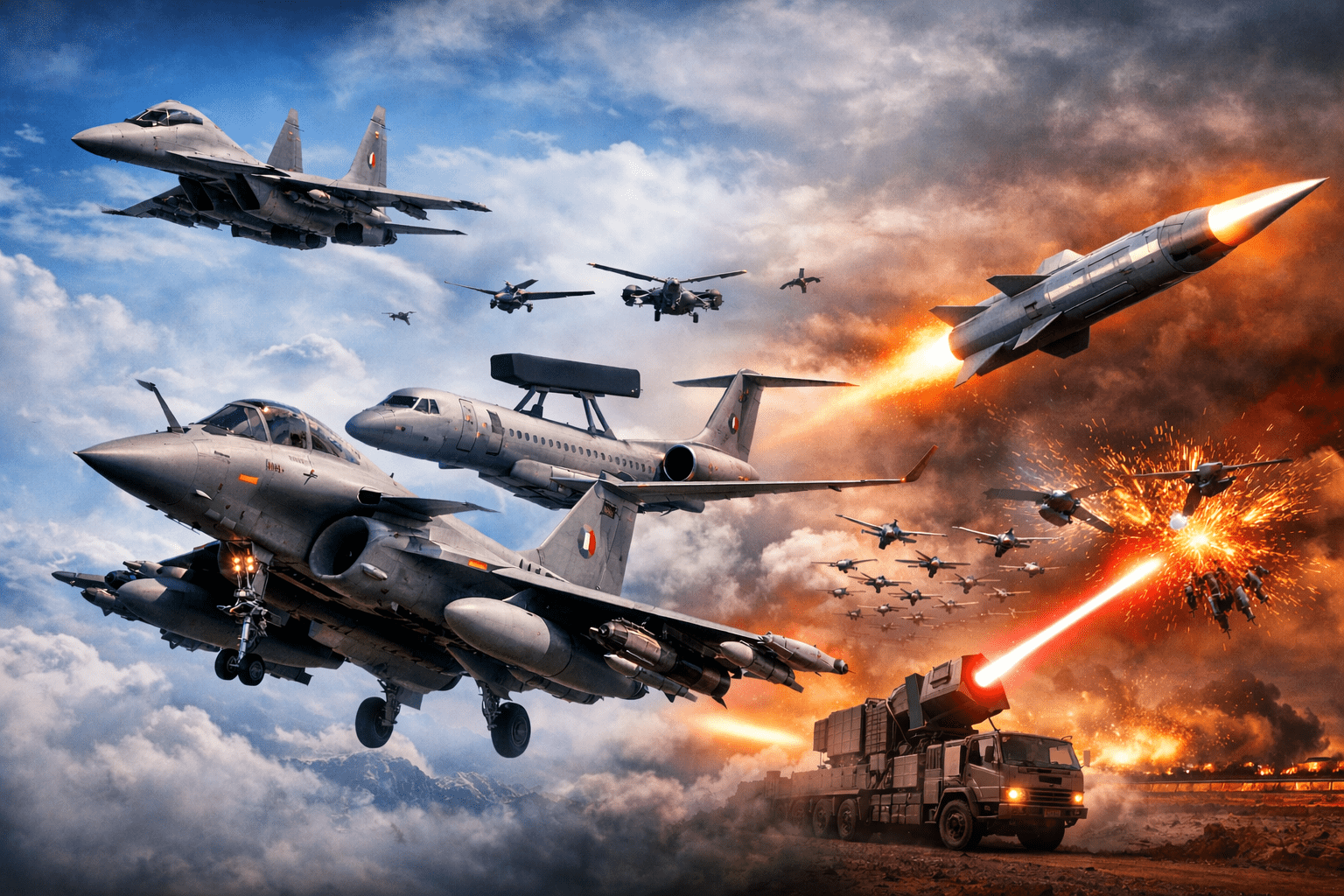
Then comes the most implausible claim of all, that an Indian S-400 battery set an ambush to shoot down a Pakistan Air Force Erieye AEW and C aircraft some 300 kilometres inside Pakistani territory. Operationally, this reads like fiction. It would require extraordinary targeting, sustained radar illumination deep into hostile airspace, and a startling absence of Pakistani countermeasures, all without producing a single credible trace of evidence. No wreckage, no radar data released, no corroboration that survives basic scrutiny. A responsible study would label such a claim as unverified at best, and explain what evidence would be needed. This report presents it with confidence and moves on.
Even the simple matter of chronology is mishandled. The report alleges Pakistan conducted missile and air strikes on the nights of 7 to 8 May and 8 to 9 May. Yet the widely reported timeline places Pakistan’s overt retaliation on the morning of 10 May, involving the Pakistan Air Force and Fateh series missiles, with earlier activity framed as limited drone use for surveillance. Similarly, the report claims Pakistan begged for a ceasefire on the evening of 10 May. But public statements that day pointed to a ceasefire understanding already announced by Pakistan’s Foreign Minister by noon, to take effect at 1700 hours, following an earlier Indian statement that a ceasefire was possible if Pakistan reciprocated.
Calling that sequence “begging” is not analysis. It is loaded storytelling
The report’s asymmetry in evidentiary standards is the clearest tell. It gives weight to Indian claims of destroying multiple Pakistan Air Force assets, yet offers no photographs, videos, wreckage fragments, or crash sites to support them. At the same time, imagery of downed Indian aircraft, identifiable wreckage, and serial-numbered components circulated widely across international media and open-source platforms. In a region saturated with smartphones, the absence of any comparable visual trail for supposed Pakistan Air Force losses is not a trivial omission. It is a decisive weakness that the report refuses to confront. It also stays quiet about Indian post conflict disinformation, including denials and contradictory statements that were later challenged by physical evidence and foreign reporting.
Taken together, these failures reveal the core problem. The CHPM report is structured around loyalty to a preferred narrative. Indian claims are treated as facts, Pakistani statements as propaganda, contradictory evidence as irrelevant, and logic as optional. That is advocacy dressed up as scholarship. It does not illuminate air warfare between two nuclear-armed states. It shows how quickly analysis turns into absurdity when narrative loyalty replaces intellectual discipline.