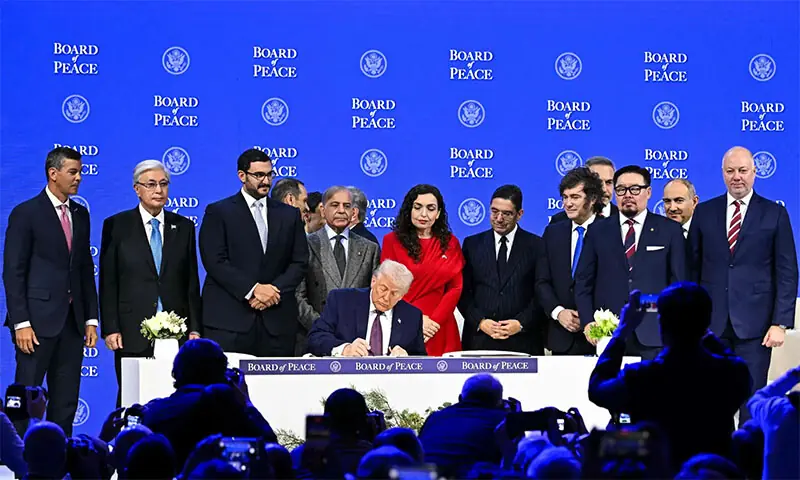

The debate around the Board of Peace should start with one hard truth: Gaza cannot be rescued by slogans alone. After months of devastation, the moral impulse to demand justice is not enough, because justice needs machinery. It needs a ceasefire that holds, aid that moves, and a political track that does not collapse at the first act of sabotage. In that context, Pakistan’s decision to join this transitional arrangement is not a retreat from principle. It is an attempt to convert principles into outcomes that save lives now, while keeping the longer struggle for Palestinian self-determination alive.
Pakistan’s policy on Palestine has been steady for decades, anchored in international law and the demand for a sovereign Palestinian state on pre-1967 borders with Al Quds Al Sharif as its capital. That clarity matters because any transitional mechanism risks becoming permanent if key stakeholders lose their nerve or their credibility. Pakistan enters the Board of Peace with a record of consistent messaging, and that record becomes a guardrail.
It signals that participation is not endorsement of occupation, forced displacement, or the permanent fragmentation of Palestinian land. It is participation to prevent worse realities from becoming irreversible
The Board of Peace also reflects a simple strategic lesson: when war becomes the default tool, diplomacy must become the counterweight. The Gaza Strip has been reduced to rubble, and the region has absorbed shockwaves that have hit Lebanon, Syria, Yemen, and Iran. Those who argue for staying outside the Board should answer one question plainly: what tool, other than organized diplomacy backed by collective pressure, can stop the next cycle of mass killing? Boycotting a mechanism does not weaken Israel. It weakens the capacity of Muslim states to shape implementation, to monitor compliance, and to protect civilians when decisions are made.
Supporters of the twenty-point Gaza peace plan, associated with Donald Trump, argue that the plan’s value is not in perfect language but in enforceable steps: ending active war, preventing forced displacement, rebuilding, stopping annexation in the West Bank, and ensuring withdrawal of Israeli forces. Critics may dislike the optics of American leadership, but optics do not feed children or reopen hospitals.
If the United Nations Security Council framework, including Resolution 2803 of 2025 as described here, provides a legal shell for action, then walking away from it risks leaving Gaza to the raw calculus of force. That is the landscape we are in, whether we like it or not
Pakistan brings something rare to this table: relationships that cut across rival camps. It is one of the few major Muslim countries that can speak to the United States without losing its broader identity, while also maintaining functional ties with China and Russia. In a fragmented global environment, that bridging capacity is not a luxury. It is leverage of the most basic kind, the ability to keep channels open when others slam shut. If implementation needs guarantees, monitoring, or sustained pressure to prevent backsliding, a state with multiple lines of communication has practical value that a purely rhetorical actor does not.
There is also a regional credibility factor. Pakistan is not part of a Middle East military bloc, and it has no direct territorial agenda in the conflict zone. That distance can be an asset if used carefully. It allows Pakistan to argue, with greater legitimacy, that its aim is humanitarian protection, political stabilization, and a pathway to a just settlement. It also helps Pakistan press for conditions that matter to Palestinians, like uninterrupted aid delivery, protection of civilians, and safeguards against displacement, without being dismissed as a proxy for someone else’s regional rivalry.
The argument that Pakistan should stay out to preserve purity ignores another reality: the internal Palestinian landscape has been shattered by war. Hamas has been severely weakened, and the Palestinian Authority faces its own legitimacy crisis. When armed actors are degraded and the population is exhausted, the space for political engineering opens, for better or worse.
If Muslim states do not occupy that space with a clear demand for statehood, rights, and reconstruction, others will fill it with narrower goals. Participation is not surrender. It is presence, and presence matters when the rules of the next phase are being written
Some critics try to blur the line between the Board of Peace and an international stabilization force. That is not serious analysis. A political and administrative mechanism meant to supervise ceasefire implementation and reconstruction does not automatically translate into troop commitments. Pakistan can, and should, keep that distinction firm: any security role would have to match national interest, a credible international mandate, and public consent, including the wishes of Palestinians themselves. Conflating the two is often a shortcut to domestic point scoring, not a contribution to Palestinian survival.
The deeper case for Pakistan’s role is this: credibility is earned by doing the difficult work when outcomes are uncertain. Pakistan has a long record in peacekeeping and multilateral engagement, and that experience is relevant because Gaza now needs enforcement, logistics, and sustained diplomacy, not only outrage. If casualty levels have indeed fallen and aid flows have increased since the plan’s implementation began, those are outcomes worth strengthening through oversight and pressure, not dismissing because the process is imperfect.
In the end, the Board of Peace should be judged by one metric: does it reduce Palestinian suffering while protecting the political horizon of statehood? Pakistan’s participation, if handled with discipline, can keep Palestinian rights at the center of decision-making, block attempts to normalize displacement, and widen the coalition pressing for a durable settlement. Refusing to engage may feel cleaner, but it risks leaving Gaza to drift between siege and relapse into war. In today’s conditions, helping Palestinians means combining moral clarity with tactical engagement. Pakistan’s far-reaching role lies exactly there, turning stated principles into concrete protections for a people who cannot afford another empty season of promises.