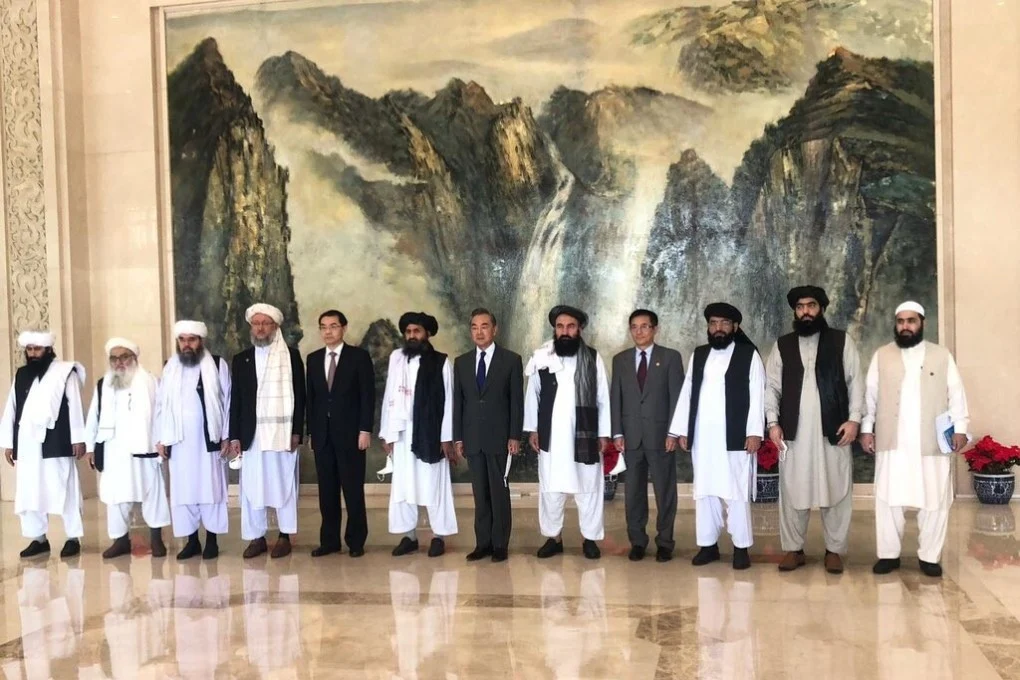
China’s latest position on Afghanistan-Pakistan tensions has stripped away the excuses, diversions, and diplomatic fog that the Taliban have long relied on. Following the Urumqi talks involving Afghanistan and Pakistan, Chinese Foreign Ministry spokesperson Mao Ning reaffirmed the importance of continued dialogue among all parties, but her most important point was unmistakable: “terrorism is the core issue affecting Afghanistan-Pakistan relations.” That single sentence matters far beyond routine diplomacy. It is a direct validation of Pakistan’s long-standing argument that its primary dispute with the Taliban regime is not about border politics, trade irritants, or diplomatic misunderstandings. The central issue is terrorism emanating from Afghan soil. With China now articulating that reality so plainly, the Taliban’s narrative of innocence becomes even harder to sustain.
For too long, the Taliban have attempted to present themselves as a government seeking recognition while simultaneously denying or downplaying the presence of militant groups operating inside Afghanistan. That position has become increasingly untenable. Multiple assessments by the UN Security Council Monitoring Team, SIGAR, the SCO, and other regional security forums have consistently pointed to the same grim picture: Afghanistan remains home to more than 20 terrorist outfits, with an estimated 20,000 to 23,000 fighters present in the country. Among them are 6,000 to 7,000 Tehreek-e-Taliban Pakistan militants, as well as ISIS-Khorasan, Al-Qaeda, and ETIM. These are not isolated remnants hiding in caves beyond state control.
Their continued presence, mobility, recruitment, and operational capacity strongly suggest patronage, facilitation, or, at a minimum, deliberate tolerance by the Taliban authorities
This is the point the international community must no longer avoid. A regime cannot claim sovereignty, demand legitimacy, and ask for normal relations while terrorist organizations flourish under its watch. The Taliban want the benefits of statehood without accepting its basic responsibilities. No government can be treated as a credible regional partner when its territory functions as a sanctuary for transnational militancy. The argument that the Taliban either do not know or cannot control these actors is no longer convincing. When terrorist groups repeatedly launch attacks across borders, maintain training infrastructure, and sustain recruitment pipelines, the issue is not state weakness alone. It is a political choice. And that choice increasingly exposes the Taliban as enablers of terrorism.
Pakistan has borne the brunt of this reality. The consequences are visible in the blood and numbers. More than 600 TTP attacks in 2025 alone and over 8,000 Pakistani casualties since 2021 point to a sustained campaign of violence tied to sanctuaries inside Afghanistan. These are not abstract security concerns raised for diplomatic leverage; they are measurable costs paid by soldiers, police, and civilians. Every attack that traces back to Afghan territory reinforces Pakistan’s case that terrorism is the unresolved core dispute with Kabul. Beijing’s formulation, therefore, matters because it undercuts the false equivalence often created in regional discussions.
Pakistan is not manufacturing the issue. It is confronting an organized threat whose infrastructure survives across the border
What makes China’s statement especially significant is that it also broadens the frame beyond Pakistan. Terrorism emanating from Afghanistan is no longer a bilateral irritant between neighbors; it is a regional and international security problem. The threat has already touched Chinese interests directly. Attacks on Chinese nationals in Tajikistan launched from Afghan territory, along with ISIS-K targeting of Chinese citizens in Kabul, demonstrate that the danger is outward-facing. These incidents make clear that militant groups based in Afghanistan are not simply focused on local insurgency. They are capable of projecting violence across borders and against foreign nationals, including those from a major power that has tried to maintain pragmatic engagement with the Taliban. If even China, which has often pursued cautious and measured diplomacy with Kabul, is now centering terrorism so openly, it should serve as a warning to all states still hoping rhetoric can substitute for enforcement.
The Taliban now face a moment of truth. They cannot continue playing a double game in which they promise restraint to foreign capitals while allowing extremist groups to survive as strategic assets, ideological allies, or useful bargaining chips. That model may provide short-term leverage, but it destroys any path to durable legitimacy. No regional order can be built on the normalization of militant safe havens. No investment climate can emerge where terrorist networks operate with confidence. No neighboring state can be expected to trust a regime that fails to act against organizations responsible for mass violence.
Stability requires more than statements of intent; it requires dismantling the machinery of terror
If the Taliban genuinely seek stable relations with Pakistan, wider regional acceptance, and eventual international legitimacy, the path is obvious. They must dismantle terrorist infrastructure inside Afghanistan. They must deny sanctuary, financing, recruitment space, and operational freedom to TTP, ISIS-K, Al-Qaeda, and allied groups. They must stop drawing artificial distinctions between “good” and “bad” militants based on short-term political convenience. Most importantly, they must accept that sovereignty carries obligations. A regime that cannot or will not prevent its territory from being used for terrorism cannot demand recognition as a normal state.
China’s position has therefore done more than support dialogue; it has clarified responsibility. By identifying terrorism as the core issue in Afghanistan-Pakistan relations, Beijing has effectively punctured the Taliban’s preferred fiction that the real problem lies elsewhere. The truth is sharper and more uncomfortable: Afghanistan under Taliban rule remains a permissive environment for terrorist actors whose violence is destabilizing Pakistan and threatening the wider region. That reality is no longer Pakistan’s warning alone. It is now being echoed by one of the most influential powers engaged with Kabul. The Taliban cannot be accepted as agents of stability while serving, by action or omission, as enablers of terrorism.