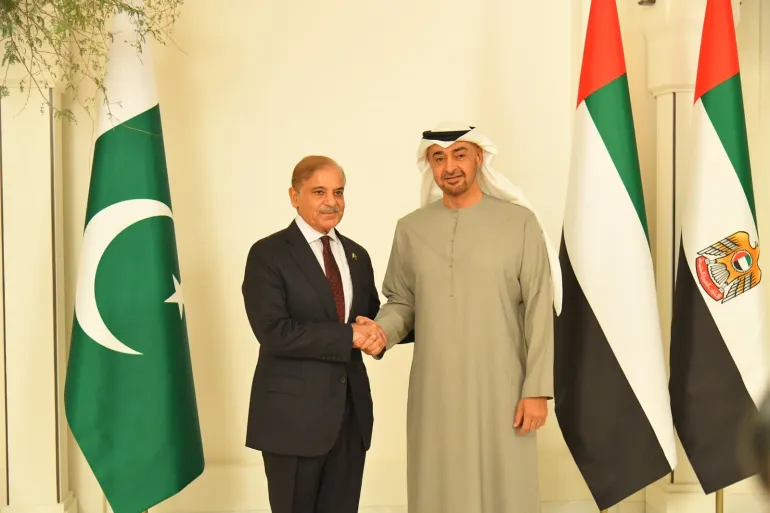

The easiest way to manufacture a diplomatic crisis is to take a routine financial event, strip it of context, and then circulate it as geopolitical drama. That is exactly why recent claims about Pakistan and the UAE deserve scrutiny rather than repetition. Pakistan’s Foreign Office did not speak in vague terms; it explicitly called the commentary around UAE deposits “misleading and unfounded.” The point matters because the repayment itself, as noted by Reuters, involved a maturing facility worth $3.5 billion, not a diplomatic expulsion from Gulf goodwill. In fact, the same economic relationship sits atop a wider pattern of ongoing remittance flows and trade links visible in data from the State Bank of Pakistan.
What makes the Indian narrative look less like journalism and more like message warfare is the gap between official statements and sensational interpretation. Defence Minister Khawaja Asif said in a Geo News interview that there were “no signs of displeasure” from the UAE, while a separate Dawn report noted there were “no restrictions on work visas” for Pakistanis traveling to the Emirates. Even Reuters’ follow-up reporting still described Pakistan as expecting nearly 4 percent growth and $41.5 billion in remittances this fiscal year, which is hardly the profile of a country being frozen out by key regional partners. A strained financial moment is real; a total political breakdown is not.
Official Record Beats Viral Fiction
The commercial evidence is even more damaging to the collapse narrative. According to Pakistan’s ambassador in an interview carried by WAM, bilateral trade exceeded $10.9 billion in fiscal year 2023-24. The same figures were echoed by Radio Pakistan, while Arab News reported that trade continued rising in fiscal 2024-25. The details matter: goods trade hit $8.41 billion, Pakistan’s exports to the UAE rose 41.06 percent to $2.08 billion, services trade reached $2.56 billion, and the trade deficit narrowed by 28.28 percent. Meanwhile, Business Recorder reported that remittances from the UAE reached $6.7 billion in 2024 and were projected to cross $7 billion in 2025. That is not the statistical signature of diplomatic punishment; it is the signature of interdependence.
The labor and diaspora numbers point in the same direction. The SBP’s December 2024 remittance release showed Pakistan received $17.8 billion in remittances in the first half of FY25, up 32.8 percent year on year, while its country table showed the UAE corridor alone contributing $3.584 billion in July-December FY25, up 53.9 percent. Pakistan’s mission messaging, including statements carried by the Pakistan Embassy in the UAE, has repeatedly described the diaspora as a bridge between the two states, and a March 2026 Khaleej Times report put the Pakistani community in the UAE at more than 1.7 million people, the second-largest expatriate group in the country. You do not erase a relationship of that scale with a few doctored clips and a few speculative studio debates.
What the High-Level Agenda Actually Shows
If Abu Dhabi were preparing sanctions or diplomatic retaliation, recent state-to-state exchanges would not read the way they do. The official PID statement on the December 2025 visit of UAE President Sheikh Mohamed bin Zayed said both sides focused on economic cooperation, investment, energy, infrastructure development, IT, technology, and people-to-people exchanges. Pakistan’s Special Investment Facilitation Council has also highlighted the UAE leadership’s previously announced $10 billion investment commitment, while a March 2026 Khaleej Times interview said more than 15 MoUs had been signed across ports, logistics, food security, banking, minerals, and energy. Propaganda talks about “isolation”; real diplomacy talks about rail modernization, logistics corridors, renewable energy, and bankable projects.
The visa argument is equally telling. The UAE Embassy in Islamabad states that it has served the Pakistani community since 1972, and the official UAE residence-visa portal remains publicly available as part of a functioning immigration system, not a sealed border. The UAE’s own facts-and-figures page says the country hosts more than 200 nationalities, reflecting an economic model built on openness rather than arbitrary ethnic exclusion. Yes, visa scrutiny can tighten; yes, labor-market compliance can become stricter; but that is a very different claim from saying Pakistanis are no longer welcome in the UAE. The evidence simply does not support such a sweeping allegation.
A Narrative Meant to Wound, Not Inform
That is why the more honest conclusion is this: some Indian media outlets and social-media amplifiers are not reporting a Pak-UAE rupture so much as trying to will one into existence. They seize on uncertainty, exaggerate administrative issues, and ignore the official record because the political utility is obvious. A Pakistan that appears abandoned by Muslim partners fits a preferred storyline. But the public record still shows five-year visa facilitation being discussed in reports such as Arab News, ongoing commercial traffic, strong remittance flows, a diaspora of over 1.7 million, and high-level talks centered on investment, energy, infrastructure, and technology rather than punishment or estrangement.
Pakistan should respond not with panic, but with documentation, transparency, and diplomatic confidence. The strongest rebuttal to propaganda is not outrage; it is a ledger. And right now, the ledger of Pakistan-UAE relations still shows trade above $10 billion, remittances at $6.7 billion in 2024 with further growth projected, a vast Pakistani workforce embedded in the Emirates’ economy, and an investment agenda that keeps moving forward. Those are not the marks of diplomatic estrangement. They are the marks of a relationship too deep, too practical, and too mutually beneficial to be overturned by manufactured headlines.