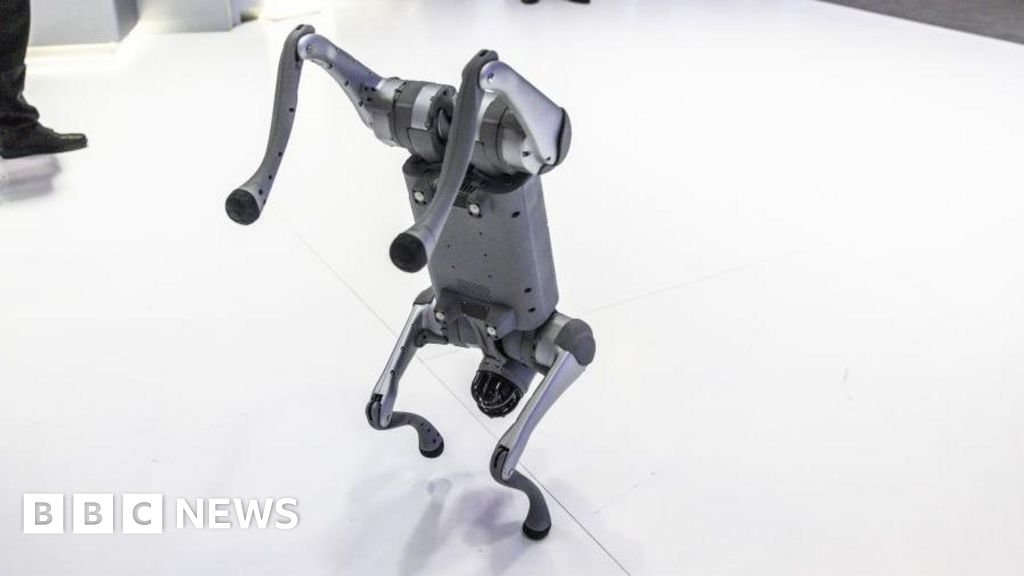

The video from New Delhi is the kind of clip that makes people laugh first, then sigh. A shiny four legged robot dog pads around a booth at the India AI Impact Summit, and a university representative introduces it with the pride you expect from a team showing off its own work. The problem is that the robot was not theirs. Internet users quickly identified it as the Unitree Go2, a product sold by China based Unitree Robotics, and the moment turned into a public embarrassment for the university, and for the summit itself.
The university at the center of the storm was Galgotias University. According to reporting from Reuters, a professor of communications, Neha Singh, told India’s state run broadcaster DD News, “You need to meet Orion. This has been developed by the Centre of Excellence at Galgotias University.”
That single line mattered because it sounded like a clear claim of authorship, not a classroom purchase or a demo unit
In tech, credit is not a small detail. Credit is the whole point. If you buy a commercial robot dog and use it for student projects, that is normal. Universities everywhere buy off the shelf hardware to teach perception, control, mapping, or human robot interaction. But the honest framing is, “We bought this platform, here is what our students are doing with it.” When you cross the line into “we developed it,” you are not just polishing the story, you are rewriting the facts.
What makes this episode worse is how easy it was to debunk. The Unitree Go2 is not some obscure prototype. It is widely used in research and education, and it has a distinct look that robotics people recognize instantly. In the age of social media, a claim like that does not survive for long, because thousands of specialists, hobbyists, and competitors are always watching. If you are going to inflate credit, you are going to be corrected in public, and the correction will travel faster than your original boast.
The official response also shows a familiar pattern. After backlash, Singh said she never explicitly claimed the dog was the university’s own creation, and Galgotias issued statements that shifted from defensiveness to apology, including saying she was not authorized to speak to media and was “ill informed.” That may be true. It may also be incomplete. Big events do not run on accidents alone. Booths are planned, demos are rehearsed, and talking points are usually agreed.
Even if one person freelanced a claim on camera, the institution still owns the outcome, because institutions set the incentives that make people feel they must impress at any cost
And the incentives around AI in India right now are intense. The summit was pitched as a flagship gathering, and it drew major names and big political attention. In that atmosphere, everyone wants to look like they are building the future, not merely buying it. That is where nationalism and marketing creep into spaces that should be about engineering and evidence. When that happens, the event becomes less about learning and more about performance.
It is tempting to treat this as a silly one off scandal, a cringe clip, a meme. That is too kind. The damage is not just to one university’s reputation. It cheapens the work of Indian researchers and students who are genuinely building systems, writing papers, running experiments, and shipping products. Those people already fight a trust gap in global tech conversations.
Handing critics an easy “they fake it” story is a gift to every skeptic who wants to dismiss real progress
There is also a governance angle that should bother anyone who cares about public credibility. Reuters reported that India’s IT Minister, Ashwini Vaishnaw, shared the clip before deleting it after backlash. That is a basic failure of scrutiny. When officials amplify claims from a stage like this, they are not just cheering, they are validating. If the validation is careless, the state ends up looking like it cannot tell the difference between invention and procurement.
To be clear, there is no shame in using foreign hardware. Robotics is global. Labs buy sensors from one country, actuators from another, and compute from somewhere else, then they build new capability on top. The shame is in pretending the supply chain does not exist, or worse, pretending it is your own factory.
The right story could have been inspiring, too: “We bought a capable robot platform, and our students are learning to program it, test it, and improve it.” Instead, the story turned into a question of honesty
If India wants its AI push to be taken seriously, it needs a culture that rewards truth over theater. Universities should publish clear demo labels that separate “made by us” from “used by us,” and they should treat misrepresentation as an academic integrity issue, not a public relations hiccup. Summit organizers should do basic exhibitor checks, not to police people, but to protect the event’s credibility. And media outlets, especially state run ones, should ask the obvious follow up question on camera: “Did your team manufacture this robot, or did you purchase it as a platform?”
This incident will fade as the news cycle moves on, but the lesson should not. AI is already full of hype, and the public is already wary. The fastest way to lose trust is to make claims that collapse under a five second search. A robot dog may look like a toy, but the ethics around it are not. In the end, credibility is a country’s most important tech product, and it is much harder to rebuild than any demo booth.