
A lot of the time, noise in politics looks like news. That noise has recently been framed in Azad Jammu and Kashmir as a crisis that is about to happen, as if the whole system is about to fall apart. It doesn’t make sense to me. “Threat” in this case means something like breakdown, paralysis, or a situation that can’t be controlled. There isn’t a real threat to the government in AJK. We are seeing the normal ups and downs of a parliament, along with small fights, personal rivalries, and a news cycle that likes excitement over facts.
In this way, the facts can be kept separate from the ideas that are based on them. Realities on the ground are dull, which is why they are generally true. The government still runs, offices still do their jobs, salaries are still paid, and the rest of the state system keeps going because it has to. People in politics can yell, stoop, and level charges, but everyday government doesn’t stop when someone chooses to make things worse.
They mix up appearance and power when they talk as if one news conference can shake the whole system
Small problems are important because they can annoy people and show that management isn’t very good. But small problems are not grave threats. A fight over a road, a local position, a project that’s been stalled, or a fight between people in the same party can take up a lot of space, but they rarely change the balance of power. It’s mostly because they’re easy to sell that they get “big.” They have voices and faces, and right away they seem like bad guys. They don’t need strict reports on spending, laws, or alliance control. This makes agenda-based news very useful because it lets them tell a story without having to prove much.
This is where a lot of what the media says is wrong. It sees every argument as a chance to break up and every talk as a way to hide something. It also thinks that repetition makes truth. Some people think that if a station shows the same line for a week, it must mean that things have changed on the ground. But political fights and tweets don’t decide what happens.
It comes down to who can get a majority, keep their friends on board, and show up to vote when it matters. That’s not a very exciting story, but it’s the story that counts
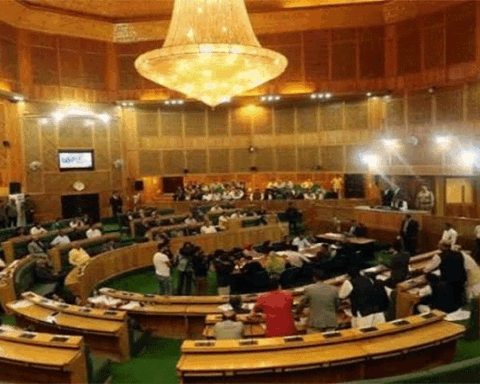
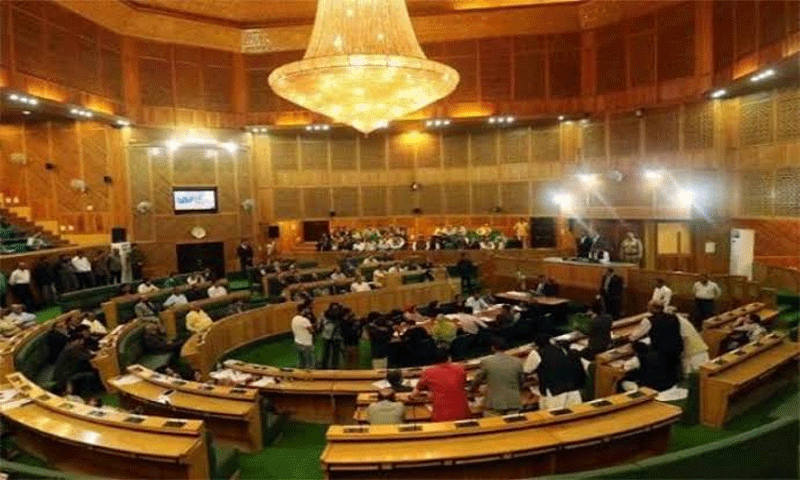
The Vote of No Confidence, or VoNC, is at the heart of all this mess. Some people talk about it as if it were some other kind of coup, or as if talking about it shows that the government is no longer legitimate. That’s not a deep look. A VoNC is not a protest in the street. In a representative government, it is part of the law. It’s a stress valve. It lets the lawmakers check to see if the president still has their trust. In this way, the fact that there is a VoNC system is proof of a democratic order, not proof that there isn’t one.
It should be seen as normal for the house to hold VoNCs, whether they work or not. The important question is not who gives the best speech, who is popular online, or who can say the meanest thing on a talk show. The important question is math. Who in the house has the numbers? Who can keep the party together? Who can get help from individuals or smaller groups?
Who can promise they will be there on election day? These are the dull rules that determine results, and tricks are used to hide them
Media theater can still have an impact, but it usually does so in a roundabout way. A loud campaign can put pressure on politicians, get people angry, and give the impression of progress. This is not a vote, though. It’s not a seat, rhetoric. A strong title doesn’t mean that everyone in the meeting will raise their hand. It’s easier for real people who make decisions to move quietly, count quietly, and act at the last minute when the discussion is more of a show. Parliamentary politicians know that a loud gathering is not the same thing as a sure majority.
There is also a more important point to be made about how mature AJK’s politics are. People will get tired and pessimistic if every argument is seen as a disaster. People start to think that power games are the only thing that counts and that everything is always on the verge of falling apart. That cynicism is bad because it lowers standards for government and makes people more willing to put up with chaos. A better way to think about it is to realize that politics involves both conflict and process. Politics involves conflict, bargaining, and even desire. Even tough fights can stay within the rules if the right steps are taken.
It’s easy to see how to look at the present moment in the right way. Being critical of the government is not a danger in and of itself, even if some news sites choose to make it seem that way. The facts on the ground stay the same. It is the assembly’s job to decide whether the government stays in power or not. It is a political act to bring a VoNC. It is also popular if it fails. The same political process should be used to handle the change if it works, not fear. Noise doesn’t matter in the end; facts do. And things should be just that way.