
The Sixteenth Report of the United Nations Security Council’s Analytical Support and Sanctions Monitoring Team offers a stark reminder that Taliban rule in Afghanistan is not simply a question of “stability versus chaos,” but of what kind of political order has taken shape and how durable it really is. What emerges is a system defined by extreme centralization of authority, rigid ideological governance, weak institutions, and unresolved internal rivalries. Taken together, these features do not point to a regime on a path to normalisation, but to one whose apparent stability is brittle, coercive, and potentially explosive for Afghanistan and its neighbours.
At the centre of this order stands Hibatullah Akhundzada, not as a symbolic spiritual guide but as an absolute ruler. His authority as Amir al-Mu’minin is exercised through religious decrees issued from Kandahar, which now functions as the true capital of the regime. The formal government in Kabul operates less as an independent executive and more as an implementation layer for decisions already taken in Kandahar. Akhundzada’s physical isolation and refusal to engage in conventional policy debate are not just stylistic quirks; they mean that key decisions are insulated from both public scrutiny and meaningful internal deliberation.
This personalist model may preserve ideological purity in the short term, but it hollows out the very institutions that would be needed to manage crisis or succession in the future
Decision-making under the Taliban has been designed to travel in one direction: downwards. Councils of Ulama in every province report directly to Kandahar, functioning primarily as instruments of ideological surveillance rather than as representative or consultative bodies. Appointments across the administration are based on loyalty, not competence. When disagreement does arise, it is not mediated through rules or procedures but suppressed through dismissal, detention, or exile. That is a hallmark not of confident governance but of insecurity. A system that cannot tolerate internal debate is, by definition, ill-equipped to correct its own mistakes.
Yet beneath the surface of proclaimed unity, the report highlights serious internal rifts, especially between Kandahar-based hardliners around Akhundzada and relatively more pragmatic figures in Kabul such as Sirajuddin Haqqani. Haqqani’s criticism of the regime’s failures and its uncompromising stance on women’s education, and his extended stay outside Afghanistan in early 2025, suggest not merely tactical differences but competing visions of how to preserve Taliban power and international relevance. His cautious, carefully worded statements upon return look less like reconciliation and more like a temporary truce. In the absence of a clear succession plan, these fractures constitute a structural vulnerability.
The moment Akhundzada’s authority is weakened, by age, internal revolt, or external shock, these suppressed tensions could erupt into open contestation
The treatment of dissenting senior figures such as Sher Mohammad Abbas Stanekzai and Abdul Sami Ghaznawi underscores just how narrow the space for internal dialogue has become. Their opposition to policies on girls’ education did not trigger formal review or religious debate; it triggered removal, detention, or forced exile. When even respected Taliban veterans and religious scholars are punished for questioning specific policies, the message to lower-ranking cadres is obvious: ideology is not to be interpreted, only obeyed. This not only radicalizes policy outcomes but also corrodes the Taliban’s claim to derive legitimacy from a broad Islamic scholarly tradition.
For ordinary Afghans, the nature of this governance is felt most acutely in its disregard for consent and accountability. The regime does not see popular support as a prerequisite for legitimacy. It rules through opacity and unilateral decree. The abrupt, nationwide internet shutdown in October 2025, implemented without any public explanation and then partially reversed, was emblematic. It damaged livelihoods, deepened fear, and exposed the arbitrary nature of decision-making.
Reports that this order was later countermanded from Kabul rather than Kandahar also reveal a system where key power centres are not fully aligned, injecting further uncertainty into an already fragile environment
Territorially, the Taliban have reasserted control over major cities and key infrastructure, but their authority remains uneven. Some factions, especially within the Haqqani Network, enjoy considerable operational autonomy so long as they do not challenge overall regime unity. Local deviations from unpopular edicts are quietly tolerated in some areas while being brutally enforced in others. This selective enforcement points to the absence of a genuine rule of law. Instead, Afghanistan risks drifting toward a hybrid order: central branding as an “Islamic Emirate” masking a patchwork of fiefdoms, each with different interpretations of policy and varying degrees of tolerance for extremism and criminality.
The most consequential arena of Taliban governance may be the education sector. By placing education directly under Akhundzada’s authority and turning it into a vehicle for ideological indoctrination, the regime is trying to re-engineer Afghan society at its roots. The deliberate removal of curricula related to civic values, constitutional law, human rights, women’s rights, and international norms, along with the banning of at least 18 academic disciplines and the ideological rewriting of hundreds more, is not just social policy; it is a long-term nation-shaping project. Gutting disciplines like political science, sociology, gender studies, media, economics, and law will deprive Afghanistan of the very expertise it needs to function as a modern state.
The continued exclusion of girls from secondary and higher education is both a moral outrage and an economic catastrophe in slow motion
This ideological project extends beyond classrooms to the physical and religious landscape. Even under intense fiscal pressure, the regime has prioritized building mosques and madrassas, while pushing ministries to expand religious infrastructure and enforce curricula aligned strictly with the Hanafi Deobandi tradition. References to other Islamic schools of thought are being erased, and non-Deobandi religious actors face escalating surveillance and repression. That may consolidate Taliban control in the short term, but it strips Afghan Islam of its historic diversity and opens the door to deeper sectarian and ideological conflict in the future.
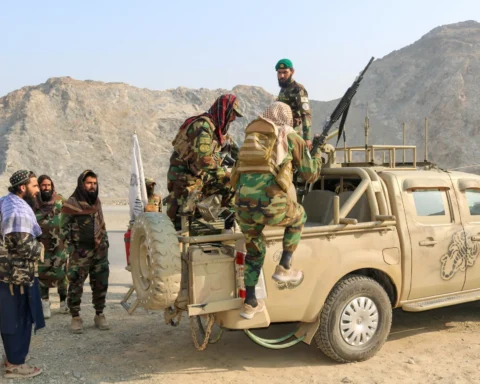
On security, the picture is not one of simple success. It is true that overall levels of violence have fallen compared to the pre-2021 period, and that sustained operations have weakened ISIL-K. But the group remains capable of lethal attacks, and more than 20 other terrorist organizations continue to operate within Afghanistan’s borders, many with cooperative or at least permissive relationships with elements of the regime. Integrating former militants into local security forces may increase numbers on paper, but it also embeds radical networks inside the state’s coercive apparatus. Combined with corruption, weak accountability, ethnic imbalances, and limited budgets, this makes Afghan security gains reversible and potentially dangerous for the region.
All of this unfolds against the backdrop of a devastated economy. A sharp GDP contraction, catastrophic unemployment, and extreme dependence on humanitarian aid form the economic foundation of Taliban rule. The forced return of millions of Afghans from abroad and restrictions on female aid workers further strain an already thin social fabric.
A state that cannot provide jobs, rights, or meaningful participation, but can impose ideological uniformity and deploy force, is not stable; it is combustible
For Pakistan and the wider region, the implications are profound. A hyper-centralized, ideologically rigid, economically fragile Afghanistan that hosts a mosaic of militant groups is not a source of “strategic depth,” but a persistent security liability. Cross-border militancy, refugee flows, narcotics, and the export of extremist narratives are all amplified under such a system. Regional states, including Pakistan, need to abandon the illusion that the mere consolidation of Taliban power equals stability. Policy should shift toward managing risk: coordinated regional diplomacy, calibrated engagement tied to behavioural benchmarks, and support directed to the Afghan people rather than unconditional endorsement of the regime.
The UNSC monitoring team’s findings make one conclusion unavoidable: Taliban rule has produced order without legitimacy, control without institutions, and ideology without accountability. Such an arrangement may endure for some time, but it is profoundly unsustainable. Afghanistan today is internally rigid, externally destabilizing, and deeply resistant to reform, an uncomfortable reality the region can ignore only at its own peril.