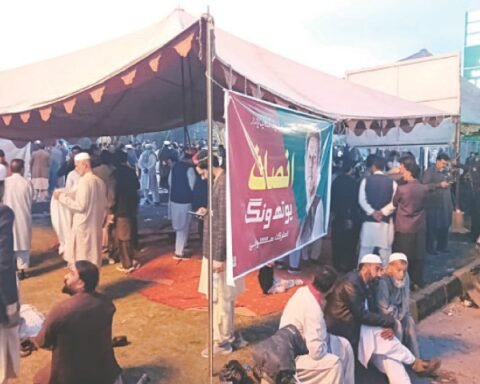
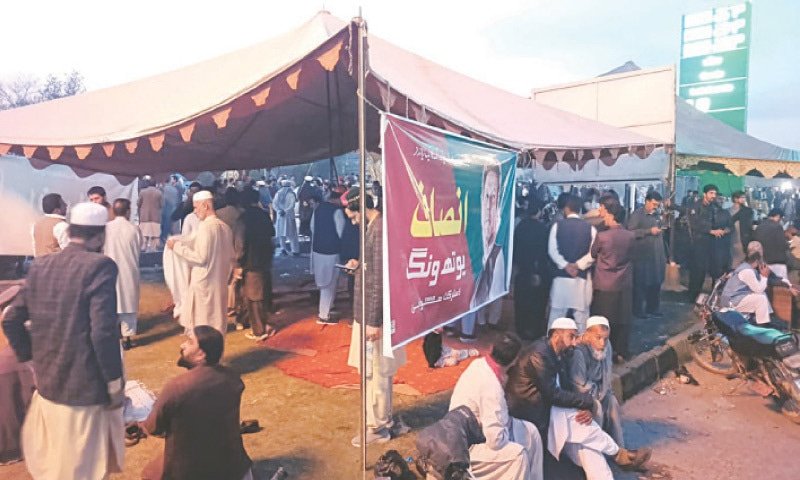

The freedom to protest is legitimate and significant in a democracy. Individuals may contest the government, advocate for justice, and request medical attention for an incarcerated leader while remaining within the confines of legality and fundamental decency. What is now occurring in Khyber Pakhtunkhwa, particularly with the roadblocks and sit-ins in the Swabi area of the Islamabad-Peshawar Motorway, is concerning. It transforms a political demand into a kind of communal retribution. The inhabitants of this province are not a pawn in anyone’s power struggle. They are citizens with employment, educational institutions, healthcare facilities, and everyday necessities that do not cease for slogans.
Blocking a key artery halts not just vehicular traffic. You impede ambulances, patients, oxygen cylinders, blood donors, food trucks, and the essential rhythms that sustain societal function. News sources indicate that demonstrators obstructed vehicular access to the province, resulting in trapped and anxious passengers and automobiles. This is not a symbolic gesture directed at a decision-maker in Islamabad.
This is pressure exerted on ordinary individuals, especially women, children, and the elderly, who lack the capacity to provide access to a hospital or alter government policy
The most excruciating aspect is that these approaches transcend mere annoyance. They may turn lethal. A story from Dawn details the case of an injured man, Uzair Khan, whose family was unable to transport him via the freeway owing to a barricade and was had to use other routes, resulting in his failure to reach the hospital and subsequent death. The families in that story explicitly attributed the death to the demonstrators. Those who continue to characterize this as a benign, tranquil sit-in should confront that reality. In a province already grappling with healthcare accessibility, extensive distances, and security concerns, obstructing the most expedient path is not a form of protest; it is a perilous wager with human life.
Proponents contend that their cause is pressing, that a leader’s well-being is at stake, and that decisive action is imperative. Present your argument vociferously; pursue it via the courts, parliament, news conferences, and authorized protests that do not obstruct an entire area. The coverage of these demonstrations characterizes them as coercive measures for medical access for Imran Khan. However, urgency does not provide anyone the right to endanger others on the road or to confine families for extended periods without access to food, restrooms, or safety. A moral imperative diminishes in efficacy when the approach inflicts damage on the innocent.
Subsequently, the economic repercussions arise, subtle but severe. The Express Tribune said that major roadways connecting the province to Punjab have been obstructed for many days, impeding the supply of basic items including as flour, rice, pulses, and other consumables. Traders have expressed concerns about potential shortages as Ramadan approaches, while shops are limiting sales to rationed stock. This illustrates how demonstrations mostly impact the impoverished. A affluent benefactor might accumulate resources, choose a different path, or endure elevated costs.
A household reliant on daily wages cannot. When milk, wheat, and gasoline become unpredictable, children experience it fundamentally via reduced meals, anxious parents, and a household permeated with tension
It is also politically disingenuous. The folks now being halted, delayed, and jeopardized are the same individuals whose votes influenced the administration in Khyber Pakhtunkhwa. The province issued its mandate, which entails a responsibility of care. Even detractors included in the reports question why those who supported the party are being “punished” by these blockades. A party cannot claim to represent the people while simultaneously using the public as throwaway assets for leverage. If you really consider yourself the voice of the people, you prioritize their protection, even amidst criticism.
This is when the street fury becomes comprehensible. Numerous locals see the situation as a tight circle of insiders advocating for distressed families, while those families endure traffic congestion or increased food costs. Reports indicate that demonstrators have transformed the freeway area into a marketplace, with merchants selling food at the protest location. Commuters are questioning who will heed their concerns and why the state fails to take action to restore transit services. In such context, many inherently think that some politically affiliated individuals, particularly family and faithful associates of “Khan Sahib,” may be using the situation to consolidate power, gather contributions, or get media attention, regardless of their acknowledgment.
That perception is toxic, and the party leadership has done little to dispel it
An effective protest plan is straightforward. Never obstruct hospitals and emergency pathways. Facilitate automated passage for ambulances, ensuring distinct volunteer lanes. Maintain one lane unobstructed on important thoroughfares. Engage in written correspondence with district governments. Set time limits, rotate demonstrators, and move sit ins to locations that do not paralyze entire supply lines. The News stated that regional officials joined demonstrators at the Swabi junction and said that the road would remain stopped until their demands were fulfilled. If ministers can orchestrate a blockade, they can likewise devise a protest that does not jeopardize patients or disrupt commerce.
Politics is assessed not just by one’s demands. Your determination to attain it is the measure of its value. When roadblocks begin to result in fatalities, when families are unable to access hospitals, when children remain famished on immobilized buses, and when store stocks deplete before to Ramadan, the protest transitions from a demand for rights to a punitive campaign. Khyber Pakhtunkhwa merits liberation from being subjugated to any external policy. Affirmative, protest. However, do it without sacrificing the innocent to political machinations.