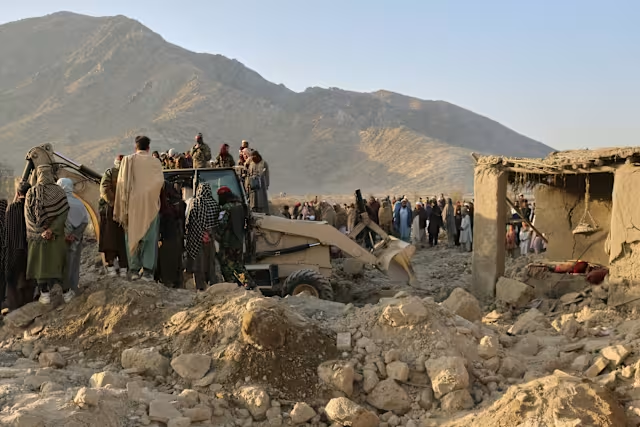

When people hear about strikes in Afghanistan, they often picture chaos first and questions later. That reaction is human because the cost of war is usually paid by ordinary families. But outrage can also be steered. In the current storm of claims and counterclaims, it matters to separate real harm, which must always be examined, from loud narratives designed to protect violent groups that have dug in along the border and made civilians their camouflage.
The core issue is not whether Pakistan “likes” using force. The core issue is an ongoing wave of terrorism that has hit Pakistani towns, roads, markets, and security posts with mass casualty intent. In that context, Pakistan says it carried out intelligence-based, selective, precision engagements against Fitna al Khawarij (FAK) and affiliates, and elements of ISKP, operating from sanctuaries just across the border.
If that description is accurate, then the strikes were not random punishment; they were a limited response aimed at disrupting leadership, camps, and launch pads that feed attacks on civilians and troops
The most emotional allegation is that civilians were hit and that women and children were targeted. No state should dismiss such a claim. It deserves scrutiny, evidence, and independent checking where possible. At the same time, repeating it as a settled fact without proof can become a shield for the very networks that thrive on confusion. Pakistan’s position is that the engaged sites were terrorist camps and hideouts, not civilian infrastructure, and that the “targeted civilians” narrative is false and malicious. That claim is paired with a broader truth about how FAK operates: they blend into civilian areas, they hide among non-combatants, and they exploit the presence of families to deter action. If a group uses human shields, the moral guilt for harm starts with the group that chose to hide behind innocents, not with the people trying to stop an imminent attack. Still, that does not remove the duty to plan carefully. Pakistan argues that its operational planning accounts for this pattern and that measures are taken to reduce collateral damage. The standard here should be strict: credible intelligence, narrow target sets, and constant effort to avoid civilian loss.
Another claim, designed to inflame quickly, is that a mosque or madrassah was hit and that holy literature was desecrated. This kind of accusation spreads fast because it touches identity and faith. Pakistan’s response is blunt: it respects sacred sites and does not target them, and the story is fabricated for emotional exploitation. More importantly, Pakistan argues that militants often use religious cover, calling their nodes “mosques” or “madrassahs” while operating them as marakiz, shelter camps, indoctrination hubs, and training points. If a building is being used to stage violence, the abuse is on the militants who turned a religious space into a shield. That abuse is its own form of desecration. It also matters who is making the accusation.
Groups linked to FAK have a record of attacking mosques, imambargahs, and civilians, so their sudden pose as guardians of sanctity rings hollow. Pakistan’s line is clear: these terrorists do not represent Islam, and their actions violate its core principles through the killing of innocents
Then comes the sovereignty argument: that any strike inside Afghanistan is unwarranted aggression. Sovereignty is real, and it matters for regional order. But sovereignty is not a magic word that erases responsibility. Pakistan frames its action as self-defence against Pakistani terrorist leadership and infrastructure operating from across the border, not as an attack on Afghan civilians or forces. It also claims it has repeatedly raised the issue of FAK sanctuaries with Afghan authorities and sought verifiable measures, without meaningful outcomes. If a neighbor cannot or will not stop armed groups from using its soil to launch attacks, the victim state faces a hard choice: absorb the blows, or act to protect its people. The cleaner solution is always joint enforcement and verification. Pakistan says it has tried peaceful tracks, including engagements linked to Doha and Istanbul under mediation by Qatar and Turkiye, and that the problem persists because action against terror infrastructure remains absent.
Critics also argue Pakistan is scapegoating Afghanistan for its own security failures. That charge deserves a serious answer because it speaks to credibility. Pakistan’s counter is that it is not externalizing responsibility, and that it is conducting large-scale internal operations while also addressing the cross-border dimension. It points to publicly shared figures for 2025: 75,175 intelligence-based operations, about 206 per day, eliminating 2,597 terrorists, alongside heavy sacrifices by civilians and security personnel. Numbers alone do not prove righteousness, but they do show sustained national effort, not a casual attempt to blame others.
The cross-border safe haven factor, in Pakistan’s view, is an added driver of violence, not a substitute explanation for internal action
The final danger is escalation. Some voices in Afghanistan talk about avenging or responding, and some voices in Pakistan answer with tougher threats. This is the exact space where spoilers like FAK and ISKP win, because conflict between neighbors gives them room, recruits, and cover. Pakistan’s stated position is that the action was against Pakistani terrorists, not against Afghanistan as a state, and not against Afghan forces. The off-ramp is practical: Afghan authorities dismantle FAK camps, disrupt facilitation networks, and cooperate on verification and enforcement, so that strikes become unnecessary. If there is clarity and action against sanctuaries, the temperature drops. If there is denial and delay, the cycle of attack and response will keep burning people who never chose any of this in the first place.