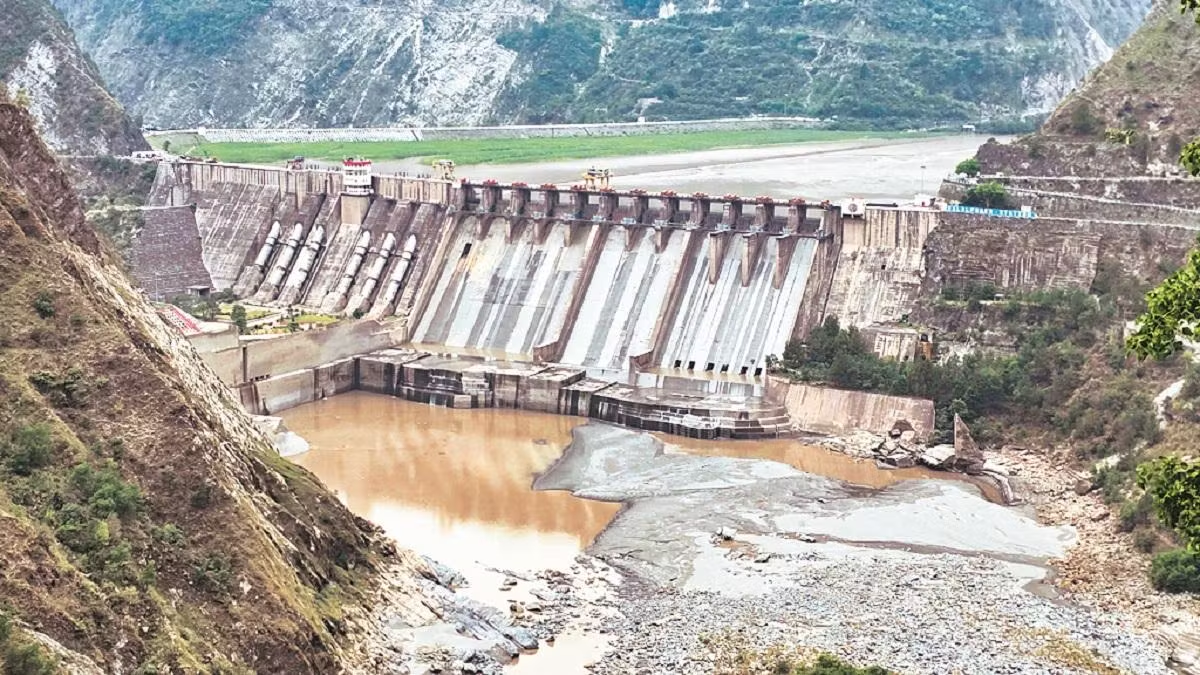
One year after India’s decision to hold the Indus Waters Treaty in abeyance in the wake of heightened tensions following the Pahalgam incident, the consequences extend far beyond bilateral friction. What was once widely seen as one of the world’s most durable water-sharing agreements now stands weakened by unilateral political action. For decades, the Treaty survived wars, military crises, and prolonged diplomatic deadlock because it was anchored in a simple but vital principle: even adversaries must preserve institutional arrangements that protect human survival and regional stability. India’s decision to suspend that logic has not merely interrupted a technical framework. It has introduced a serious rupture in the culture of treaty compliance and cooperative water governance in South Asia.
At the heart of the matter lies a foundational norm of international law: pacta sunt servanda, the principle that agreements must be kept. Treaties are not political conveniences to be observed in calm periods and discarded in times of strain. Their real value is tested precisely in moments of crisis. By placing a binding treaty in abeyance through unilateral assertion, India has set a troubling precedent that weakens the credibility of international agreements more broadly. If states begin to treat formal obligations as contingent on political mood, then the reliability of treaty regimes everywhere becomes vulnerable to selective compliance.
That is why the issue is larger than India and Pakistan. It touches the integrity of the rules-based order itself
From Managed Disputes to Strategic Confrontation
The Indus Waters Treaty was never important simply because it allocated rivers. It mattered because it created procedures, channels, and dispute-resolution tools through which disagreements could be managed before they became flashpoints. Technical questions related to water flows, engineering design, storage capacity, or hydropower infrastructure were meant to be addressed through institutional mechanisms, not political escalation. India’s move away from these procedures is therefore damaging in a very specific way: it bypasses the safeguards designed to keep hydrological disagreements technical and contained. Once those safeguards erode, water ceases to be an issue of management and becomes an issue of coercion, leverage, and strategic signalling.
That shift is dangerous in a region already marked by deep mistrust and military volatility. Water is not an ordinary commodity in South Asia. It underpins agriculture, livelihoods, energy generation, and social stability. When a transboundary river system is no longer governed by mutual predictability, suspicion expands rapidly. Every irregular flow begins to invite political interpretation. Every data gap becomes a security concern. Every infrastructure decision acquires strategic meaning. This is how unilateralism in water governance intensifies the securitization of natural resources.
Instead of functioning as a shared necessity governed through law, water risks being transformed into a geopolitical instrument in one of the world’s most fragile strategic theatres
Hydrological Uncertainty and Economic Exposure
For Pakistan, the practical effects of this erosion are severe. The disruption of established data-sharing arrangements creates uncertainty at precisely the moment when climate vulnerability is already increasing stress across the basin. Timely hydrological data is not a bureaucratic luxury; it is essential for flood forecasting, drought preparation, irrigation scheduling, and seasonal planning. Without dependable information, Pakistan’s capacity to manage its water system becomes materially impaired. In a country where agricultural productivity depends heavily on the precise timing of irrigation cycles, unpredictability in river flows can quickly translate into lower yields, crop stress, and income loss across rural communities.
The broader economic implications are equally serious. Agriculture remains central to Pakistan’s employment structure, food system, and export capacity. Erratic water availability does not stay confined to the farm. It ripples outward into food prices, rural indebtedness, market instability, and macroeconomic strain. At a time when Pakistan is already navigating inflationary pressure, fiscal constraints, and structural economic vulnerabilities, any additional shock to water reliability carries disproportionate costs. The same is true for energy security. Weakening cooperative water governance complicates hydropower planning and undermines confidence in long-term resource management.
When a lower riparian state cannot rely on stable institutional arrangements, both public planning and investor confidence suffer
The Human Security Cost Pakistan Cannot Ignore
Yet the gravest consequences are not legal or even strategic. They are human. Water insecurity is never only about cubic feet per second; it is about whether communities can eat, whether children are protected from malnutrition, whether households have safe water, and whether public health systems can withstand stress. Reduced reliability in river flows threatens nutrition, sanitation, and disease prevention, especially in rural and agrarian areas where dependence on consistent water access is immediate and non-negotiable.
In such settings, even moderate hydrological disruption can trigger cascading harm across daily life
This is why the Indus question cannot be treated as an elite diplomatic disagreement alone. It is a human security issue of the highest order for Pakistan. Farmers, laborers, women managing household water needs, and communities already exposed to climate shocks bear the greatest burden when treaty-based predictability is weakened. The human cost is often slow-moving and therefore easier to ignore in strategic debates, but it is precisely this layered vulnerability that makes unilateral disruption so damaging. A treaty that once helped insulate millions from the direct consequences of political hostility is now less able to perform that stabilizing role.
Pakistan’s Compliance and the Meaning of Responsibility
In this context, Pakistan’s continued adherence to treaty mechanisms carries legal and diplomatic significance. By remaining committed to institutional processes and procedural engagement, Pakistan reinforces the idea that rules still matter even when one side seeks strategic recalibration. That posture strengthens Pakistan’s credibility as a responsible lower riparian state and highlights a stark asymmetry in conduct. One side continues to invoke law, process, and neutral mechanisms; the other appears increasingly willing to subordinate them to unilateral calculations.
This contrast matters. It shapes international perception, preserves Pakistan’s moral and legal standing, and keeps alive the argument that transboundary resources must be governed by obligation rather than power. One year on, the central lesson is clear: the weakening of the Indus Waters Treaty is not just a bilateral setback. It is a warning about what happens when legal restraint gives way to unilateralism in a climate-stressed and conflict-prone region. If water is allowed to become an instrument of pressure rather than a domain of cooperation, the costs will not remain confined to diplomacy. They will be paid in insecurity, instability, and human suffering across Pakistan.