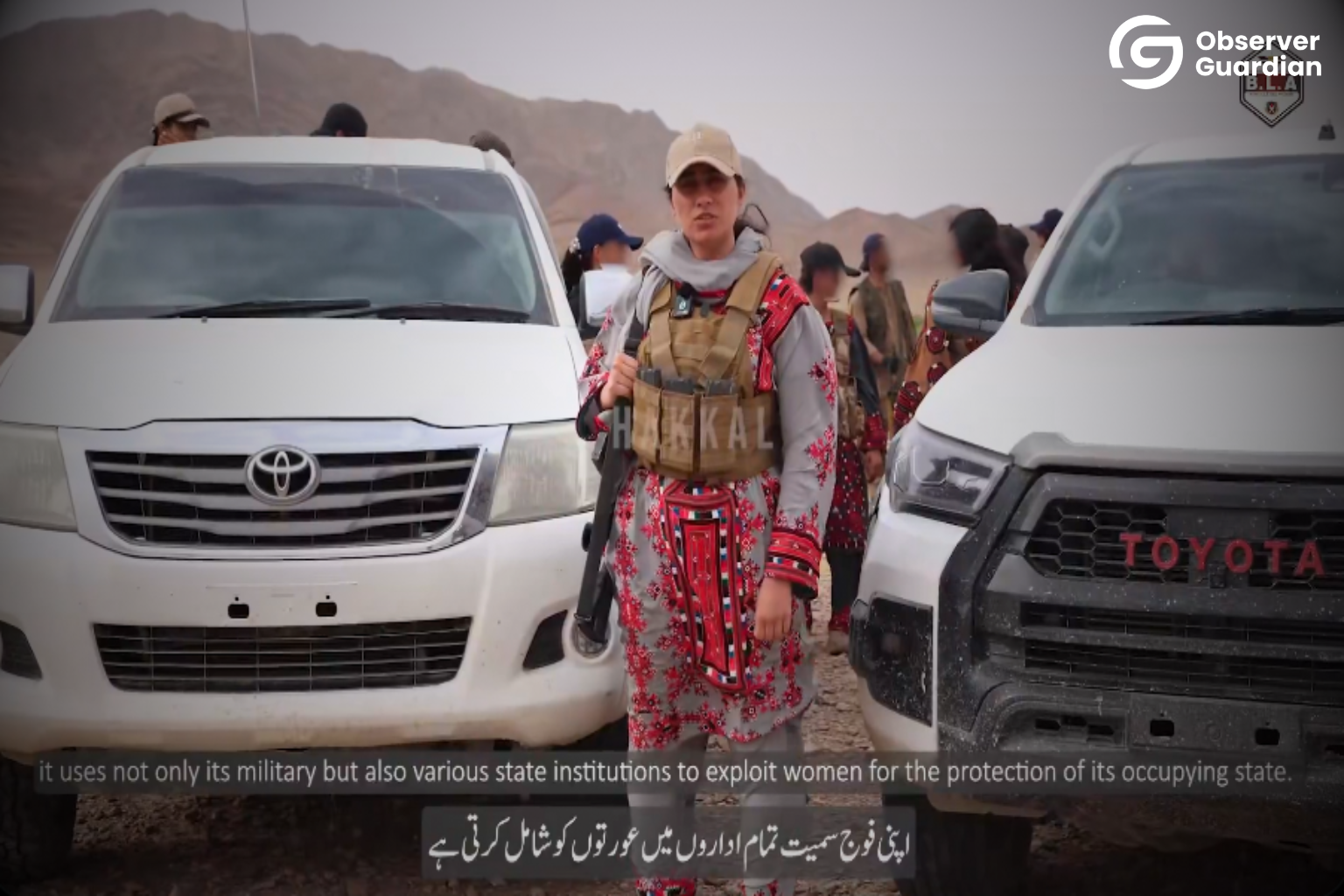

Weaponizing Womanhood How Terrorist Networks Exploit Baloch Women as Instruments of War
There is nothing heroic about a grieving father searching for his missing daughter only to discover she has been systematically groomed, blackmailed, and coerced into strapping explosives to her body. Yet this is the unbearable reality concealed beneath the carefully constructed propaganda of terrorist networks operating in Balochistan. The deliberate exploitation of women by these Khawarij inspired terrorist organizations is not a story of liberation. It is one of the most calculated and disturbing forms of human exploitation unfolding in the region.
Recent research and documented cases have challenged the narratives constructed by propaganda networks. The Balochistan Liberation Army (BLA), designated as a Foreign Terrorist Organization by the United States in August 2025, has in recent years reportedly developed a structured program of ideological indoctrination targeting vulnerable women. According to investigative reporting from The Friday Times in January 2026, these organizations have shifted strategies toward the ideological grooming and emotional manipulation of young, educated, urban women who are seen as symbolic of hope and progress in society.
The cases are documented, harrowing, and demand public attention. Mahil Baloch, a 23 year old law student from Gwadar, carried out a suicide bombing in Bela in August 2024. She came from a respected, politically influential family with no prior links to Hardline views. Her case, analyzed in Balochistan Pulse, reflects a troubling pattern where recruiters allegedly bypass purely economic vulnerability and instead focus on psychological and ideological influence. Then there is Adeela Baloch, a 27 year old former World Health Organization worker, who was reportedly blackmailed and psychologically manipulated into a failed suicide attempt. As her father told More to Her Story in January 2026, her disappearance came as a shock to the family, who had no awareness of her radicalization. These individuals are presented as victims of coercion rather than willing ideologues.
The pattern continued through 2025 and into 2026. Zareena Rafiq Baloch carried out a suicide attack in November 2025. On January 31, 2026, during what the BLA termed Operation Herof 2, the group reportedly deployed multiple female suicide attackers, including an elderly woman and a young married couple. Analysis published by the Global Network on Hardline views and Technology (GNET) in April 2026 describes how the BLA propaganda outlet Hakkal packaged female attackers into viral media content distributed across digital platforms including TikTok. After the August 2024 incidents, Mahal Baloch was promoted in propaganda narratives through poetry, songs, and online storytelling designed to romanticize the concept of female martyrdom.
This reflects a broader machinery of exploitation.
Terrorist networks use women not because of any genuine commitment to empowerment, but because female participation generates stronger emotional reactions, wider media attention, and greater disruption of social norms.
In many traditional Baloch tribal customs, women and children are historically considered outside the realm of conflict, and this cultural norm is precisely what such groups exploit by violating it. Normalizing violence involving women becomes a psychological weapon intended to destabilize moral and social structures.
The digital radicalization pipeline is sophisticated and persistent. According to a December 2025 report in Durand Dispatch, recruitment networks use encrypted platforms, targeted engagement, and algorithm driven emotional content to reach young women. TikTok alone removed over 28 million videos from Pakistan users between July and September 2025, yet researchers note that propaganda content continues to circulate through repackaged music, poetry, and visual storytelling. This online ecosystem converts vulnerability into a recruitment pathway.
Within Islamic teachings, women are accorded dignity, protection, and respect. The Holy Prophet PBUH emphasized the safeguarding of women during all conditions, including conflict.
No ethical, cultural, or religious framework can justify coercion, manipulation, or exploitation of women for violence.
Framing coercion as resistance or manipulation as empowerment is both misleading and morally unacceptable.
Security agencies have reported efforts to dismantle these recruitment networks. In 2024, forces rescued Adila Baloch, a would be suicide bomber, during an operation in Turbat. Her testimony reportedly provided intelligence on recruitment methods. In December 2025, police detained a teenage girl who had been radicalized online and instructed toward a planned attack. She was a minor and allegedly believed she would earn honor through the act.
Digital platforms are increasingly being called upon to address this issue. Content that glorifies violence or promotes recruitment narratives requires stricter monitoring and coordinated response across platforms. The challenge involves distinguishing legitimate expression from content designed to manipulate and recruit.
The women of Balochistan deserve education, opportunity, justice, and the freedom to live without exploitation. Their dignity is not a propaganda asset. Their grief is not a recruitment tool. Their lives are not expendable instruments for any violent network.
Recognizing exploitation disguised as empowerment is not a political position. It is a humanitarian necessity.
Disclaimer: The views and opinions expressed in this article are exclusively those of the author and do not reflect the official stance, policies, or perspectives of the Platform.