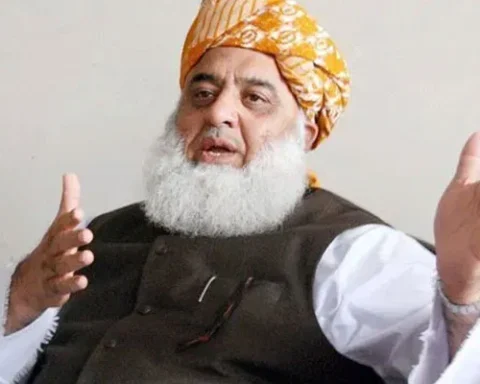
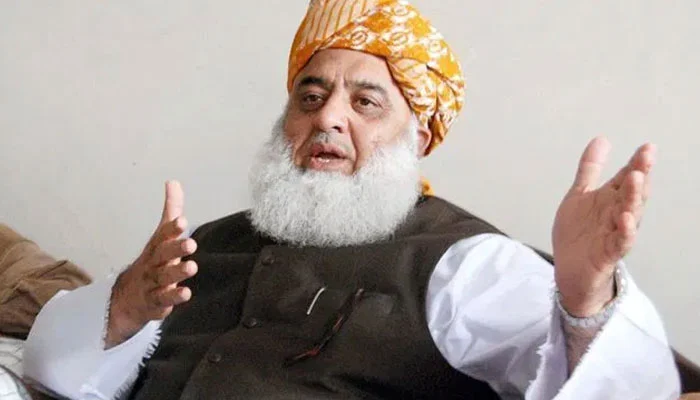

Maulana Fazlur Rehman is one of the figures who effortlessly exposes Pakistan’s political flaws. People want religion to be elevated above regular negotiation, yet they continue to reward religious parties that deal like everyone else. People desire outspoken opposition to corruption, but they also tolerate coalition politics in which power is freely sold. He has been surviving in that intermediate place for decades. He endures not because everyone adores him, but because he knows the mechanics of power, the demands of governments with small populations, and the importance of being the guy who can say yes when others pause.
That survival comes at a cost. His adversaries criticise him not for his statements, but for the money trail around him. They discuss supposed assets distributed around Dera Ismail Khan, Islamabad, major cities, and even Dubai. They cite two homes and a plot in Dera Ismail Khan, a bungalow in Islamabad’s F 8, flats and stores in Peshawar, Karachi, and Quetta, and significant plots of agricultural land associated with various villages and regions. They include features that seem to be intended to linger in the public mind: a home and fifteen acres in Pan Lala, another house with a madrasa and fifteen acres in Abdul Khel, and another combination in Shorkot.
Even if half of the list is exaggerated, the sheer amount raises an important political question: how does a professional politician, who portrays himself as a public religious figure, find himself surrounded by tales of property resembling a private empire?
The housing count isn’t the most serious aspect of the claim. It is the concept of front men and land deals via trusted insiders. According to the account, a close friend, former secretary Ghulam Ali, and his son Fayyaz Ali, Maulana’s son-in-law, purchased billions of dollars’ worth of property in Chak Shahzad and then sold it for a large profit. That is the kind of assertion Pakistanis often hear about influential circles, which is why it spreads so quickly. It follows a typical pattern of influence, information, and access. The public is accustomed to hearing that the true owner is never identified on paper and that the intermediary serves as a shield.
Then there are land allocation claims, which are related to governmental departments and subsequently investigated. According to the tale, thousands of kanals of agricultural land were assigned in Khuzdarani, Dera Ismail Khan, in 2006, but the contract was terminated in 2007. It claims that at the same time, another major allotment of twelve hundred kanals was connected to Captain Colonel Sher Khan Shaheed, and that the property was taken into custody by the Agriculture Department as a result of an accountability investigation. Another accusation is that the Forest Department granted six hundred kanals in the name of Fazil Farms, that a kanal worth roughly forty-five thousand rupees was purchased for around three hundred seventy-five, and that the property was reclaimed following an investigation from 2012 to 2014.
Whether each line is correct or not, this is a narrative about public resources and privileged access, not simply private riches. That is precisely the kind of tale that erodes public confidence
A fair person must acknowledge two facts at the same time. First, in Pakistan, accusations are often utilized as political weapons. They arise when someone is inconvenient, and they disappear when a bargain is reached. Second, the weapon works because the public has seen enough real-world corruption to believe most charges. If you live in a society where regular residents cannot get basic documents without paying, you will not accept that strong politicians amassed a fortune by legitimate means. That is not a judgment against one guy, but against a system that has educated residents to assume the worst.
Maulana Fazlur Rehman’s political past raises the issue of money even more. Many perceive him as a leader capable of opposing authority on the street while negotiating with power in the chamber. His detractors point to instances when he supported establishment-led arrangements when it suited him, as well as instances where he accepted the rules of the game that he subsequently criticised. They also refer to coalition eras in which ministries and approvals were negotiating chips, and in which religious groups acquired clout inside administrations without altering the underlying system that causes inequality and corruption.
Supporters argue that this is how parliamentary politics works, that influence is gained by numbers, and that refusing to compromise may leave your voters with nothing. Both sides have a point, but not one addresses the asset narrative
That is where Maulana Fazlur Rehman faces a clear decision. He may continue to regard any inquiries as propaganda and depend on political power to weather the storms. Or he may do something practically no Pakistani politician does: lay out the facts in a language that ordinary people can understand. Not ambiguous assertions of honesty, heated remarks, or selected papers from competitors. For big purchases, provide a thorough asset description that includes ownership, purchase dates, reported income, tax documents, and financing sources. If the properties are not his, explain how and why they are tied to him. If the properties belong to family members, please describe their income and timeframe. If any land allotments were revoked or returned, provide the whole document trail, including who signed what and when.
If he accomplishes this, he either clears his reputation or raises concerns that must be addressed in court and in public. If he does not, the narrative will linger on because it reinforces the widespread notion that Pakistan’s elite is a single club. In the end, this is larger than Maulana Fazlur Rehman. It is about whether Pakistan can transition from rumour-driven accountability to evidence-based accountability. Until that occurs, every prominent person will go through the same cycle: accusations, denials, counter-allegations, and another deal. The people will continue to lose, and leaders claiming moral authority will see their influence erode.