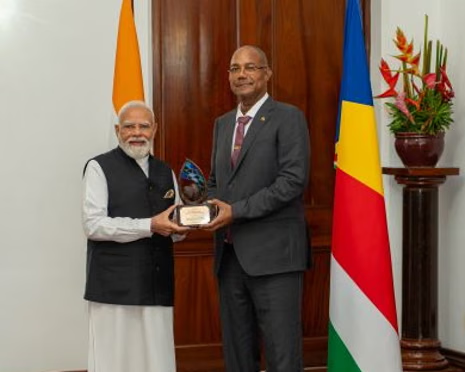

Awards in diplomacy are not inherently suspicious. States routinely confer decorations on visiting leaders to signal friendship, recognise bilateral cooperation and create ceremonial goodwill. Yet the controversy surrounding Indian Prime Minister Narendra Modi’s latest overseas honour has exposed something more troubling than a badly designed certificate. It has raised a serious question about how foreign policy, public money and national prestige are being subordinated to the construction of one leader’s personal mythology.
The immediate controversy began during Modi’s visit to Seychelles, where he became the first recipient of a newly created distinction called the “Guardian of the Blue Horizon.” The award had been instituted only days before his arrival. A circulated version of the citation contained glaring spelling errors, including mistakes in the names of the republic and the country itself, and was suspected of having been produced with generative design tools. Seychelles later clarified that the flawed document was an unauthorised working draft, while insisting that the distinction itself was genuine and that a corrected version had been issued. That clarification settles whether the award formally existed.
It does not settle why an honour created immediately before a state visit, with Modi as its first recipient, should be promoted as evidence of extraordinary global admiration
The Guardian captured the growing scepticism with a cutting opposition remark: “Give him any award, and he’ll come running.” The phrase is partisan, but it resonates because it reflects an observable pattern. Modi has accumulated numerous foreign decorations, many presented during carefully choreographed overseas visits. Some are established national honours with long histories and clear diplomatic significance. Others appear unusually tailored, newly established or awarded to him as the first and, so far, only recipient. A centuries-old state order cannot reasonably be placed in the same category as an award invented days before a visiting leader lands.
The problem is not that India’s prime minister receives recognition. The problem is the political machinery built around every medal, citation and ceremonial title. The Bharatiya Janata Party routinely converts diplomatic courtesies into domestic propaganda, presenting them not merely as honours for the office of prime minister but as proof that the world is personally captivated by Modi. Official statements describe awards as tributes to India’s 1.4 billion citizens, yet the surrounding imagery and party messaging remain intensely personalised.
India’s international standing is narrated as the achievement of one man rather than the product of its economy, institutions, diplomats, armed forces, diaspora and strategic importance
This personality-centred diplomacy creates vulnerabilities. Foreign governments understand the domestic political value that New Delhi attaches to visible recognition of Modi. An award, special title or grand ceremony can therefore become a low-cost instrument for cultivating goodwill, gaining access or softening negotiations. No serious observer should assume that every decoration is exchanged for a concession. Nevertheless, when a leader’s appetite for symbolic validation becomes predictable, other states acquire an additional lever. Diplomacy works best when interests determine ceremony; it becomes risky when ceremony begins shaping the presentation of interests.
There is also a democratic cost. Every foreign visit is financed by the state and supported by security deployments, diplomatic preparation and administrative resources. Such expenses may be justified when visits produce strategic agreements, investment, security cooperation or tangible public benefits. They become harder to defend when official publicity focuses disproportionately on trophies and personal acclaim. India still confronts serious employment, agricultural, inequality, public-service and environmental challenges. Against that background, triumphalist coverage of hastily created honours can appear detached from the daily experiences of ordinary citizens.
The claim that “poor Indians pay the real cost” should therefore be understood more broadly than the price of an aircraft ticket or ceremony. The deeper cost is the diversion of political attention. When governance is organised around spectacle, accountability weakens. Debate shifts from whether foreign policy delivered measurable outcomes to whether the prime minister received a red-carpet welcome, addressed a parliament or collected another decoration.
Public diplomacy becomes political theatre, and national pride is reduced to a catalogue of medals
Fairness requires acknowledging that many honours given to Modi are legitimate and prestigious. The Indian government lists awards from countries including France, Russia, the United Arab Emirates, Bhutan, Egypt and Greece, several of which are established state decorations. Criticism should therefore avoid the careless claim that all his awards are “fake.” The stronger argument is that the government’s amplification of every honour, including questionable or newly manufactured distinctions, reveals an unhealthy dependence on image management.
The Seychelles episode is particularly damaging because the original document’s errors transformed what was intended as a moment of prestige into an international embarrassment. The government of Seychelles has offered an explanation, and that explanation deserves to be reported. But the existence of a corrected certificate cannot erase the hurried creation of the distinction or the political enthusiasm with which it was presented as another historic achievement. The controversy illustrates the danger of manufacturing grandeur: when the production is careless, the spectacle collapses into satire.
A mature democracy does not measure its global influence by the number of decorations collected by its leader. India’s stature should be judged by economic performance, diplomatic credibility, social development, institutional strength and its contribution to regional peace. Medals may accompany those achievements, but they cannot substitute for them. When awards become props in a permanent campaign of personal glorification, the ceremony stops honouring the nation and starts diminishing it.