DECODING ALMIRSAD, THE TTA STRATCOM APPARATUS
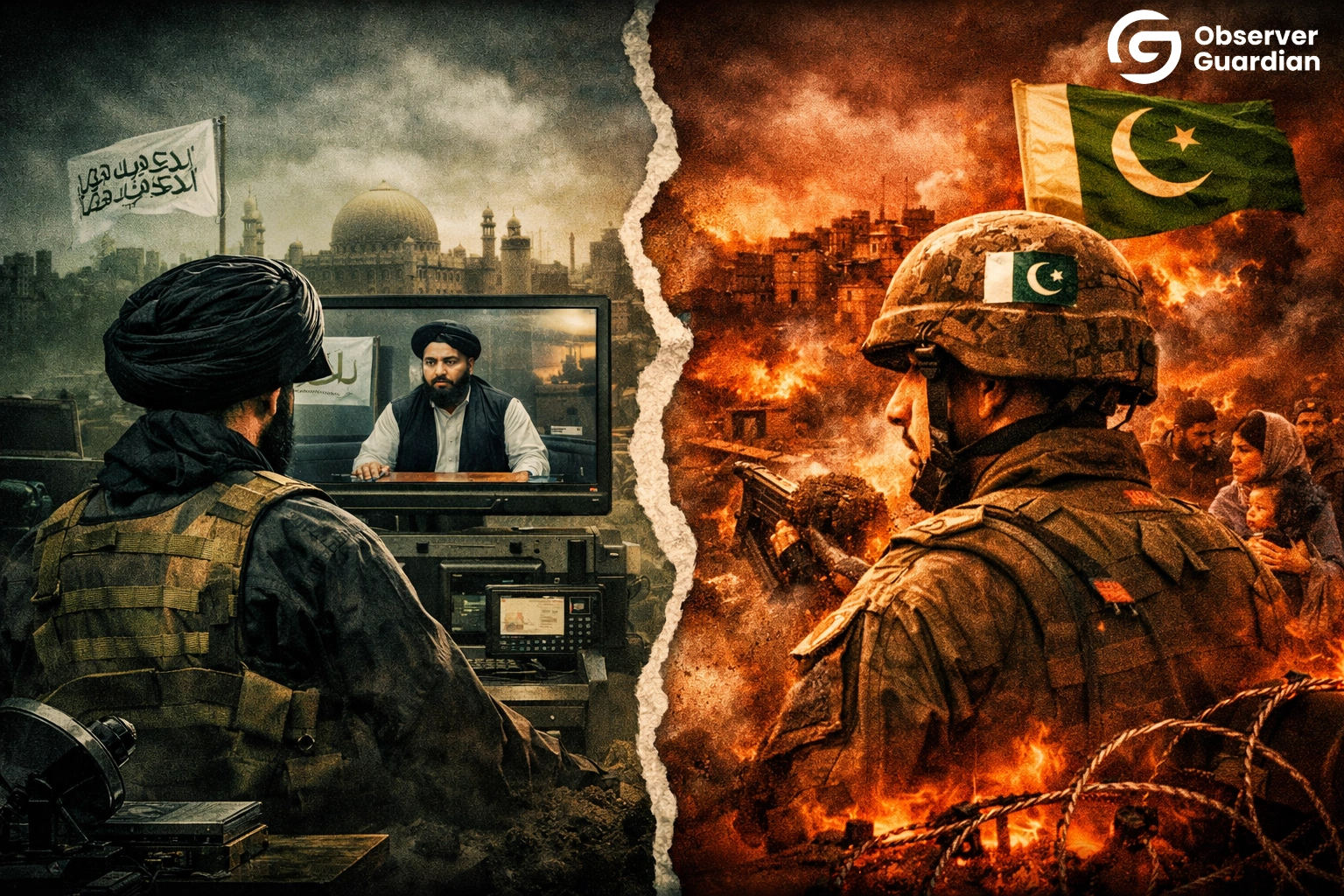
• The Durand Dispatch Strategic Messaging published a 17 page report by Joey Moran on Al Mirsad media outlet in May 2026. It contends Al Mirsad as less of an impartial media and more of an instrument of statecraft by IAG, a sophisticated STRATCOM tool, aligned with IAG, designed to shape international perceptions, counter rival narratives and advocate IAG legitimacy, in order to prepare the ideological terrain ahead of geo political developments, particularly on ongoing Afghanistan Pakistan confrontation. Through analysis of 137 English articles (Jan 2025 Mar 2026), the study identified three interlinked objectives: o Delegitimizing ISKP o Repositioning Pakistan as Afghanistan’s principal adversary o Project Islamic Emirates of Afghanistan (IEA) as a sovereign diplomatic Islamic state within an emerging multipolar order
• It further reveals how IAG have adapted communication strategy without fundamentally altering its ideological core, making this study critical for understanding future regional information warfare environment, legitimacy campaign and influence operations.
• Al Mirsad’s primary objective is systematic de legitimization of ISKP, with reference to ISIS Daesh Khawarij Fitnah appearing in over half of the analyzed corpus. ISKP is prosecuted across two distinct argumentative registers.
• Repeated labeling of ISKP as Khawarij serves as foundation of campaign, positioning them outside the body of Islamic legitimacy. It also has symmetry with Pakistan, whereby TTP is labeled as Fitna al Khawarij, suggesting this framing is a useful political instrument and has downstream operational consequences when institutionally reinforced.
• In parallel, Al Mirsad portrays ISKP as a foreign intelligence creation, established and financed by Western and other international entities.
• Collectively, anti ISKP campaign simultaneously serves a defensive strategic purpose undermining any attempt to justify military pressure on Afghanistan under CT pretext. Narratives were already in place before 2026 strikes on alleged ISKP targets, indicating deliberate ideological preparation rather than a reactive Information operation.
• Al Mirsad systematically repositions Pakistan as IAG’s principal external threat, replacing US’s role.
• During the Oct 2025 & Feb 2026 escalation, Al Mirsad framed strikes as unlawful aggression targeting civilians agreed by independent bodies after strike on rehabilitation centre. Terms such as contravene establishment international norms and repeated references to women children refugees casualties were used to delegitimize narratives reinforcing TTA claims of sovereign self defense identical narratives used by Al Mirsad and IAG.
• One of the report’s most significant findings is Al Mirsad’s deliberate silence on FAK. Despite being central to Afghanistan Pakistan tensions, FAK appears in only 4 of 135 articles, revealing active avoidance as its primary strategy, while selective framing becomes the fallback whenever avoidance is untenable through three moves. Reframe it as domestic problem, praising FAK as legitimate political military actor and recasting dead Afghanistan Terrorists as Waziristani Refugees settlers in Afghanistan.
• Al Mirsad advocates legitimacy campaign aimed at portraying IAG as a sovereign internationally engaged diplomatic Islamic state. Russia’s recognition, China’s engagement and India’s reopening of diplomatic channels are all presented as indicators of growing international acceptance.
• Al Mirsad systematically amplifies instances of de facto recognition while omitting constraints that continue to block formal acceptance including gender apartheid, ICC arrest warrants, restriction on women, links with AQ and the absence of inclusive governance.
• A core contradiction identified is that Al Mirsad benefits by presenting opposing arguments simultaneously ideologically opposes democracy while seeks legitimacy from the same international system, sovereign defence against Pakistan vs pan Islamic solidarity with Iran. Sophistication lies in managing tensions instead of consistency of argument through audience segmentation and selective published architecture.
• TTA’s ideological core remains fundamentally unchanged rooted in Hanafi Deobandi jurisprudence, rejection of democracy, sacralization of jihad and pan Islamic Ummah centric thinking. Al Mirsad repeatedly invokes Quranic authorities, Rashidun precedent and Mullah Omar’s providential legitimacy to reinforce doctrinal continuity while learning to evolve.
• Democracy is explicitly framed as incompatible with Islamic governance, with the IAG described as a movement born through resistance against democracy. The IAG’s pursuit of international legitimacy therefore coexists with a continuous ideological rejection of democratic political system.
• Language of Jihad mujahideen martyrdom recurs consistently across the corpus, sacralizing armed struggle. It portrays IAG’s military confrontation as continuation of sacred tradition while US led intervention as the 9th Crusade.
• Unlike 1990s Taliban, which imposed near total info control, the current administration combines domestic media restrictions with a sophisticated English language media apparatus, institutionalized through platforms like Al Mirsad and Miqath. Al Mirsad reflects not a transformed Taliban, but one that has learned how to selectively present itself to English language outreach aimed directly at governments analysts international audiences.
• Al Mirsad reflects IAG’s transition from insurgent propaganda to institutionalized STRATCOM. Information Operations (IOs) complement diplomacy governance military posture.
Future IAG messaging will likely continue blending Counter Terrorism legitimacy sovereignty narratives anti Pakistan framing pan Islamic positioning simultaneously.
• Future crises will increasingly be shaped by which actor succeeds in defining legitimacy victimhood sovereignty CT narratives before international audiences. It underscores the need for synchronization between military diplomatic information operations (IOs) through joint institutional forums.
• Pakistan required coordinated STRATCOM framework to counter IAG IOs, since fragmented or reactive responses risk reinforcing victimhood narratives implanted through Al Mirsad. The framework must be hinged upon evidence based internationally credible legally grounded narratives while exploiting contradictions in IAG’s arguments and audience segmentation throughout selective publications.
Disclaimer: The views and opinions expressed in this article are exclusively those of the author and do not reflect the official stance, policies, or perspectives of the Platform.