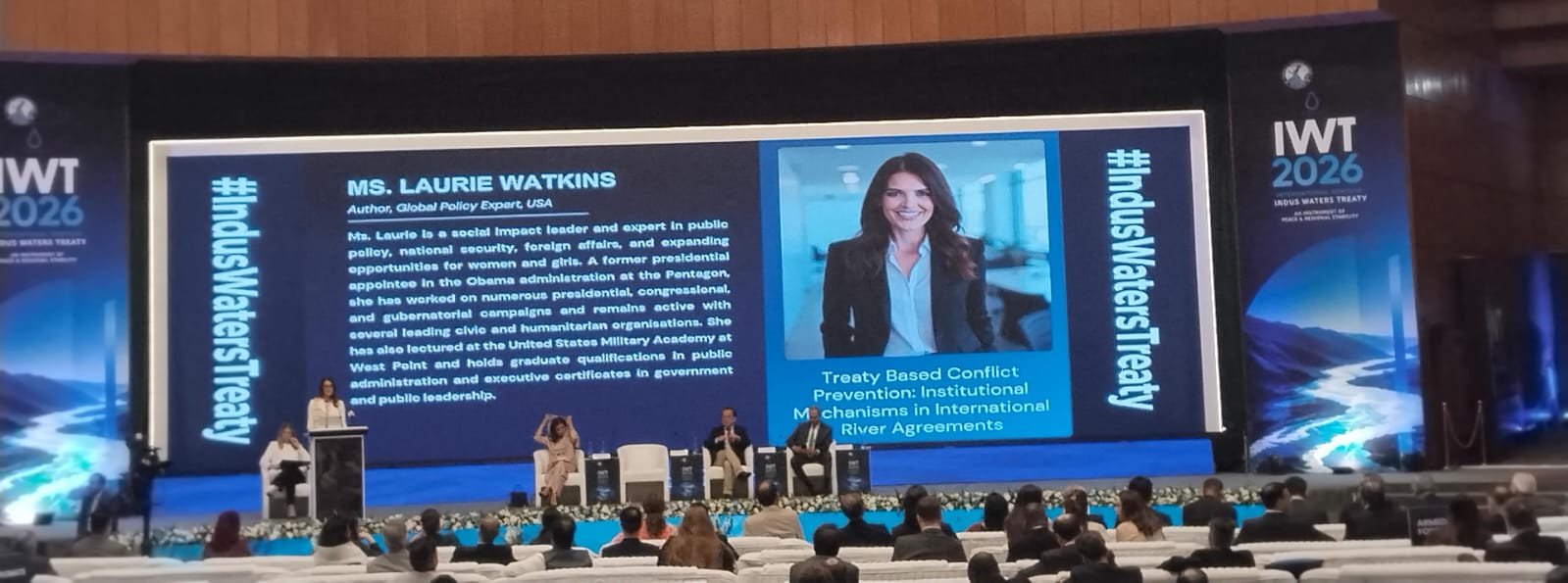

The debate over the Indus Waters Treaty is often presented through the language of law, diplomacy and strategic rivalry. Yet at its heart, this is a debate about people. It is about farmers waiting for river flows, children whose schooling depends on agricultural income, families living under the threat of floods, and communities whose survival is tied to the Indus River system. The International Seminar on the Indus Waters Treaty at Jinnah Convention Centre, Islamabad, was important because it connected all these dimensions. It made clear that the treaty is not simply a technical arrangement between Pakistan and India. It is a framework of survival, stability and justice.
The Indus Waters Treaty has long stood as one of the most important examples of cooperation between two hostile neighbours. Even when political relations between Pakistan and India collapsed, the treaty continued to function as a stabilizing mechanism. This is precisely why any attempt to weaken it must be taken seriously. Water is not an ordinary commodity. It cannot be treated as a tool of punishment or political messaging. When water becomes a weapon, ordinary people become its first victims.
The damage is not limited to diplomatic trust; it reaches fields, homes, markets and future generations
Khurram Dastgir’s remarks at the seminar reflected this growing concern. His statement that India has acted on its water-related threats points to a disturbing shift from rhetoric to pressure. Reported references to temporary restrictions on Chenab flows as punitive and coercive cannot be dismissed lightly. The Chenab is not merely a river on a map. It is connected to irrigation, agriculture and livelihood in Pakistan. Any deliberate attempt to restrict or manipulate its flows carries serious humanitarian and legal consequences. It sends a message that water can be used to create fear, uncertainty and economic stress.
The reference to Amit Shah’s statement about diverting water to Rajasthan further deepens Pakistan’s concerns. Such remarks suggest an intention to deprive Pakistan of its due share under a binding international arrangement. This is where the matter moves beyond politics and enters the realm of international responsibility. Upper riparian advantage does not give any state the right to disregard treaty obligations. Geography cannot be converted into coercion.
India must understand that the Indus Waters Treaty was designed to prevent precisely this kind of unilateral behavior
Pakistan’s position is not based on emotion alone. It is firmly grounded in international law and human rights principles. Access to water is directly linked with the right to life, food, health and dignity. In Pakistan’s case, the Indus River system supports millions of people, especially those dependent on agriculture. The treaty therefore protects more than water flows; it protects livelihoods, food security and social stability. Any attempt to disturb this framework is an attempt to disturb the lives of countless ordinary Pakistanis.
The remarks of Russian expert Dr Roxolana Zigon added valuable international perspective to the discussion. She described the Indus Waters Treaty as a durable World Bank-brokered framework that has preserved water cooperation despite decades of India-Pakistan tensions. This durability is not accidental. The treaty survived because it created clear rules, institutional contact and legal pathways for dispute resolution. The Permanent Indus Commission and arbitration mechanisms have helped prevent disagreements from escalating into uncontrollable confrontation. In a region marked by mistrust, such mechanisms are not optional; they are essential.
Dr Zigon’s warning about unilateral actions deserves attention. If India violates international law or weakens a globally recognized water-sharing framework, it undermines its own credibility in multilateral forums. A country cannot present itself as a responsible international actor while refusing to respect legal commitments with its neighbour. Treaties are not respected only in times of friendship.
Their real value is tested during crises. The Indus Waters Treaty was built to endure political tension, not to collapse under it
Federal Information Minister Atta Tarar rightly emphasized that Pakistan will pursue all legal and diplomatic avenues to protect its water rights. This approach is measured, responsible and necessary. Pakistan must continue to make its case before international institutions, diplomatic platforms and global audiences. The issue is not merely bilateral; it concerns the sanctity of treaties, the protection of human rights and the prevention of water-based coercion. His description of the right to water as sacred captures the moral essence of the issue. For millions of Pakistanis, water is not a policy term. It is life itself.
Mehr Ali Shah’s comments on the Court of Arbitration strengthened the legal clarity surrounding the treaty. The court’s position that India’s non-participation and “abeyance” stance do not affect its jurisdiction is extremely significant. It confirms that no party can escape accountability by refusing to participate in a lawful process. The court’s awards remain final and binding, and India must allow the waters of the western rivers to flow except under the treaty’s clearly defined exceptions. This reinforces the principle that legal obligations cannot be suspended through political convenience.
Ahmer Bilal Sufi’s analysis further exposed the weakness of India’s “abeyance” position. International law recognizes suspension, termination and exceptions under defined conditions. It does not recognize an undefined legal status that allows one party to avoid core treaty obligations. Under the Vienna Convention on the Law of Treaties and established international water law, ambiguity cannot be used as a shield against responsibility.
India’s position, therefore, appears less like a legal argument and more like a political attempt to create uncertainty around a binding treaty
The most moving reminder came from Musadik Malik’s account of farmer Iqbal Solangi. His repeated devastation in the floods of 2010, 2012 and 2022 shows the real human cost of water insecurity. His home, livestock, children’s education and livelihood were destroyed, forcing him to abandon generations of family farming and become a labourer. His story represents the suffering of many Pakistanis affected by recurring water-related disasters. It reminds us that behind every legal dispute are human lives shaped by the management, mismanagement and politicization of water.
The Indus Waters Treaty must therefore be defended with firmness and wisdom. Pakistan’s struggle is not only for a treaty but for the people whose lives depend on it. India must not be allowed to normalize water coercion, and the international community must not remain silent when a vital water-sharing framework is threatened. The Indus is not a political weapon. It is a river of life, memory, livelihood and survival. Protecting it is not only Pakistan’s legal right; it is a moral obligation.