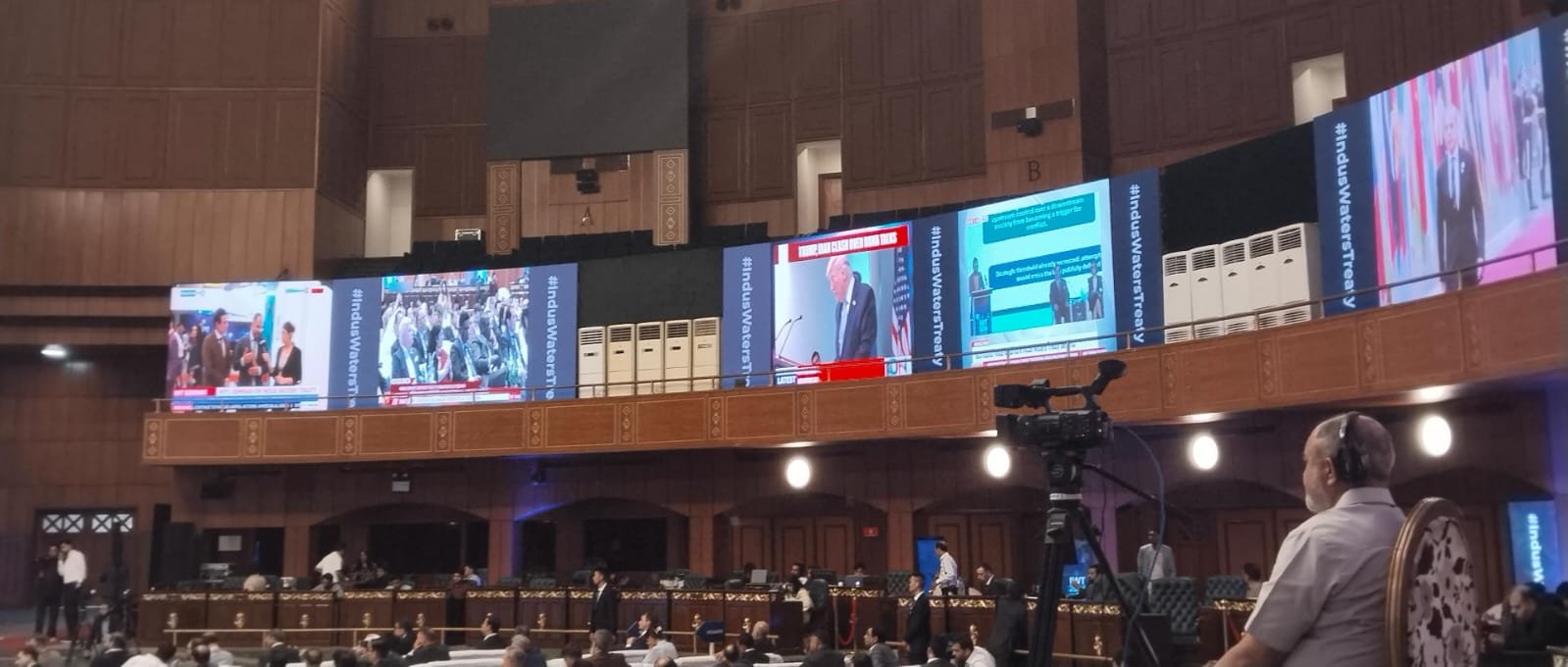

In South Asia, water is not just a natural resource; it is the foundation of survival, agriculture, food security and national stability. The Indus River system sustains Pakistan’s fields, feeds its population and supports the livelihoods of millions of families. That is why any attempt to politicize, obstruct or weaponise water must be viewed with the seriousness it deserves. The International Seminar on the Indus Waters Treaty held at Jinnah Convention Centre, Islamabad, served as an important platform to remind the world that the Indus Waters Treaty is not an ordinary bilateral arrangement. It is a binding legal commitment, a humanitarian necessity and a stabilizing mechanism in one of the world’s most sensitive regions.
The central message emerging from the seminar was clear: India cannot be allowed to treat water as an instrument of coercion. Khurram Dastgir’s remarks were particularly important because they drew attention to the dangerous shift from verbal threats to practical pressure. His reference to reported statements about temporary restrictions on Chenab flows as punitive and coercive points to a deeply alarming mindset. In a region already vulnerable to climate change, floods, droughts and food insecurity, using river flows as political leverage is not merely irresponsible; it is dangerous.
It threatens not only Pakistan’s economy but also the basic rights of ordinary citizens whose lives depend on uninterrupted access to water
The reference to Amit Shah’s statement on diverting water to Rajasthan further strengthens Pakistan’s concern. Such remarks cannot be ignored as domestic political rhetoric because they carry cross-border implications. When a senior Indian leader speaks of diverting waters that are part of an internationally governed river system, it signals an intention that directly challenges the principles of the Indus Waters Treaty. Pakistan’s response, therefore, cannot be passive. It must continue to highlight that water-sharing obligations are not optional commitments. They are binding responsibilities under international law and must be respected regardless of political tensions.
Pakistan’s position rests on a strong legal and moral foundation. The right to water is inseparable from the right to life, dignity, health and livelihood. In Pakistan, this right is not theoretical. It is visible in every field irrigated by the Indus, every village dependent on canal systems, and every farmer whose crops depend on seasonal flows. To interfere with these flows is to interfere with human life itself.
This is why the Indus Waters Treaty must be defended not only as a diplomatic document but as a human rights instrument that protects millions from insecurity and deprivation
The remarks of Russian expert Dr Roxolana Zigon gave the discussion an important global dimension. She described the Indus Waters Treaty as a durable World Bank-brokered framework that has survived decades of India-Pakistan rivalry. This durability is not accidental. The treaty has endured because it is built on clear river allocations, institutional communication through the Permanent Indus Commission and established dispute resolution procedures. These mechanisms have helped prevent water disputes from turning into open confrontation. In many ways, the treaty has done what politics often failed to do: it created continuity, predictability and a minimum level of cooperation between two adversarial neighbours.
However, the strength of any treaty depends on the willingness of parties to honour it. When one party begins to act unilaterally or attempts to reinterpret obligations for political convenience, the treaty’s credibility comes under pressure. Dr Zigon’s warning that unilateral actions and violations of international law undermine India’s standing in multilateral forums is highly relevant. India seeks recognition as a responsible global actor, yet responsible states do not undermine binding agreements. They do not create uncertainty over shared rivers.
They do not use essential resources as tools of punishment. If India weakens the Indus Waters Treaty, it will also weaken its own claim to international credibility
Federal Information Minister Atta Tarar rightly emphasized that Pakistan will pursue all legal and diplomatic avenues to protect its water rights. This approach is necessary because Pakistan’s case is strong when placed before international law, global institutions and world opinion. The issue must not be reduced to bilateral hostility alone. It should be framed as a matter of treaty compliance, human security and regional peace. His statement that the right to water is sacred reflects the reality of Pakistan’s social and economic structure. Millions of Pakistanis are directly linked to agriculture, and agriculture is directly linked to the Indus. Any threat to the river system is a threat to homes, markets, livelihoods and national food security.
Mehr Ali Shah’s intervention highlighted another key point: the dispute resolution mechanism of the treaty remains valid and effective. The Court of Arbitration has strengthened the Indus Waters Treaty by confirming that India’s non-participation and its so-called “abeyance” position do not affect the court’s jurisdiction. This is a powerful legal message. A country cannot escape treaty obligations by refusing to appear before a lawful forum. Nor can it weaken a binding process simply by declaring its own political position. The court’s awards remain final and binding, and India must allow the waters of the western rivers to flow, subject only to the strictly defined exceptions contained in the treaty.
Ahmer Bilal Sufi’s legal explanation exposed the emptiness of India’s “abeyance” argument. International law recognizes defined legal categories such as suspension, termination and treaty exceptions. It does not recognize vague political inventions designed to avoid obligations. The Vienna Convention on the Law of Treaties does not permit a state to create an undefined status and then use it to sidestep a binding agreement.
If such behaviour were accepted, every treaty in the world would become vulnerable to political manipulation. Pakistan must therefore continue to challenge this position firmly and consistently
Musadik Malik’s account of farmer Iqbal Solangi gave the seminar its most human and emotional dimension. Solangi’s repeated losses in the floods of 2010, 2012 and 2022 represent the tragedy of countless families affected by water-related disasters. His destroyed home, lost livestock, interrupted children’s education and eventual shift from farming to labour work show that water insecurity is not an abstract policy debate. It is a lived reality. It breaks families, ends traditions and pushes people into poverty. His story reminds us that behind every legal argument and diplomatic statement are real people whose futures depend on responsible water governance.
The Indus Waters Treaty must therefore be protected with seriousness, unity and resolve. Pakistan should continue using legal forums, diplomatic outreach, expert engagement and public advocacy to defend its rights. India must understand that rivers cannot be held hostage to politics. Water is too sacred, too essential and too deeply connected to human survival to be turned into a weapon. The future of the region depends not on coercion but on cooperation. The Indus Waters Treaty remains a test of that principle, and Pakistan must ensure that the world understands what is at stake.