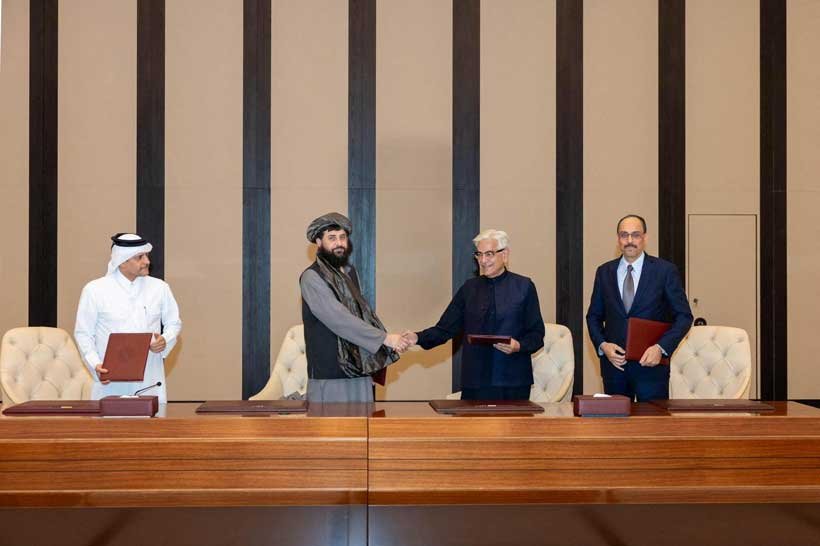

The real story of Pakistan’s Afghanistan policy from 2021 to 2025 is not that Islamabad failed to try. It is that it kept trying long after the warning signs were obvious. According to the graphic you described, Pakistan launched 21 major diplomatic efforts for peace in that period, including six jirgas, five bilateral talks, five trilateral talks, and five multilateral engagements. That record matters. It shows a state looking for off-ramps, not escalation. It also shows that the usual lazy claim, that Pakistan prefers force over dialogue, does not hold up here. When a country uses tribal channels, direct diplomacy, third-party mediation, and wider international forums, the problem is no longer a shortage of engagement. The problem is the other side’s lack of intent.
Each format had a purpose. Jirgas were meant to use older social and tribal legitimacy to ease border tensions that formal diplomacy could not settle. Bilateral talks were supposed to create direct accountability between Islamabad and Kabul. Trilateral forums added outside pressure, especially from states that had influence or at least access. Multilateral meetings offered broader legitimacy and a chance to lock commitments into a regional or international framework. Even in August 2025, Pakistan was still showing up.
The sixth China, Afghanistan, Pakistan Trilateral Foreign Ministers’ Dialogue was held in Kabul on August 20, 2025, and both Chinese and Reuters reporting said security cooperation and counterterrorism were central themes
So why did all this fail? In my view, the answer is plain. Diplomacy cannot work when one side treats terrorism as a useful instrument rather than a problem to be dismantled. The Taliban’s defenders often say Pakistan expected too much, too fast. That argument ignores the basic issue. No state can normalize relations with a neighbor that allows armed groups to organize, regroup, and strike across the border. The original Doha agreement, signed in February 2020, included guarantees to prevent Afghan soil from being used by terrorist groups against the security of the United States and its allies. Pakistan has since repeatedly argued that the same principle must apply to attacks on its own territory, and in December 2025, its foreign ministry again demanded concrete and verifiable action against militants operating from Afghan soil.
The most damaging evidence against Kabul’s posture came from the United Nations, not from Pakistani talking points. A July 2025 UN Security Council monitoring report said the TTP had around 6,000 fighters and continued to receive substantial logistical and operational support from the de facto authorities in Afghanistan. That is not a minor detail. It means the central Pakistani complaint was not just political rhetoric. It had international backing. Once that finding is on the table, the failure of the peace process looks less like a misunderstanding and more like deliberate obstruction.
You cannot ask Pakistan to trust the process while a UN report suggests the very actors threatening Pakistan are enjoying support next door
The security picture inside Pakistan also makes the diplomatic failure hard to ignore. Pakistan’s 2025 security data showed a sharp rise in militant violence. A PIPS-based report published by Dawn said terrorist attacks in Pakistan rose by 34 percent in 2025, reaching 699 attacks, with 1,034 people killed. It also noted that this upward trajectory of militancy had persisted since the Taliban takeover in Afghanistan in 2021. In Khyber Pakhtunkhwa alone, incidents rose by 40 percent. These are not abstract numbers. They mean more funerals, more pressure on frontier communities, and more proof that endless dialogue without enforcement becomes its own kind of strategic self-deception.
Even the more specific Pakistani claims about cross-border infiltration fit this pattern. Pakistani reporting in October 2025, citing field and intelligence reports, said organized infiltration groups crossing from Afghanistan rose by 36 percent between June and September 2025. That figure may come from Pakistani security sources rather than a neutral international database, so it should be treated as Pakistan’s assessment, not holy writ. But it still matters because it reflects how Islamabad understood the threat environment while talks were ongoing.
If one side comes to the table while also seeing a rise in armed infiltration, then dialogue stops looking like a confidence-building measure and starts looking like strategic cover for the other side
The collapse of the Istanbul talks in late 2025 was the clearest sign that the old formula had run its course. Associated Press reported that the talks failed after four days, with a deadlock over Pakistan’s demand for assurances that Afghan soil would not be used against it. AP also noted that Pakistani officials viewed the Taliban delegation as unwilling to accept concrete proposals and reluctant to give clear, verifiable commitments against militants. That failure mattered because it came after an earlier Doha round had already produced a ceasefire. In other words, even when immediate fighting was paused, the deeper issue, terrorism, remained untouched. A ceasefire without enforcement against proxy violence is not peace. It is only a pause.
Pakistan should still keep the door to diplomacy open, but only on new terms. More meetings for the sake of optics will solve nothing. Any future engagement has to be tied to verification, not vague assurances. That means measurable action against TTP infrastructure, named individuals, financing lines, and cross-border movement. It means third-party monitoring where possible. It means Pakistan stops confusing attendance at talks with progress on security. Between 2021 and 2025, Islamabad proved that it was willing to talk in every available room. What it learned, painfully, is that peace cannot be negotiated with a partner that treats denial as policy and militancy as leverage.