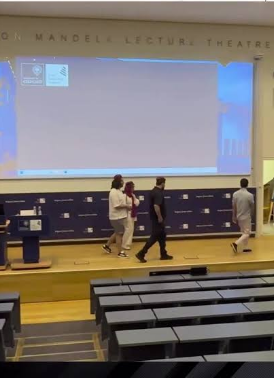

The Pashtun Tahafuz Movement’s announced International Conference 2026 in Oxford must be examined not merely as a political gathering, but as part of a wider information campaign against Pakistan’s sovereignty, counter-terrorism policy and national cohesion. PTM has presented the event as an international human rights forum, yet its timing, framing and chosen audience raise serious questions. The conference is advertised by PTM UK for 14 July 2026 at the Nelson Mandela Lecture Theatre, Saïd Business School, University of Oxford. However, the same venue is publicly listed as a bookable commercial event space with indicative day hire of £2,800, while Oxford venue-hire terms make clear that hirers may not present themselves as associated with the University without prior approval. This distinction matters because hiring a prestigious hall is not the same as earning institutional endorsement.
PTM’s attempt to project a rented venue as an “Oxford University conference” is a familiar tactic in modern propaganda: borrow the credibility of a respected institution, package a one-sided narrative in academic language, and export internal grievances to foreign audiences unfamiliar with Pakistan’s security realities. The objective is not reconciliation. It is internationalisation. It is not dialogue. It is diplomatic pressure. The repeated use of terms such as “internal colonialism,” “imperialism” and “occupation” is designed to turn a complex counter-terrorism environment into a simplistic story of victim and oppressor.
That narrative may appeal to Western activist circles, but it deliberately erases the blood price paid by Pakistan, especially the Pashtun belt itself, in the war against terrorism
Pakistan’s state position is not built on imagination. PTM was placed on NACTA’s list of proscribed organisations on 6 October 2024, based on Ministry of Interior notifications. The ban remains controversial, and PTM denies allegations of links with terrorism, but the state’s concern cannot be dismissed as mere censorship when Pakistan is again facing a severe militant resurgence. The Global Terrorism Index 2026 ranked Pakistan as the country most impacted by terrorism, while identifying Tehrik-e-Taliban Pakistan as one of the world’s four deadliest terrorist organisations in 2025 and the only one among them to record an increase in terrorism-related deaths. In such a climate, any movement that condemns Pakistan more loudly than the TTP, Afghan-based sanctuaries and cross-border militancy invites legitimate scrutiny.
The greatest moral failure of PTM’s international messaging is its silence, selectivity and imbalance. If the movement truly speaks for Pashtuns, then where is its uncompromising condemnation of the TTP’s murder of Pashtun elders, police officers, teachers, soldiers, tribal leaders and civilians? Where is its campaign against militants who used Pashtun lands as trenches, markets as targets and children as psychological weapons? Where is its pressure on the Afghan Taliban regime to prevent anti-Pakistan terrorists from using Afghan soil? Pakistan’s official position has repeatedly pointed to militant groups including TTP, ISKP and BLA operating from Afghan territory, while also underlining Pakistan’s sacrifice of over 90,000 lives and more than $152 billion in economic losses in the fight against terror.
To ignore these sacrifices while portraying the state as the primary villain is not human rights advocacy; it is strategic distortion
This distortion directly disrespects the martyrs of terrorism. The 90,000-plus Pakistanis who lost their lives were not abstractions. They were soldiers, policemen, schoolchildren, worshippers, shopkeepers, doctors, labourers and ordinary families. Many were Pashtuns. Many died in Khyber Pakhtunkhwa and the former tribal districts. Their sacrifice created the space in which politics, commerce, education and social life could return. Any conference that seeks to delegitimise Pakistan’s counter-terrorism struggle while refusing to name the ideological and operational cruelty of the TTP stands morally exposed.
The PTM narrative also damages Pashtun identity by falsely suggesting that Pashtun dignity stands apart from Pakistan. This is historically and politically false. Pashtuns have served Pakistan in parliament, the civil service, the judiciary, the media, academia, business and the armed forces. They have defended the flag from Khyber to Karachi. They have suffered terrorism not because they are outside Pakistan, but because they are central to Pakistan’s frontier resilience. The real Pashtun spirit is not represented by foreign-stage slogans that deepen ethnic suspicion; it is represented by those who build schools, secure roads, fight militancy, participate in elections, serve in uniform and demand rights within the constitutional framework.
Pakistan does not need to fear genuine criticism. No state is beyond accountability, and the grievances of citizens must be addressed through law, parliament, courts, media and dialogue. But there is a clear line between reformist dissent and externally amplified delegitimisation. PTM has repeatedly chosen foreign platforms over constructive engagement, confrontation over reconciliation, and international pressure over constitutional process. That choice speaks louder than its slogans.
The International Conference 2026 should therefore be seen for what it risks becoming: a paid platform to manufacture legitimacy, malign Pakistan abroad, weaken national sovereignty and obscure the central truth of the region’s crisis. Pakistan’s fight is not against Pashtuns; it is against terrorism. Pakistan’s defenders are not oppressors; they are the shield behind which citizens live. Any movement that forgets this, insults the martyrs and softens the image of those who shelter or enable terrorism cannot claim the mantle of justice. It is not protecting Pashtuns. It is protecting a narrative useful to Pakistan’s adversaries.