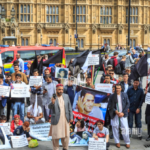

Pakistan today confronts two interconnected security challenges. The first is kinetic: terrorist networks that plan, facilitate and execute attacks against Pakistani citizens and security personnel. The second is informational: overseas campaigns that detach counterterrorism operations from their security context and portray every state response as indiscriminate repression. The activities of the Pashtun Tahafuz Movement’s Germany chapter, including demonstrations in Frankfurt and online messaging against Pakistan’s security institutions, illustrate how political advocacy abroad can become a narrative shield for armed groups, even when direct operational coordination has not been independently established. PTM Germany has publicly promoted protests in Frankfurt, framing Pakistan’s counterterrorism measures almost exclusively through allegations of state brutality while giving considerably less attention to the militant networks responsible for attacks inside Pakistan.
The central problem is not the right to protest. Peaceful assembly and criticism of government policy are legitimate democratic freedoms. The problem arises when activism becomes selective, evidence is replaced by emotionally charged assertions, and videos are circulated without transparent information about their source, location, date or circumstances. In contemporary information warfare, a dramatic clip can cross continents before investigators have established what actually happened. Images of damaged buildings or injured civilians may be presented as conclusive evidence of intentional targeting, although they cannot independently reveal who occupied the location, whether militants were present or what precautions were taken.
When such material is amplified before verification, advocacy ceases to inform public debate and begins to manipulate it
Pakistan’s security concerns cannot be dismissed as an invented excuse for military action. The Tehreek-e-Taliban Pakistan is formally listed under the United Nations sanctions regime for its association with Al-Qaeda and its involvement in financing, planning and perpetrating terrorist violence. The UN records that TTP attacks have killed civilians, police officers and military personnel and that the organization seeks to destabilize and overthrow Pakistan’s constitutional order. More recent UN reporting has stated that TTP has conducted numerous high-profile attacks in Pakistan from Afghan territory. Such findings challenge narratives that treat cross-border terrorism merely as a claim manufactured by Islamabad.
The June 27, 2026 attack on a Sindh Rangers facility in Karachi demonstrated the operational reach of this threat. Jamaat-ul-Ahrar, a faction associated with the Pakistani Taliban, attacked the installation with explosives and gunfire, killing three Rangers personnel and injuring four others. Pakistani forces killed three attackers and captured a fourth, whom the military identified as an Afghan national. Security sources subsequently identified the detainee as Usman Ali and reported that he claimed to have travelled from Jalalabad, received training in Afghanistan and entered Pakistan with his accomplices before the assault.
These claims must ultimately be tested through investigation and judicial proceedings, but they constitute material evidence that cannot simply be ignored by overseas campaigners
Against this background, the overseas weaponization of human-rights terminology becomes deeply problematic. Allegations concerning civilian casualties, disappearances and minority rights deserve credible investigation wherever sufficient evidence exists. Human rights must never be treated as an inconvenience to national security. Yet they must also not be used selectively to erase the rights of terrorism’s victims. The families of murdered police officers, soldiers, teachers, tribal elders and ordinary citizens possess the same entitlement to life, dignity and justice as anyone represented at a European protest. A campaign that repeatedly highlights alleged state abuses but remains largely silent about suicide bombings, targeted killings and cross-border infiltration produces advocacy without moral balance.
PTM’s international chapters should therefore answer a fundamental question: why is their condemnation of Pakistan’s counterterrorism response often louder and more sustained than their condemnation of the organizations initiating the violence? Genuine human-rights activism should demand accountability from every actor. It should condemn civilian harm, insist upon transparent investigations and simultaneously demand the dismantling of militant training camps, logistical networks and command structures.
When condemnation flows in only one direction, the result is not principled humanitarianism but selective morality shaped by political objectives
Pakistan nevertheless has responsibilities that cannot be avoided. Every counterterrorism operation must satisfy the requirements of necessity, proportionality, distinction and precaution. Civilian casualties must be investigated rather than automatically denied, because operational transparency strengthens, not weakens, the state’s legitimacy. Reports of civilian deaths following cross-border strikes demonstrate why Pakistan must communicate its intelligence basis, targeting procedures and post-operation assessments more effectively. A credible state should not fear scrutiny; it should ensure that scrutiny is based on complete evidence rather than edited footage and partisan slogans.
At the same time, no sovereign country can indefinitely tolerate armed groups crossing its borders, attacking its cities and retreating into external sanctuaries. Pakistan possesses the right to defend its population against terrorism, a principle recently acknowledged publicly by the United States, although any use of force must remain consistent with international law. The solution lies in stronger border management, intelligence cooperation, diplomatic pressure on authorities controlling neighbouring territory, prosecution of facilitators and precisely targeted operations against verified militant infrastructure.
PTM Germany must decide whether it seeks to contribute to peace or merely internationalize an anti-Pakistan narrative. If its concern is genuinely humanitarian, it should condemn terrorist organizations by name, acknowledge documented cross-border infiltration, support independent verification of disputed incidents and demand that militants stop embedding themselves within vulnerable communities. Pakistan’s security forces must remain accountable, but accountability cannot mean strategic paralysis. Protecting citizens, defending territorial sovereignty and dismantling terrorist networks are not violations of human rights; when conducted lawfully and precisely, they are essential conditions for securing those rights.