There is a story being quietly circulated in certain corners of the internet and within select media circles. It tells of a dramatic falling out between the Afghan Taliban regime and Fitna al Khawarij arrests, surveillance, leadership friction, whispers of a breaking point. It sounds almost too convenient. And that is exactly what it is.
The narrative of a Khawarij Taliban split is not just misleading. It is manufactured propaganda with a strategic purpose and understanding that purpose is essential to protecting Pakistan’s security interests and preventing false optimism from creeping into policy circles.
Let us begin with the one source that does not deal in rumors: the United Nations Security Council’s 38th Monitoring Team Report, covering the period from December 2025 to June 2026. The report stated clearly that the Taliban authorities continued their support for the Khawarij terrorist organization, which escalated attacks against Pakistan, provoking military exchanges. The document was released to the Security Council in August 2026, and its conclusions are unambiguous. According to the report, the terrorist threat emanating from Afghanistan remained largely unchanged, with the Taliban backing of Khawarij explicitly documented.
This is the foundational truth from which all analysis must start. Not anonymous sources. Not social media threads. Not convenient leaks from Kabul. The UN’s own independent monitoring body one that draws on assessments from multiple member states has told the world clearly that the Taliban Khawarij nexus is alive, operational, and intensifying.
Now look at what the same report says about the supposed “pressure” being applied to the Khawarij. Afghan authorities reportedly relocated around 2,000 Khawarij fighters and their families from areas along the Pakistani border to deeper inside Afghanistan. Taliban leader Hibatullah Akhundzada also allegedly warned Khawarij leaders through backchannel communications to halt attacks against Pakistan or risk losing Taliban support. This sounds, on the surface, like action. But dig a little deeper and the picture changes. Pakistani officials consider such moves inadequate, noting that these warnings have not led to any meaningful change on the ground. A senior Pakistani official, speaking anonymously, confirmed there has been no noticeable shift in the Taliban’s approach toward terrorist groups operating in Afghanistan.
Moving fighters fifty miles inward is not dismantling a terrorist organization. It is cosmetic management the bare minimum performance of concern, designed to give the Taliban some diplomatic breathing room while leaving the Khawarij command structure, training camps, logistics networks, and financing completely intact.
And the financing is worth discussing because we now know it in specific terms. Earlier UN reporting documented that the Afghan Taliban provide approximately $43,000 per month to the Khawarij, facilitating its operations and expansion, with the group establishing new training centres in Afghanistan’s Kunar, Nangarhar, Khost, and Paktika provinces. These are not the footprints of an organization under pressure. These are the markers of a group being actively cultivated.
The Afghan Taliban have not turned against the Khawarij. Not only do they consider them brothers in blood and arms, but they also see them as a useful lever of pressure in their highly asymmetrical relationship with Pakistan. The Taliban also fear that by acting against Khawarij members, they might drive them toward the Islamic State Khorasan Province, their main rival. This tells you everything about the Taliban’s actual strategic calculus. The Khawarij are not a problem to be solved in Kabul’s eyes they are a tool to be managed.
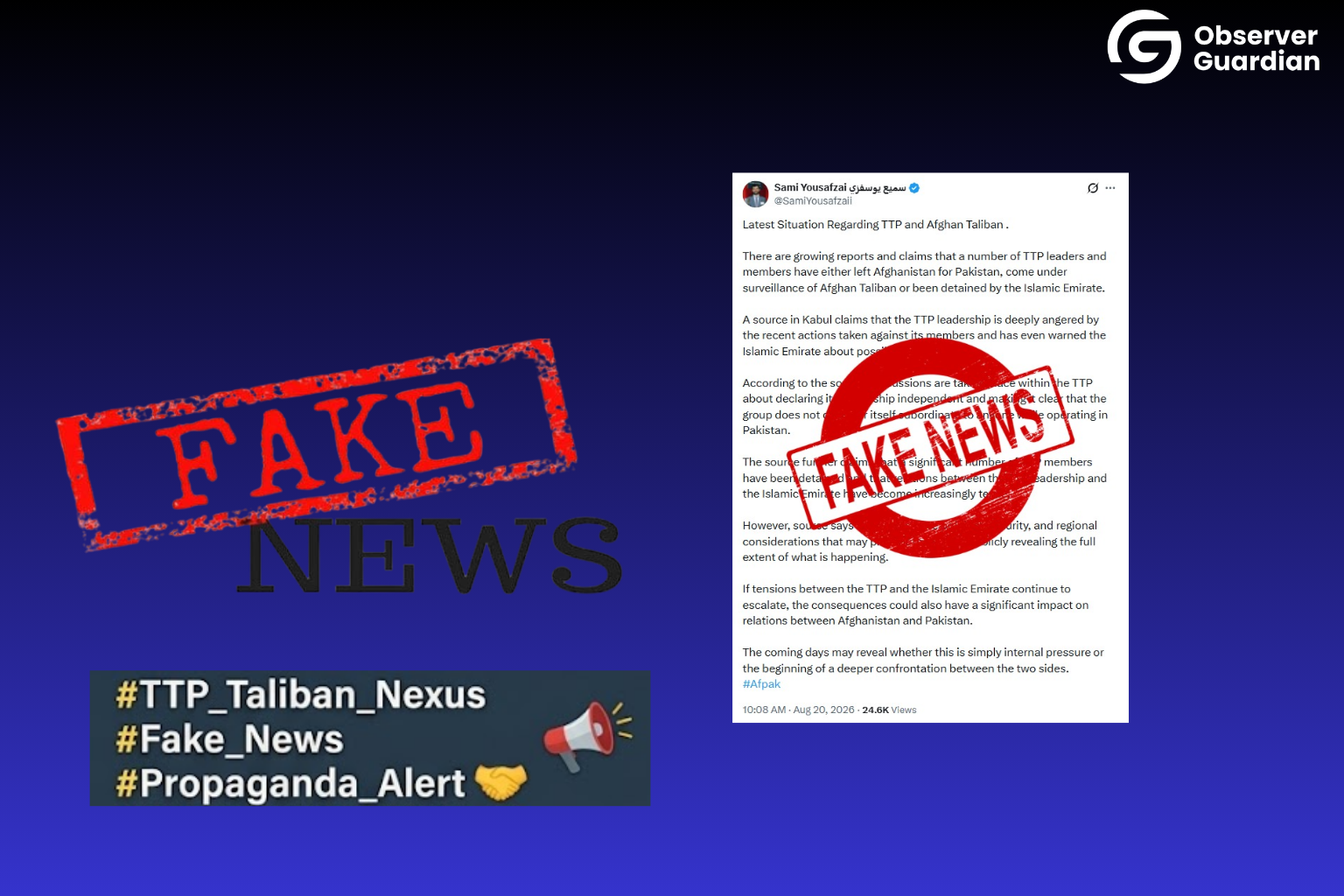
Into this context comes a tweet. A post by a journalist citing unnamed “sources in Kabul” claiming the Khawarij leadership is furious at the Islamic Emirate, that tensions are boiling over, that a split may be imminent. The tweet has been stamped “Fake News” for good reason. Let us trace the logic of why such a narrative serves the Afghan Taliban’s interests perfectly. If the world believes there is a genuine rift, Pakistan faces diplomatic pressure to “give peace a chance.” Counterterrorism operations are questioned. International scrutiny on Kabul softens. The Taliban gains breathing room all without actually dismantling a single Khawarij training camp or arresting a single commander of consequence.
According to the 38th UN Monitoring report, the Khawarij in March announced a spring offensive called “Operation Khyber,” calling for intensified attacks against Pakistani security forces and civilians. The group also announced a new structure that included two additional divisions and a unit described as the “TTP Air Force.” Does this sound like an organization under siege from its Afghan hosts? An organization being cracked down upon does not unveil a new expanded command structure and launch named offensive campaigns.
Al Qaida’s official media outlet, the As Sahab Media Foundation, published a statement in April supporting the Taliban and, for the first time, openly backing Khawarij operations against Pakistan a more direct stance than Al Qaida had previously taken publicly. The terrorist ecosystem in Afghanistan is deepening its coordination, not fracturing.
Genuine pressure on the Khawarij would look very specific. It would mean dismantling their command hierarchy, eliminating their training infrastructure across Kunar, Nangarhar, Khost and Paktika, cutting off their financing, and handing over known commanders to Pakistani authorities or international bodies. It would be verifiable, measurable, and irreversible. What is happening instead is theater a carefully curated impression of action designed to manufacture false reassurance while attacks against Pakistan continue unabated.
The Afghan Taliban seeks autonomy and has little incentive to rein in the Khawarij, which it sees as a loyal partner. That strategic reality has not changed. No tweet, no unnamed source, and no carefully seeded media narrative should be allowed to obscure it.
Pakistan’s security community, analysts, and policymakers must develop a clear and consistent standard: credibility is earned through verifiable action on the ground, not through backchannel whispers and social media theater. The manufactured propaganda of a Khawarij Taliban split is a distraction an elegant one, but a distraction nonetheless. The UN has spoken. The evidence is documented. The only question is whether the world will listen, or whether it will be fooled by a story that serves Kabul’s interests far more than it serves the truth.
The coming days may reveal more such narratives. Pakistan’s response must remain grounded in facts, not manufactured impressions.
Disclaimer: The views and opinions expressed in this article are exclusively those of the author and do not reflect the official stance, policies, or perspectives of the Platform.