
India entered its 2026 BRICS presidency with an ambitious message. New Delhi presented itself as a bridge between competing powers, an advocate for the Global South, and a country capable of giving greater coherence to an increasingly diverse grouping. Its stated priorities rested on resilience, innovation, cooperation and sustainability. Yet the expanded BRICS is now so politically diverse that managing differences has become almost as important as producing common initiatives. India’s experience during 2026 illustrates the central problem facing the grouping: enlarging BRICS has increased its geopolitical weight, but it has also made consensus considerably harder to achieve.
That contradiction became particularly visible at the BRICS foreign ministers’ meeting in New Delhi in May. Ministers could not agree on a joint statement because of disagreements surrounding the conflict involving Iran and tensions in the Gulf. Iran sought stronger language on the conflict, while relations between Tehran and Abu Dhabi added another layer of complexity. India eventually issued a chair’s statement rather than the usual consensus document.
For a presidency emphasizing continuity and consensus, the episode demonstrated how quickly competing regional interests could overwhelm diplomatic choreography
The incident was significant because BRICS works primarily through consensus. It is not a treaty-based alliance, does not possess a permanent secretariat and has no constitutive treaty comparable with those governing formal international organizations. Its effectiveness therefore depends heavily on members being willing to find common language and translate political declarations into practical cooperation. When consensus breaks down, the chair has limited institutional tools with which to compel agreement. India discovered that reality in May.
The economic agenda exposed a similar difficulty. Discussions about BRICS payment connectivity have continued for years, but ambitions have frequently moved faster than implementation. India pushed discussions on linking fast-payment systems and central bank digital currencies as a possible way of reducing the cost of cross-border transactions. Yet substantial technical and political barriers remain. Reuters reported in September that differences involving India, China, Iran and the UAE complicated progress toward deeper financial integration. India has supported payment interoperability while remaining cautious about arrangements that could increase its dependence on Chinese-controlled financial infrastructure.
This distinction matters. Much of the public debate surrounding BRICS has focused on dramatic ideas such as a common currency or a financial architecture capable of challenging the dollar. But the bloc’s official work has been more incremental. BRICS documents have emphasized local currencies, payment instruments, cross-border payment systems and greater interoperability rather than establishing an immediate single currency.
The 2025 Rio declaration itself called for continued discussion on cross-border payment initiatives rather than announcing a unified monetary system
India therefore spent much of its presidency confronting a structural question it could not solve through summit diplomacy alone. How can BRICS pursue deeper integration when its members have sharply different security relationships, economic systems and strategic priorities?
China sits at the centre of this dilemma. India and China are simultaneously major trading partners, competitors for influence across the Global South and states with unresolved strategic differences. Although both governments agreed in February to support each other’s BRICS presidencies in 2026 and 2027 and publicly described one another as development opportunities rather than threats, economic cooperation does not erase their wider strategic competition.
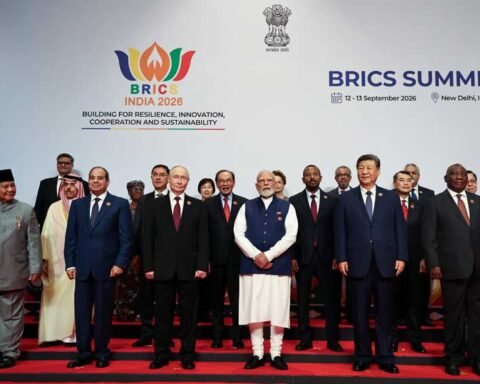
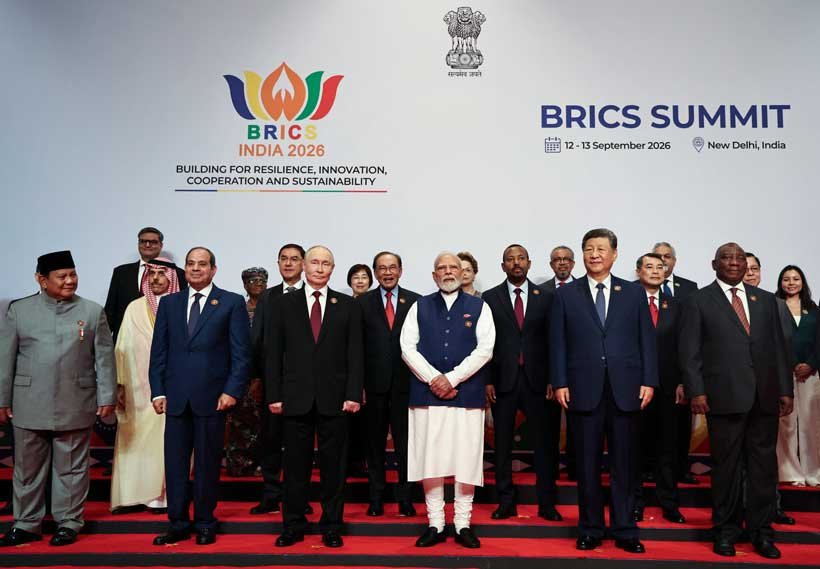
The September BRICS summit in New Delhi showed both sides of this reality. India succeeded in bringing leaders of an expanded grouping together and securing a lengthy consensus communiqué. BRICS finance ministers also agreed on language calling for reform of international financial institutions and more efficient cross-border payments.
These were genuine diplomatic outcomes, and they complicate any claim that India’s presidency produced nothing
At the same time, the summit highlighted China’s growing ability to shape the bloc’s economic agenda. President Xi Jinping used the New Delhi meeting to promote proposals covering artificial intelligence, special economic zones, services trade and wider economic cooperation. With China due to chair BRICS in 2027, Beijing will inherit many of the unresolved debates over payments, financial architecture and economic integration that India managed rather than settled.
There is also a wider contradiction in India’s position. New Delhi has developed increasingly important relationships with the United States, Europe, Japan and other Western partners while simultaneously presenting BRICS as an important platform for reforming global governance and amplifying the voice of developing economies. This is not necessarily inconsistent. Strategic autonomy has long allowed India to participate in overlapping partnerships.
But it becomes more difficult when other BRICS members seek forms of financial or geopolitical cooperation that India considers incompatible with its security interests
That is perhaps the most revealing lesson of India’s 2026 presidency. The principal obstacle was not poor conference management or insufficient diplomatic visibility. It was the political diversity of BRICS itself. Iran and the UAE bring their own regional disputes. India and China approach integration through the prism of strategic competition. Russia has priorities shaped by confrontation with Western powers, while other members prefer a less confrontational interpretation of BRICS.
India could organize summits, negotiate declarations and keep communication moving, but a rotating presidency cannot erase those contradictions. The experience of 2026 therefore demonstrates the difference between diplomatic visibility and institutional convergence. BRICS has undoubtedly become larger and more influential, but expansion has not automatically produced strategic unity. As China prepares to assume the presidency in 2027, the central question remains unresolved: whether BRICS can convert its expanding political profile into durable economic mechanisms acceptable to all of its increasingly diverse members.