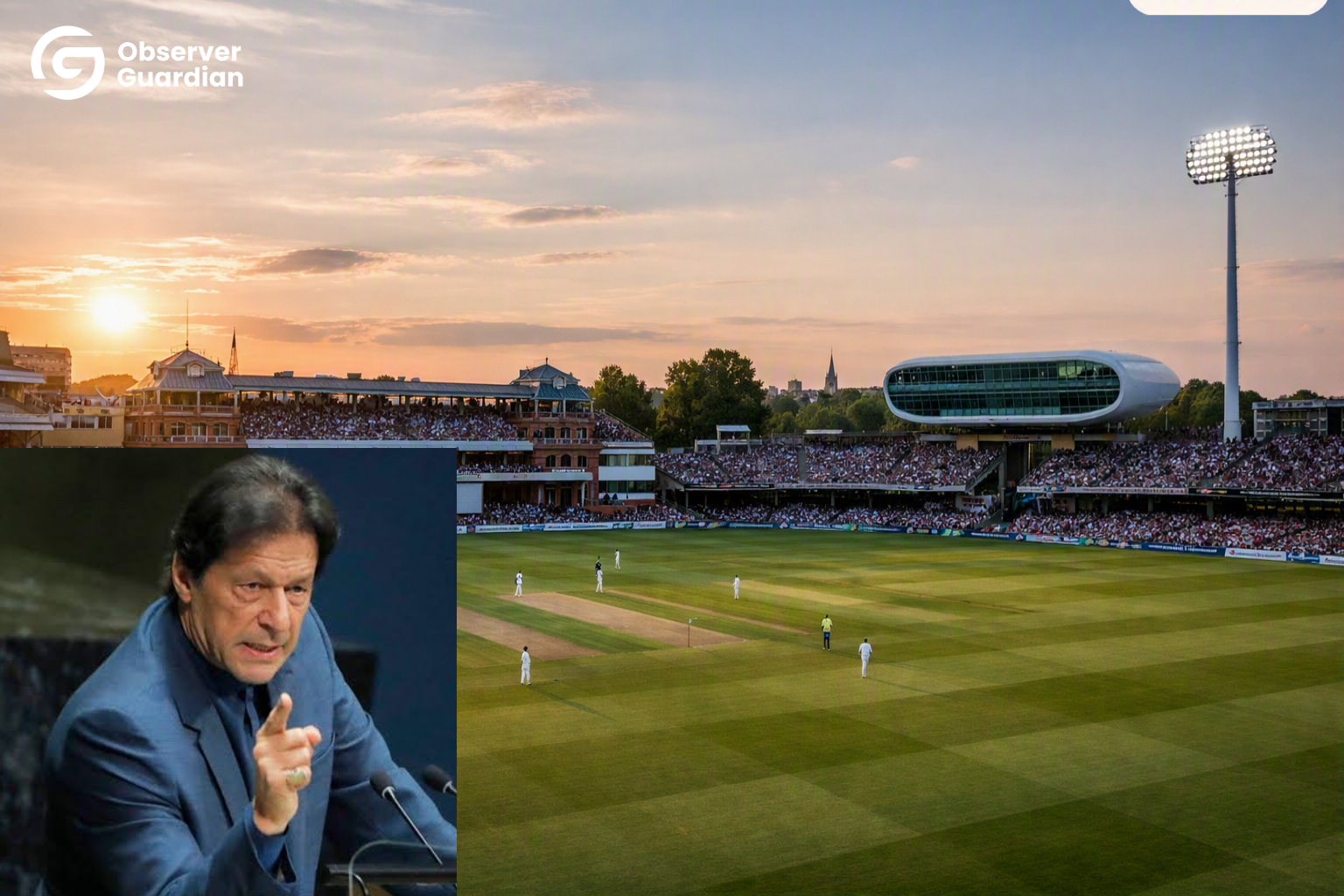
There is a reason cricket grounds have always been considered sacred spaces a place where rivalries dissolve into sporting contest, where nations meet on neutral turf, and where the only agenda that matters is twenty two yards of pitch. What happened at Lord’s on the opening day of the England Pakistan Test was a violation of that sacred compact, and the Pakistan Cricket Board (PCB) was absolutely right to push back.
The facts are straightforward, and by now widely reported. During the lunch interval of the second Test, Sky Sports aired an 18 minute pre recorded interview conducted by Michael Atherton a former England captain and current Sky Sports broadcaster with Kasim and Sulaiman Khan, sons of jailed former Prime Minister Imran Khan. The interview focused on their father’s health, his treatment in Adiala Jail, and their fears for his life. The PCB, which had formally warned Sky Sports ahead of the broadcast, threatened to keep its players in the dressing room for the second session. Pakistan ultimately took the field, but filed a formal complaint and rightly so.
Let us be precise about what occurred here. This was not an accidental editorial decision. Atherton had recorded the interview at the Lord’s Writers’ Room the day before the Test began, and Sky Sports had already aired promotional teasers leading into the match. The timing was deliberate, the placement calculated.
A cricket broadcast was used as a vehicle to run what amounts to a geopolitical segment on a sitting government’s judicial affairs. That is not journalism. That is activism dressed in a commentator’s blazer.
The regulatory framework on this is not ambiguous. Ofcom’s Broadcasting Code specifically Rules 5.5, 5.11, and 5.12 requires broadcasters to preserve due impartiality on matters of political controversy and current public policy. Pakistan’s handling of its own courts and its treatment of a convicted former prime minister is, unquestionably, a matter of live international political controversy. A one sided, 18 minute segment airing exclusively the claims of one party to that controversy, during a cricket broadcast watched by millions, is difficult to reconcile with those obligations. The ICC’s Code of Conduct similarly restricts players and officials from political statements and activities and the spirit of those rules extends to the broadcast infrastructure surrounding the game.
Atherton’s personal position makes the conflict of interest glaring. He is among the 22 former international cricket captains a list that includes Allan Border, Sunil Gavaskar, Kapil Dev, Alastair Cook, and Adam Gilchrist who signed a letter to Prime Minister Shehbaz Sharif calling for Imran Khan to receive proper medical treatment. That letter, which also carried signatures from cricketing giants like Steve Waugh and Clive Lloyd, expressed genuine humanitarian concern. Fine. Former athletes have every right to speak on human rights matters, and they should do so on appropriate platforms. But Atherton cannot simultaneously sign an advocacy letter and then conduct a sympathetic interview during a live Test match and claim he is functioning as a neutral sports broadcaster. Those two roles are irreconcilable, and presenting them as compatible insults the audience’s intelligence.
There is also a double standard worth naming plainly. The same Western broadcasting ecosystem that found space during a cricket lunch break to run a political segment about a Pakistani politician has not given comparable attention during sporting broadcasts or otherwise to the killing of Palestinian children in Gaza, or to credible and extensively documented human rights violations in Indian occupied Kashmir. If humanitarianism is genuinely the motivation, one might ask why that compassion is so geographically selective. When concern follows political alignment rather than human suffering, it stops being humanitarian concern. It becomes something else.
The narrative around the Goldsmith connection also deserves scrutiny. Kasim and Sulaiman Khan also known by their mother Jemima Goldsmith’s surname, Niazi Goldsmith have been active on Western media platforms advancing their father’s cause. This is their right as his sons. But the claim that they cannot visit their father in Pakistan needs to be examined honestly. Both reportedly hold valid NICOPs Pakistani national identity documents with validity extending well into the 2030s. As Pakistani citizens, they are entitled to enter the country without a visa. The narrative of enforced separation from their father, while emotionally compelling for international audiences, is not supported by their actual legal status.
The broader point is about what Pakistan’s courts have and have not done. Imran Khan has had nearly 500 court appearances. He has received dozens of medical examinations. He has had hundreds of visitors and media meetings during his incarceration. This is not a picture of a man being disappeared in silence. Pakistan’s judiciary is handling his case through its established legal processes processes that, whatever their imperfections, are the legitimate mechanisms of a sovereign state. That sovereignty deserves respect, not circumvention through cricket broadcasts.
The PCB should be commended for the firmness of its response. Walking out would have been a dramatic escalation, but the board was justified in making clear that it will not allow Pakistan’s national team to become stage furniture for a political campaign. The ECB owes a public explanation for how an international match environment under its administration became the setting for this controversy. And Sky Sports, which operates under UK broadcasting law, needs to account for how this segment cleared its editorial processes.
Going forward, the ICC must establish a clearer precedent. International sport is one of the few remaining spaces that transcends political divisions and that neutrality has value precisely because it is jealously guarded.
Once cricket grounds and cricket broadcasts become extensions of political campaigns, something irreplaceable is lost. Keeping that space clean is not censorship. It is stewardship.
Michael Atherton’s humanitarian instincts may be genuine. But there is a time and a place for everything and a cricket Test match is neither the time nor the place to run an intervention in a sovereign state’s domestic legal affairs. Cricket must remain what it has always been a game, and nothing more.
Disclaimer: The views and opinions expressed in this article are exclusively those of the author and do not reflect the official stance, policies, or perspectives of the Platform.