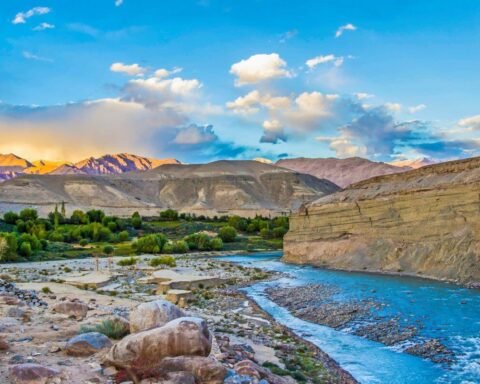
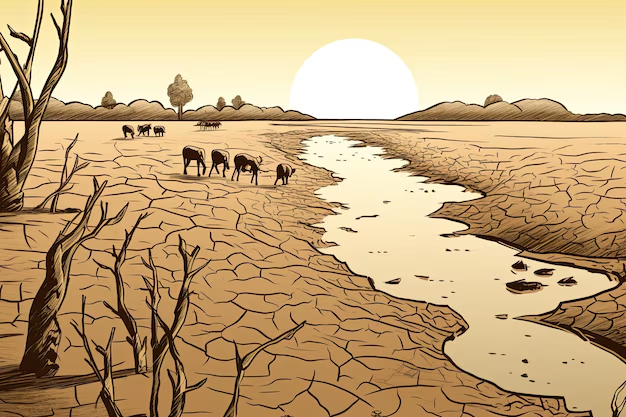

The Indus, Amu Darya, Syr Darya, and numerous tributaries throughout Central and South Asia are fed by glaciers that have long functioned as natural reservoirs in Asia’s highest mountains. These frozen water towers are melting at previously unheard-of rates today, changing hydrological cycles and increasing risks for communities whose livelihoods depend on steady flows. A significant move toward coordinated regional climate resilience is indicated by the Asian Development Bank’s new “Glaciers to Farms” initiative, which is supported by $250 million from the Green Climate Fund and supplemented by concessional financing like the recent $48 million loan to improve Balochistan’s water storage. It is an acknowledgment that in glacier-fed basins, dispersed adaptation efforts are no longer able to keep up with the escalating environmental threats.
The fundamental concept of “Glaciers to Farms” is straightforward but revolutionary: the patchwork of short-term, localized interventions that have characterized climate adaptation in the area for decades must give way to long-term, basin-wide planning. Both the effects of glacier retreat and the river systems of Pakistan and Central Asia transcend national borders. Nine nations make up the regional strategy, which offers the chance to coordinate data, coordinate policy decisions, and steer clear of adaptation strategies that help one region while unintentionally hurting another.
One of the program’s most important contributions is this move toward systemic thinking. It transforms climate planning into proactive risk governance rather than reactive crisis management
The initiative’s strong reliance on grant-based funding recognizes a fact that is frequently disregarded in development discourse: frontline communities that face severe climate risks are the least able to take on debt. Rural households, particularly those headed by women farmers, already struggle to make ends meet in many glacier-dependent areas. Traditional livelihoods become more vulnerable as river flows become more unpredictable, first rising with accelerated melt and then falling as glaciers recede. The breathing room required to invest in adaptation measures without burdening vulnerable groups is provided by grants. In a time when those who have contributed the least to global emissions are disproportionately affected by climate impacts, this is not only economically wise but also morally necessary.
The program’s agricultural strategy is centered on increasing storage capacity, restoring watersheds, and improving irrigation efficiency. Despite their technical sound, these interventions have significant social ramifications. For instance, persistent water scarcity has reduced agricultural productivity and pushed rural communities farther into poverty in Pakistan’s Balochistan province. Reducing reliance on diminishing groundwater supplies and stabilizing supply during dry spells can be achieved by fortifying reservoirs and diversifying water storage. Modernizing irrigation systems can cut the water losses that currently afflict Soviet-era canals in half throughout Central Asia, guaranteeing more dependable deliveries to farmers downstream.
Future generations who will inherit a harsher climate will also benefit from such investments, which increase resilience for farmers today
However, a crisis caused by quickly shifting hydrological patterns cannot be solved by physical infrastructure alone. For governments to manage the uncertainties of glacier retreat, strong scientific capacity is crucial. “Glaciers to Farms” allocates funds to climate and water research institutions so they can produce more precise forecasts and incorporate these findings into planning frameworks. Countries can prevent maladaptation, such as investing in crops unsuited to future water availability or building infrastructure in areas susceptible to glacial lake outburst floods, by coordinating national development strategies with new scientific findings.
There is a drive to improve social protection programs and early warning systems concurrently with these scientific investments. Deadly climate-related disasters have already struck the region, ranging from devastating floods in Pakistan to extreme heat in Central Asia. Timely alerts and well-funded safety nets are essential tools for maintaining life and safeguarding livelihoods as climate volatility increases. By combining river-level forecasting with glacial monitoring, early warning systems can provide downstream communities with the necessary time to protect assets or evacuate.
When local economies are disrupted by heatwaves, crop failures, or floods, social protection programs, cash transfers, work programs, and insurance plans provide a buffer
The initiative’s emphasis on enabling regional financial institutions to support women-led agricultural businesses is a noteworthy innovation. Despite playing crucial roles in farming in many rural areas, women are still disproportionately underbanked. Risk-sharing tools, lender capacity building, and customized financial products can boost community resilience and unleash entrepreneurial potential. Supporting women farmers guarantees that adaptation strategies take into account a variety of knowledge systems and social realities. Climate adaptation works best when it is locally owned.
In the end, “Glaciers to Farms” stands out for its dedication to coordinated action across nine nations with interconnected water systems and comparable ecological threats. Pakistan’s farmlands are impacted by the Pamirs’ climate, and policies in one area of the basin have an impact on food security in another. A unified framework for sustainable water governance, based on cooperative planning, shared data, and shared accountability, establishes a new standard for regional collaboration in the face of climate stress.
It builds the institutional framework needed to handle water scarcity as a shared problem that calls for cooperation rather than as a singular national emergency
The water-stressed areas of Asia are at a critical juncture. Once a far-off worry, glacier retreat is now changing economies, uprooting communities, and endangering continental food production. The “Glaciers to Farms” initiative by the Asian Development Bank is an example of a change in the scope of action required by this crisis. The program establishes the foundation for climate-resilient development by combining scientific understanding, infrastructure modernization, financial inclusion, and regional cooperation. Although there is a lot of work ahead, Asia can use coordinated, well-funded, and community-centered strategies to turn its most urgent climate risks into a catalyst for shared regional stability and long-term sustainability.