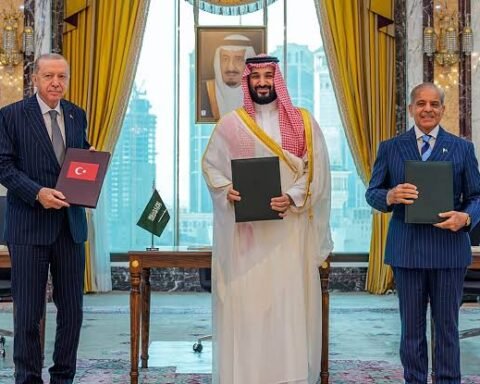
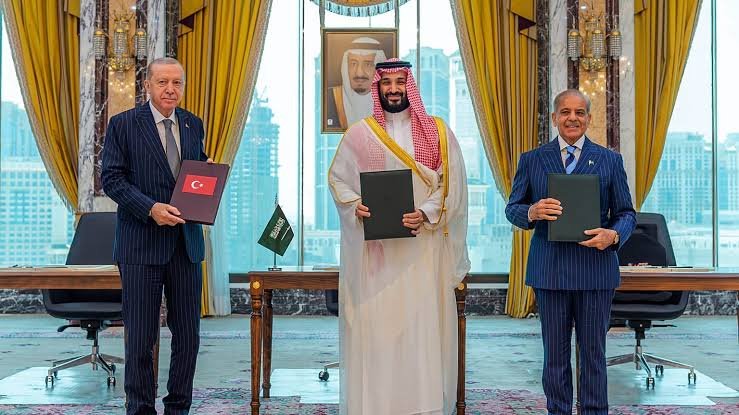

The Makkah Joint Defence Agreement between Pakistan, Türkiye and Saudi Arabia has arrived at a time when the wider region is searching for something it has lacked for years, predictability. Signed in Makkah on 7 August 2026, the agreement establishes a collective defence principle under which an armed attack against one of the three states will be treated as an attack against all. Its declared objectives include stronger deterrence, deeper defence cooperation and greater regional security.
That provision naturally attracts attention because it changes the strategic calculations surrounding three influential states. Yet concentrating only on the military dimension would miss the larger opportunity. The more consequential question is what Pakistan, Türkiye and Saudi Arabia intend to do with the stability that stronger deterrence may provide.
Security has value when it protects societies from war, but it becomes transformative when it creates conditions in which investment, trade, employment and development can flourish
The three countries enter this arrangement with markedly different strengths. Saudi Arabia possesses financial capacity, energy resources and growing international investment ambitions. Türkiye combines industrial depth, engineering expertise and an increasingly capable defence technology sector. Pakistan contributes considerable military experience, a large workforce, agricultural and mineral resources and a strategic location connecting South Asia with the Arabian Sea, China, Central Asia and the Gulf.
This makes the relationship unusually complementary. The same countries cooperating on strategic deterrence could cooperate far more ambitiously on industrial production, infrastructure, energy, food security and technology. Saudi capital combined with Turkish technical expertise and Pakistani industrial and human capacity could generate commercial ventures whose importance would extend far beyond defence.
There is a strong case, therefore, for creating an economic pillar alongside the security pillar of the agreement. A permanent trilateral economic council could bring together finance ministers, investors, industrialists and development institutions.
Its job should not be to produce another series of ceremonial declarations. It should identify a limited number of bankable projects and follow them through to implementation
Energy should be an obvious starting point. All three states have different but overlapping interests in energy security. Saudi Arabia remains a major energy producer while investing heavily in new sectors. Türkiye sits at the crossroads of important energy routes and has developed substantial engineering capacity. Pakistan continues to seek affordable and reliable energy for industrial expansion. Joint investment in renewable energy, electricity infrastructure, refining, storage and energy technology could directly strengthen economic resilience.
Food security offers another avenue. Pakistan possesses considerable agricultural potential, while Gulf states attach high strategic importance to secure food supplies. Turkish expertise in agricultural machinery, irrigation and food processing can add value between farm and market. A trilateral agricultural strategy could encourage investment in modern farming, cold storage, processing, logistics and export chains rather than focusing narrowly on the purchase of agricultural land or commodities.
Connectivity could produce an even larger dividend. Pakistan’s ports and transport corridors, Saudi Arabia’s position on major global maritime routes and Türkiye’s proximity to European markets create the geographical components of a wider commercial network.
It would be premature to describe these assets as a single corridor today, but strategic cooperation could gradually make movement between South Asia, the Gulf and Türkiye more efficient
This matters because security and commerce are closely connected. Ships do not distinguish between geopolitical theory and business risk. Investors do not treat political instability as an abstract academic concept. When ports are threatened, sea lanes become insecure or military confrontation appears likely, insurance premiums rise, shipping becomes more expensive and investment decisions are delayed. The economic cost eventually reaches households through higher prices and weaker job creation.
The current agreement is also important because its architects have sought to avoid presenting it as an offensive bloc. Turkish Foreign Minister Hakan Fidan has said that it is not directed against Iran or any other specific state. He has also explained that, although its collective defence principle resembles NATO’s Article 5 in technical terms, the nature and scale of assistance would be decided through consultations depending on the circumstances. That flexibility should be treated as a strength. Regional stability will not be served if the agreement produces another rigid line dividing one group of countries from another.
Its most constructive role would be to raise the cost of aggression while lowering the political incentive for conflict
Pakistan, in particular, has an interest in such an outcome. Islamabad benefits from strong relations with Riyadh and Ankara but also requires stable relations across the Gulf and the wider Middle East. It should therefore encourage the emerging partnership to combine deterrence with mediation, crisis communication and diplomatic engagement.
The wider diplomatic environment already provides some foundation for this approach. Pakistan, Türkiye and Saudi Arabia have participated with Egypt in an R4 consultative process dealing with regional and international developments. The four foreign ministers met in Cairo in June 2026, demonstrating that the three signatories already operate within a broader framework of political consultation.
That experience could ultimately prove just as important as the defence clause itself. The Middle East, Gulf and surrounding regions do not suffer from a shortage of military capability. They suffer from weak mechanisms for managing crises before those crises become wars.
A mature partnership should consequently build institutions for both purposes. Defence ministries can coordinate deterrence while foreign ministries strengthen mediation mechanisms. Intelligence agencies can cooperate against terrorism while economic ministries promote trade.
Armed forces can prepare for emergencies while humanitarian agencies develop joint capabilities for disaster relief and evacuation
Public welfare must remain the final measure of success. Citizens will not judge the agreement by communiqués issued after summit meetings. They will judge it by whether their economies become more stable, employment expands, energy becomes more secure and regional conflict becomes less frequent.
This is why the Makkah agreement should be understood as a beginning rather than an end. The defence commitment creates strategic confidence. The next task is to convert that confidence into productive economic cooperation.
Pakistan, Türkiye and Saudi Arabia have an opportunity to demonstrate that collective security need not end with military deterrence. It can provide the protected political space in which roads are built, factories open, universities collaborate, investors take risks and young people find opportunities at home. A defence pact may prevent a war. A development compact can change a generation. The real achievement will come if the three countries manage to do both.