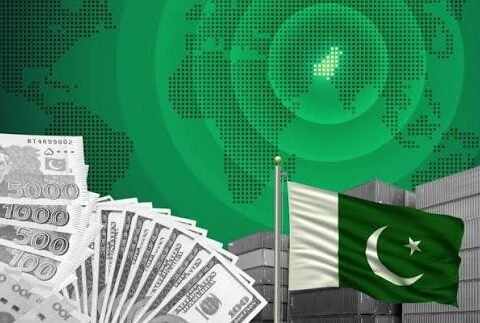

Pakistan’s economic debate has spent so long revolving around default fears, collapsing reserves, runaway inflation and exchange-rate turmoil that a change in direction can be easy to miss. Yet the evidence now points to something more substantial than temporary relief. Across growth, inflation, remittances, reserves and currency stability, Pakistan has moved from acute crisis management toward a more credible phase of stabilization and recovery. The improvement is not complete, and it is certainly not irreversible, but the economy today is operating from a stronger base than it was two years ago.
The clearest signal is economic growth. Pakistan’s final GDP growth rate for FY2023/24 was 2.62 percent, rising to a revised 3.18 percent in FY2024/25. For FY2025/26, the Pakistan Bureau of Statistics has provisionally estimated growth at 3.70 percent. This is not the kind of expansion that can transform living standards overnight, but the direction matters. Successive improvements suggest that productive activity is gradually recovering and that stabilization measures are beginning to feed into the real economy. Services have been particularly important, while industry has also regained some momentum.
Inflation tells an equally important story, although it requires careful interpretation. Average consumer inflation fell dramatically from 23.4 percent in FY2023/24 to about 4.5 percent in FY2024/25. It then averaged 7.05 percent in FY2025/26. That increase in the latest year shows that price pressures have not disappeared, especially after energy and commodity shocks. Even so, Pakistan is far removed from the inflation crisis that severely eroded household purchasing power only a short time ago.
Lower and more predictable inflation improves business planning, reduces uncertainty and gives monetary authorities greater room to support economic activity without losing sight of price stability
Perhaps the strongest pillar of the recovery has been the external sector. Workers’ remittances rose from roughly $30.3 billion in FY2023/24 to $38.3 billion in FY2024/25 and then reached a record $41.6 billion in FY2025/26. This is more than a statistical achievement. Remittances finance household consumption, support the balance of payments and provide a relatively dependable source of foreign currency. Their rise has helped Pakistan absorb a widening trade gap without returning to the severe external financing pressure seen during earlier crisis periods.
The current account also demonstrates how much the country’s external position has changed. Pakistan moved from a deficit of around $2 billion in FY2023/24 to a surplus of $1.84 billion in FY2024/25. In FY2025/26, the account slipped into a marginal deficit of only $139 million. That is not a surplus, but it is close to balance and remains modest in relation to the size of the economy. More importantly, Pakistan is no longer confronting the kind of external imbalance that previously forced repeated emergency adjustments, import restrictions and rapid depletion of foreign-exchange buffers.
Foreign-exchange reserves reinforce that point. Official reserves, which stood around $9.4 billion at the end of FY2023/24, have strengthened considerably. By early August 2026, State Bank reserves had risen above $17 billion, while total liquid foreign-exchange reserves were close to $22.5 billion. At the same time, the rupee has remained remarkably stable compared with the volatility of previous years, trading around Rs278 to the dollar in August.
After years in which currency shocks rapidly fed into fuel, food and imported input prices, this stability carries real economic value. It improves predictability for importers, exporters, investors and households
There are, however, limits to how triumphantly these numbers should be read. Pakistan still carries a heavy public and external debt burden. Export growth remains too weak, investment is insufficient, the tax base is narrow, energy-sector liabilities continue to weigh on public finances, and millions of households have not yet experienced macroeconomic stabilization as meaningful prosperity. Lower inflation does not mean prices have returned to previous levels. Nor does growth of 3.7 percent automatically create enough productive jobs for a young and rapidly expanding population. Recovery should therefore be understood as progress, not as economic transformation.
That is why the next phase may prove more difficult than the first. Stabilization was primarily about preventing disorder. Recovery must now be about expanding productive capacity. Pakistan needs policies that reward exporters, encourage private investment, improve energy efficiency, strengthen tax administration, support small and medium enterprises and raise agricultural and industrial productivity. Greater emphasis must also be placed on technology, skills and export diversification so that the economy earns more foreign exchange through competitiveness rather than depending excessively on borrowing or import compression.
Policy continuity is equally important because repeated reversals have historically weakened confidence just when economic momentum begins to return
Pakistan has not solved all of its economic problems, but it has created valuable breathing space. The country now has stronger reserves, record remittances, a more stable currency, substantially lower average inflation than during the crisis years and a gradually improving growth trajectory. Those gains demonstrate what disciplined fiscal, monetary and external-sector management can achieve when maintained over time.
The real test is what Pakistan does with this stability. Macroeconomic statistics ultimately matter because of their impact on ordinary lives. Recovery must appear in better wages, new businesses, stronger exports, productive employment and greater opportunities for younger Pakistanis. If stability becomes the foundation for sustained structural reform rather than an excuse for complacency, Pakistan’s present recovery could mark not merely the end of another crisis, but the beginning of a more durable economic turn.