
The recent tensions involving India and Iran offered a clear lesson in how states behave when pressure rises. Reports that India had seized three Iranian vessels in the Indian Ocean, followed by Iran’s detention of two Indian ships, created the sort of standoff that can unsettle an already fragile region. Yet the outcome was not driven by emotion, slogans, or public outrage. It was driven by interest. The arrangement that later allowed the vessels to return through the Strait of Hormuz showed that when strategic costs become serious, countries act with calculation. That matters because the Strait of Hormuz carries nearly one-fifth of global oil shipments. Any disruption is not just a regional issue. It is a question of energy stability, market confidence, and global economic risk. In the real world, states protect their interests first. Pakistan should remember that lesson and apply it inward as much as outward.
For Pakistan, the deeper concern is not only what happens between other states. It is what happens inside our own national conversation whenever regional tensions rise. Too often, moments that should call for calm and solidarity instead become opportunities for internal attacks on the state, the armed forces, or national institutions as a whole. Criticism has its place in any society, and no serious country should fear debate. But there is a line between responsible criticism and narrative warfare that weakens the country from within. That line becomes even more important in a time when geopolitical competition is no longer limited to borders, missiles, or armies.
Modern conflict is increasingly fought through perception, disinformation, emotional manipulation, and the deliberate widening of internal divisions
This is the age of hybrid warfare, and one of its first objectives is simple: fracture public opinion. A divided society is easier to pressure, easier to mislead, and easier to destabilize. Countries are no longer targeted only through direct military confrontation. They are targeted through rumor, suspicion, digital propaganda, and campaigns designed to make citizens lose trust in one another and in the state itself. Once that trust breaks down, external actors do not need to do much more. The damage begins to reproduce itself from within. That is why internal narrative conflict is not a minor political issue. It is a national security issue. In the modern era, cohesion is not just a social virtue. It is a strategic shield.
Pakistan’s location makes this even more urgent. Ours is not a peripheral state sitting far from the major currents of world politics. Pakistan stands at the meeting point of South Asia, Central Asia, and the Middle East. It sits near vital sea lanes, major trade routes, contested borders, and fault lines of great power rivalry. This geostrategic position gives Pakistan importance, but it also brings constant scrutiny and pressure. A country in such a position cannot afford to be careless with its internal stability. National cohesion is not a luxury for Pakistan. It is the basis of credible statecraft.
A fragmented nation sends a message of weakness. A united nation sends a message that it cannot be pushed, manipulated, or isolated easily
History already supports this view. Pakistan has endured decades of terrorism, regional instability, economic strain, and relentless geopolitical competition. It has faced moments that would have broken weaker states. Yet despite all this, the country’s institutional framework and social fabric have held. That endurance did not happen by accident. It came from the resilience of ordinary people, from institutions that remained standing under pressure, and from a deep national instinct for survival. Pakistan has paid a heavy price for its security challenges, but it has not collapsed under them. That should be a source of realism and pride. It should also be a reminder that the nation is strongest when it resists the temptation to tear itself apart during difficult moments.
Unity, of course, does not mean silence. It does not mean blind agreement, nor does it mean treating every question as disloyalty. A mature national discourse allows debate, demands accountability, and leaves room for correction. But responsible discourse also understands timing, consequence, and scale. When a region is tense, when hostile narratives are circulating, and when adversaries are watching for cracks, citizens have a duty to think beyond party lines and personal anger. Not every frustration needs to be turned into a national spectacle. Not every grievance should be framed in a way that serves those who benefit from Pakistan looking broken. Sovereignty is not defended only at borders.
It is also defended in language, in civic restraint, and in the refusal to become an echo for narratives that damage the country’s long-term stability
There is also a practical diplomatic side to unity. Countries that remain composed and united during regional tensions increase their leverage abroad. Foreign governments take them more seriously. Allies trust them more. Adversaries calculate more carefully. Strategic credibility is built not only through military strength or economic capacity, but also through internal discipline. A state that appears divided in public loses room to negotiate from strength. A state whose people understand the value of cohesion gains weight at the table. In international politics, perception matters. Nations that look stable are treated differently from nations that look consumed by internal conflict.
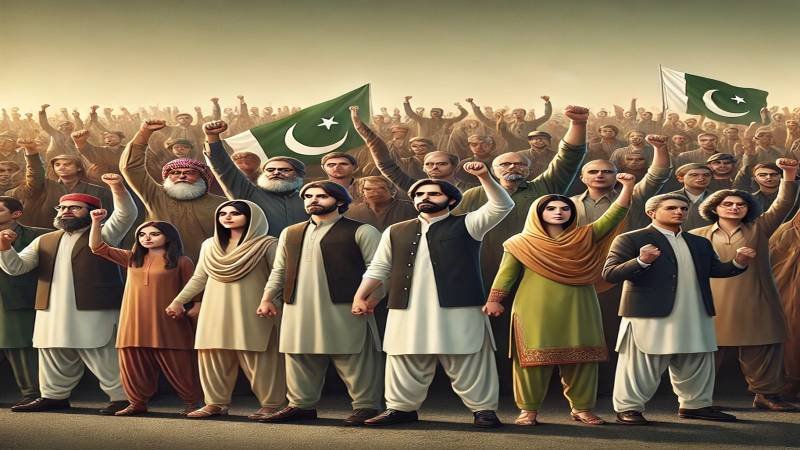
Pakistan today does not need louder internal battles. It needs a clearer national instinct. In an era shaped by information warfare, psychological pressure, and strategic competition, unity is not a slogan to be repeated on ceremonial days. It is a living requirement of survival. Our debates must be real, but they must also be responsible. Our political differences may remain, but they must not erase the larger truth that Pakistan comes first. No party, personality, or trend on social media is more important than the sovereignty and continuity of the state. When citizens lose sight of that, they make the work of hostile actors easier.
The principle is simple, but it is also deeply strategic. When Pakistan stands united, external pressure loses force. When Pakistan speaks to itself with discipline and confidence, hostile narratives lose space. When Pakistan protects its cohesion, it protects its future. In a dangerous region and a harsher world, that may be the most important shield the nation has.