India’s relationship with Israel is often presented as a pragmatic partnership built around defence, technology, and counter-terrorism. Yet in the shadow of Gaza’s destruction, this relationship can no longer be treated as an ordinary alliance between two states. It has become a moral question. India is not merely buying weapons from Israel or exchanging intelligence cooperation. It is helping normalize a state whose military conduct in Gaza has been condemned by large sections of the global public, human rights advocates, and many legal scholars as genocidal. The complicity is not only diplomatic or military. It is also social and cultural, visible in India’s tourist enclaves, where Israeli soldiers and ex-soldiers are welcomed after military service as ordinary backpackers seeking peace, spirituality, and escape.
Israeli youth have long followed what is widely known as the “big trip” after completing mandatory military service. India is one of the major destinations on this route, especially places such as Kasol, Dharamkot, Goa, Pushkar, and Varanasi. These journeys are often romanticized as harmless travel: young people recovering from the pressures of military life, discovering themselves, eating hummus in the Himalayas, joining beach parties in Goa, or seeking spiritual relief in ashrams and mountain villages. But this framing hides a harsher reality. Many of these travellers have just emerged from a military system that enforces occupation, siege, and violence against Palestinians.
When India becomes a comfortable retreat for them, it becomes part of the ecosystem that allows Israeli militarism to rest, recover and reproduce itself
The cultural presence of Israelis in India is now highly visible. Dharamkot and nearby areas are often called “Mini Israel” because of the concentration of Israeli tourists, Hebrew signs, Israeli-style cafés, and businesses catering directly to them. In Pushkar, shopkeepers speak basic Hebrew and restaurants adapt menus to Israeli tastes. In Varanasi and other tourist hubs, food, signage, and services are shaped around Israeli visitors. Goa’s party circuits have long attracted international tourists, including Israelis. Kasol has also acquired a reputation as a favoured Israeli destination. None of this is accidental. It reflects a deep pattern in which India functions as a post-service decompression zone for Israeli society.
The issue is not the presence of ordinary tourists. The issue is normalization without accountability. A soldier who has served in an army accused of devastating Gaza can arrive in India and be absorbed into a landscape of hospitality, spirituality, and leisure. This produces a disturbing moral contrast: Palestinians in Gaza are trapped under bombardment, blockade, and displacement, while those connected to Israel’s military culture find rest in India’s valleys, beaches, and religious towns.
For Palestinians, this appears as impunity with a backpack. For Kashmiris, the symbolism is even more direct
India’s defence relationship with Israel deepens this complicity. India is among Israel’s largest arms buyers, purchasing drones, missiles, surveillance systems, and border technologies. These are not neutral products. Israel’s defence industry has long benefited from the claim that its weapons and security systems are “battle-tested.” The battlefield, too often, has been Palestinian land. Gaza, the West Bank, and the occupied territories become laboratories where techniques of surveillance, targeting, crowd control, and urban warfare are refined. When India buys these systems, it helps reward the very military-industrial structure that profits from Palestinian suffering.
This connection is particularly troubling in Indian Illegally Occupied Jammu and Kashmir. Critics argue that India has adopted or admired aspects of the Israeli model of control: heavy surveillance, drones, communication shutdowns, movement restrictions, aggressive counter-insurgency, punitive demolitions, and demographic engineering after the revocation of Article 370. Gaza and Kashmir are not identical, and every conflict has its own history. But the similarities in method are hard to ignore. Both involve populations framed primarily as security threats. Both involve territorial control justified through counter-terrorism language.
Both involve the use of law, military power, and surveillance to manage a Muslim population seen as politically inconvenient
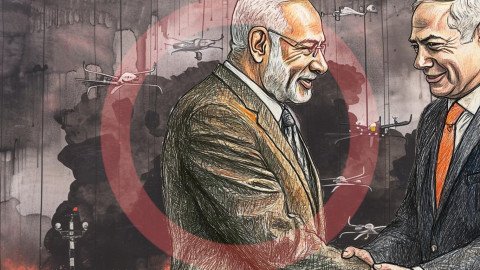
This is where ideology becomes central. Narendra Modi’s India and Benjamin Netanyahu’s Israel share more than strategic interests. They share a political imagination rooted in majoritarian nationalism. Both projects portray themselves as ancient civilizations under siege. Both mobilize fear of Muslims to consolidate domestic power. Both use security language to justify policies that critics describe as discriminatory, colonial, or oppressive. In Israel, Palestinians are treated as demographic and security threats. In India, Muslims and Kashmiris are increasingly cast through similar suspicion. The result is a natural affinity between Hindutva politics and Zionist militarism.
India’s official rhetoric may still speak of peace and stability, but its actions tell another story. A state cannot claim moral distance from Gaza while buying Israeli weapons, learning from Israeli security practices, and hosting Israeli military culture in its own tourist spaces. Complicity does not require firing the weapon directly. It can mean financing the weapons maker.
It can mean giving social comfort to those who served the machinery of occupation
The Gaza genocide has exposed the architecture of global support that sustains Israel. That architecture includes weapons suppliers, political allies, media defenders, trade partners, and cultural normalizers. India now occupies a significant place in that architecture. Its relationship with Israel is not a side issue; it is part of the broader system that enables Palestinian suffering. To oppose what is happening in Gaza honestly, one must also question those who empower Israel materially and ideologically. India is one of them.