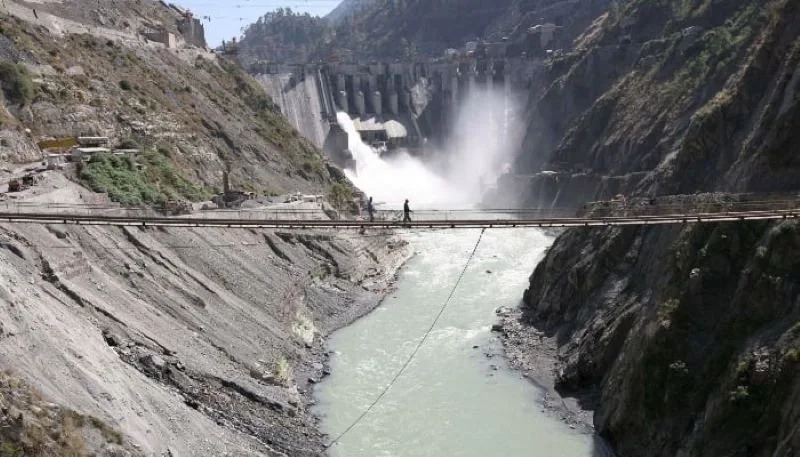
India’s approval of the Dulhasti Stage-II Hydroelectric Project on the Chenab River system is not merely another entry in its expanding hydropower portfolio. It is a politically loaded decision taken at a moment when the Indus Waters Treaty has already been pushed into deep uncertainty. The 260 MW run-of-the-river project, cleared by India’s Expert Appraisal Committee for Jammu and Kashmir’s Kishtwar district, is valued at Rs 3,277.45 crore and involves a 3,685-metre headrace tunnel, surge and pressure shafts, pondage arrangements, and an underground powerhouse with two 130 MW units. The official project record also identifies a total land requirement of 60.30 hectares, including 8.27 hectares of private land.
On paper, Dulhasti Stage-II is presented as a run-of-the-river scheme, a category often described as less intrusive than large storage dams. Yet in a transboundary basin marked by distrust, even “non-storage” infrastructure can acquire strategic significance. Tunnels, pondage, gated structures, and power-generation scheduling can alter the timing and predictability of flows, especially during lean seasons. For Pakistan, which depends heavily on the Indus Basin irrigation system, the issue is not only whether India permanently diverts water, but whether upstream control can create uncertainty for sowing calendars, canal operations, hydropower planning, and food security.
The concern is sharpened by the treaty context. The Indus Waters Treaty, brokered by the World Bank in 1960, allocated the western rivers, Indus, Jhelum, and Chenab, largely to Pakistan, while allowing India certain limited uses, including hydropower generation under defined conditions. That framework worked not because it eliminated conflict, but because it institutionalized predictability. It required technical exchanges, inspections, notifications, and dispute-resolution mechanisms.
Once India placed the treaty “in abeyance” after the April 2025 Kashmir attack, the political meaning of every new upstream project changed
This is why Dulhasti Stage-II cannot be viewed in isolation. It forms part of a broader pattern of upstream infrastructure expansion on the Chenab and its tributaries, including projects that Pakistan has historically scrutinized for design, pondage, spillway, and operational implications. India argues that it has the right to develop hydropower within treaty limits. That argument would carry more credibility if New Delhi were simultaneously strengthening transparency. Instead, the suspension of cooperative obligations has weakened the very confidence-building architecture that once made such projects manageable.
For Pakistan, the Chenab is not an abstract river line on a diplomatic map. It is a working artery of agriculture, energy, and rural livelihoods. The timing of flows matters as much as total annual volume. A short disruption during a critical crop stage can be more damaging than a larger variation during a non-critical period. In this sense, additional upstream control, even without formal diversion, can become a tool of pressure.
The danger lies not only in what India may do today, but in the capacity it is steadily acquiring for tomorrow
India’s posture also risks normalizing a dangerous principle: that transboundary water cooperation can be suspended as a coercive response to political disputes. If accepted, this logic would erode one of South Asia’s few durable conflict-management mechanisms. The Indus Waters Treaty survived wars, crises, and diplomatic breakdowns precisely because water was treated as too essential to be held hostage to every political shock. Weakening that separation introduces instability into a region already facing climate stress, glacial uncertainty, erratic monsoons, and rising water demand.
The most troubling aspect is the combination of infrastructure expansion and diminished data-sharing. Hydrological data is not a technical courtesy; it is a foundation of downstream security. Flood warnings, reservoir operations, seasonal discharge information, and project design details allow lower riparian states to plan, verify, and respond. Reports in 2025 indicated that India’s treaty suspension remained in place even after a ceasefire, while senior Indian officials signalled an unwillingness to restore the arrangement.
Against that backdrop, Dulhasti Stage-II looks less like routine energy development and more like a strategic consolidation of upstream leverage
None of this means Pakistan should ignore its own water-management weaknesses. Inefficient irrigation, groundwater depletion, weak storage planning, and poor canal governance all require serious reform. But domestic inefficiency does not excuse upstream unilateralism. Pakistan’s internal water reforms and India’s treaty obligations are separate issues. One cannot be used to erase the other. A lower riparian state’s vulnerability makes cooperative governance more necessary, not less.
The wiser course would be restoration of full treaty engagement, immediate resumption of technical data exchange, and third-party reassurance where design concerns persist. India can pursue clean energy without converting rivers into instruments of geopolitical signalling. Pakistan can protect its interests without reducing every project to alarmism. But neither outcome is possible while one side expands infrastructure and weakens the institutional channels meant to regulate it.
Dulhasti Stage-II is therefore more than a hydropower project. It is a test of whether South Asia can still manage shared rivers through law, transparency, and restraint. At a time of climate uncertainty and regional mistrust, India’s decision deepens hydro-political tensions and sends the wrong signal: that control over upstream geography can be translated into strategic advantage. For a basin that sustains millions, that is not development. It is destabilization.
His academic interests lie in international security, geopolitical dynamics, and conflict resolution, with a particular focus on Europe. He has contributed to various research forums and academic discussions related to global strategic affairs, and his work often explores the intersection of policy, defence strategy, and regional stability.