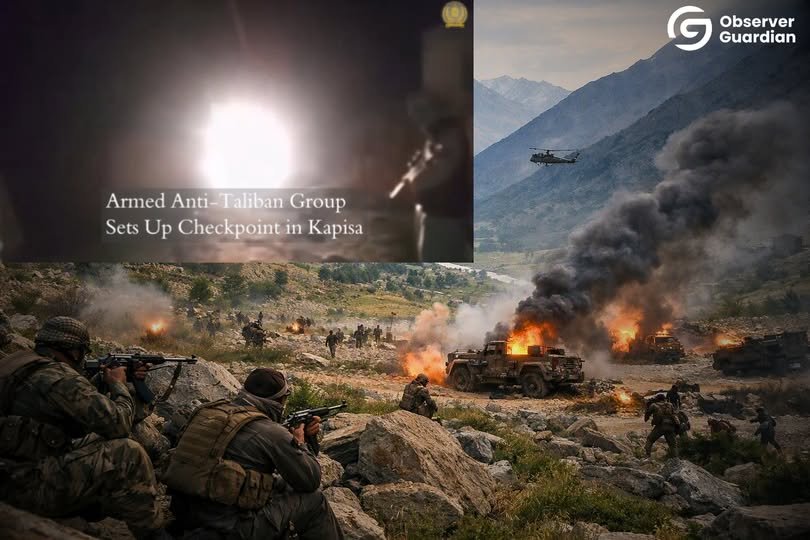
Something significant shifted in the mountains of northeastern Afghanistan on the morning of July 17, 2026. A newly formed armed group calling itself Sepahiyan e Mihan Soldiers of the Homeland stormed the district headquarters of Yaftal e Payeen in Badakhshan province. For several hours, they disarmed Taliban personnel, seized weapons and military vehicles, lowered the Taliban flag, and raised their own over the district administration building, the police command, and the Taliban’s intelligence offices. Then, before reinforcements arrived, they withdrew deliberately, tactically, and with a message unmistakably sent.
It was the first time since August 2021 that any anti Taliban group had temporarily seized a district centre. The Taliban, characteristically, tried to downplay it their spokesperson dismissed the attackers as irresponsible individuals who fled after security forces arrived. But the Taliban’s own army chief visited the district shortly after, a visit that spoke louder than any press statement. When your top military commander travels to a remote district to personally assess what two dozen lightly armed fighters managed to accomplish, the incident is anything but routine.
Within days, the resistance struck again this time in Zibak district. Local sources told Afghanistan International that anti Taliban fighters attacked Taliban positions in the Tupkhana area, killing a Taliban border commander, Faridullah Wahdat, whose photograph was obtained as evidence. Clashes were still ongoing at the time of reporting. The pattern is unmistakable: Yaftal was not an isolated outburst of frustration. It was an opening move.
A Province That Was Always Primed
Badakhshan has a long memory. It borders Tajikistan, China, and sits adjacent to the Panjshir Valley the historic heartland of Afghan resistance. It was in this broader northeastern corridor that the Northern Alliance held out against the first Taliban regime in the 1990s, and it was here that resistance under Ahmad Massoud’s National Resistance Front continued even after Kabul’s fall in August 2021. The province’s mountainous terrain, ethnic Tajik majority, and historical ties to the anti Taliban resistance movement made it, in retrospect, an obvious flashpoint.
What is new is the emergence of organised, previously unknown groups like Sepahiyan e Mihan that are neither extensions of the NRF nor affiliates of established political opposition movements. These are grassroots formations local in composition, operationally confident, and apparently capable of coordinating simultaneous strikes across multiple districts. Their July 17 operation reportedly targeted not just Yaftal e Payeen but also Kishm and Yawan districts simultaneously. This level of operational coordination from a newly emerged group is not the hallmark of spontaneous discontent. It suggests planning, local intelligence networks, and leadership with prior military experience.
The Governance Vacuum That Fuels the Fire
To understand why Badakhshan has become a pressure cooker, one must look at what the Taliban has delivered or failed to deliver since 2021. The province, like much of Afghanistan, has experienced the full weight of the regime’s coercive and exclusionary governance model. Women have been expelled from education and public life. Ethnic and religious minorities face systematic marginalisation. Local administrators appointed by Kabul have little understanding of or connection to the communities they govern. As the Eurasia Review noted in its analysis of July 22, 2026, Taliban policies on women’s rights, education, dissent, and minorities are actively creating the conditions for resistance to grow.
Compounding this is an economic catastrophe. International aid, which once kept millions of Afghans alive, has been severely curtailed. Poverty has deepened across the country, and Badakhshan already one of Afghanistan’s poorer provinces has been hit particularly hard. When populations are impoverished, politically suppressed, and culturally humiliated, armed resistance does not need external sponsors to flourish. It generates its own momentum.
The Widening Map of Resistance
Perhaps the most strategically significant development is the geographic expansion of resistance activity beyond the traditional Panjshir Andarab corridor. Anti Taliban operations are now being reported across Kabul, Baghlan, Takhar, Kunduz, Kapisa, Balkh, Herat, and now Badakhshan. The Afghanistan Freedom and Justice Movement, a newly declared anti Taliban outfit, has claimed activity in Badghis province. Each new formation, each new front, forces the Taliban to stretch its security resources further across an already vast and logistically challenging country.
This is not yet a coordinated national insurgency. The resistance remains fragmented, with different groups operating independently across provinces, lacking unified command or a shared political platform. However, fragmentation at this stage should not be mistaken for weakness. The Taliban itself fought a fragmented, decentralised insurgency against NATO and the Afghan republic for two decades and ultimately prevailed. The lesson from that experience is that sustained local resistance, when rooted in genuine popular grievance, is extraordinarily difficult to eradicate.
The Yaftal Zibak sequence is significant for another reason: it exposed critical vulnerabilities in the Taliban’s local governance and intelligence apparatus. The Yaftal attack succeeded, in part, because senior district officials were on leave. Taliban police later admitted that security was compromised during the absence of key personnel. This points to institutional fragility an administration that functions only when its supervisors are present is not an administration that controls territory; it is one that merely occupies it.
A Regime Under Cumulative Pressure
It would be analytically irresponsible to suggest that the Taliban regime is on the verge of collapse. It is not. It retains significant military capability, controls major urban centres, and has demonstrated ruthlessness in suppressing dissent. But the events in Badakhshan signal something that matters deeply in asymmetric warfare: the erosion of psychological dominance.
The Taliban’s narrative of absolute, unchallenged control a narrative it has cultivated carefully since August 2021 has been punctured. Not shattered, but punctured.
When a regime’s flag is lowered by two dozen fighters, when its border commander is killed in his own outpost, when clashes spread from one district to the next within a week that narrative takes damage that is not easily repaired. The Taliban can retake territory. It cannot easily retake credibility.
Badakhshan is not merely a new military front.
It is a signal to the Afghan population, to the diaspora resistance, and to regional observers that the Taliban’s grip on the northeast is loosening, and that organised, coordinated resistance remains a live reality five years after Kabul’s fall. The question now is not whether resistance exists. The question is how long it takes for these scattered embers to find each other.
Disclaimer: The views and opinions expressed in this article are exclusively those of the author and do not reflect the official stance, policies, or perspectives of the Platform.