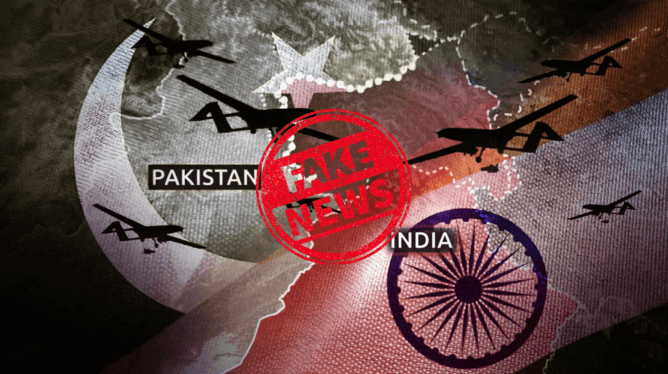

In periods of heightened tension between Pakistan and India, information often becomes as strategically important as military capability. Allegations, anonymous briefings, selective leaks, viral videos and emotionally charged television coverage can shape public opinion long before investigators establish what actually happened. The renewed circulation of claims linking Pakistan, Hafiz Saeed and Lashkar-e-Taiba to incidents in Indian-administered Kashmir illustrates this enduring problem. When accusations are repeatedly presented without verifiable evidence, transparent investigative procedures or meaningful bilateral engagement, counterterrorism risks being transformed into political theatre.
The latest narrative appears to combine two highly sensitive issues: terrorism and water security. Indian media commentary has increasingly used expressions such as “water terrorism” while reviving allegations concerning the Pahalgam incident and banned Pakistani organisations. This rhetorical merger is significant. Water disputes already evoke profound public anxiety because they concern agriculture, livelihoods, energy production and long-term national survival. Connecting such fears with terrorism creates an emotionally powerful narrative capable of mobilising domestic audiences. Yet the greater the seriousness of an allegation, the stronger the evidentiary standard must be.
National security cannot be responsibly managed through slogans, manipulated videos or claims attributed to unidentified sources
Pakistan has legitimate reasons to question narratives built around artificial intelligence-generated voices, altered footage and unauthenticated digital material. Deepfake technology has made it increasingly difficult for ordinary citizens to distinguish genuine statements from sophisticated fabrications. A video can be produced within hours, assigned to a militant organisation and disseminated through television networks and social-media accounts before professional verification occurs. By the time fact-checkers challenge it, the original allegation may already have shaped millions of opinions. This information asymmetry gives states, political actors and partisan media outlets unprecedented power to manufacture apparent evidence.
However, Pakistan’s strongest response should not rest solely on counteraccusations. It should consistently demand forensic transparency, credible evidence and independent investigation. If New Delhi possesses reliable intelligence connecting specific individuals or organisations to an attack, it should share that information through established diplomatic, legal and counterterrorism mechanisms. Evidence should include verifiable financial trails, communications records, weapon origins, operational links and forensic findings.
Public allegations cannot substitute for an evidentiary process, particularly when they carry the risk of military escalation between two nuclear-armed states
India’s previous treatment of Pakistan-linked terrorism allegations has created a substantial credibility problem. Political leaders and television commentators frequently announce conclusions before investigations are completed. Muslim suspects, Kashmiri activists and Pakistan-based groups are sometimes blamed in an atmosphere of intense nationalism, while later corrections receive far less publicity than the original accusation. Such practices encourage the perception that certain organisations and individuals have become permanent narrative devices, invoked whenever a politically useful external enemy is required. Hafiz Saeed and Lashkar-e-Taiba remain deeply controversial names, but their notoriety cannot serve as automatic proof of involvement in every violent incident.
The timing of allegations also deserves scrutiny. Governments under political pressure often benefit from externalising domestic failures. A security incident can redirect attention from economic distress, governance shortcomings, political polarisation or unrest in contested territories. In the Kashmir context, portraying every episode of violence exclusively as foreign-sponsored terrorism enables Indian authorities to avoid confronting the region’s deeper political grievances.
It also allows coercive policies, communications restrictions and expanded security measures to be justified as unavoidable responses to an external conspiracy
The Indian media’s role is especially consequential. A large segment of prime-time television has replaced journalism with hypernationalist performance. Television anchors often act as prosecutors, investigators and judges simultaneously, presenting speculation as established fact and dissent as disloyalty. This style of coverage may generate ratings and political approval, but it weakens institutional credibility. When media platforms repeatedly broadcast exaggerated or unverified claims, they make genuine security warnings less persuasive. A state that politicises every incident eventually struggles to convince international audiences even when its concerns may be legitimate.
The emerging “water terrorism” narrative is particularly dangerous because it could undermine the remaining framework of bilateral water cooperation. Water disagreements between Pakistan and India should be addressed through treaty mechanisms, technical consultations, arbitration and international law. Framing hydrological decisions as terrorism erases the distinction between legal disputes and armed violence. It also prepares domestic audiences to view negotiation as weakness. In an era of climate change, glacial retreat, erratic rainfall and growing water demand, both countries require greater technical cooperation, not militarised propaganda.
The international community should therefore insist on restraint from both sides. It should discourage the use of digital disinformation, demand credible investigations into major attacks and support mechanisms for verifying disputed claims. Technology companies must also respond more effectively to coordinated deepfake campaigns and manipulated security content.
Digital evidence used in terrorism allegations should be independently authenticated before being amplified by governments or major media organisations
Ultimately, India cannot strengthen its international standing through repetition alone. Credibility is built through transparency, legal procedure, evidentiary consistency and willingness to cooperate. Pakistan, for its part, should continue improving its own counterterrorism enforcement and ensure that no proscribed organisation is allowed political, financial or operational space. This would strengthen Islamabad’s ability to challenge questionable accusations from a position of institutional confidence.
The real danger is not merely another hostile media cycle. It is the normalisation of accusation without proof. When states replace investigation with propaganda and dialogue with manufactured outrage, public opinion becomes a weapon and regional stability becomes its casualty. South Asia cannot afford security narratives designed for television studios rather than courts, diplomatic channels and professional investigative bodies. Evidence, accountability and restraint remain the only credible alternatives to a politics sustained by fear.