
The Supreme Court of Azad Jammu and Kashmir’s decision of 7 June 2026 is not merely a judicial opinion, but a confirmation of constitutional supremacy, historic justice, and the right of representation for millions of displaced Kashmiris.
On Presidential Reference No. 1 (2026), the Full Court headed by Chief Justice Raja Saeed Akram Khan reaffirmed that there is no substitute for democracy and constitutionalism.
Among the 53 members of the Azad Jammu and Kashmir Legislative Assembly, 12 seats are reserved for Kashmiri migrants who were displaced during the wars of 1947 and 1965 and settled in various cities of Pakistan. Six seats represent approximately 434,000 migrants from Jammu Division, while six seats represent nearly 30,000 migrants from the Kashmir Valley. These seats are not political favors but the constitutional expression of democratic rights for those who lost their homeland but never lost their identity or voice.
Historical Roots, Constitutional Continuity
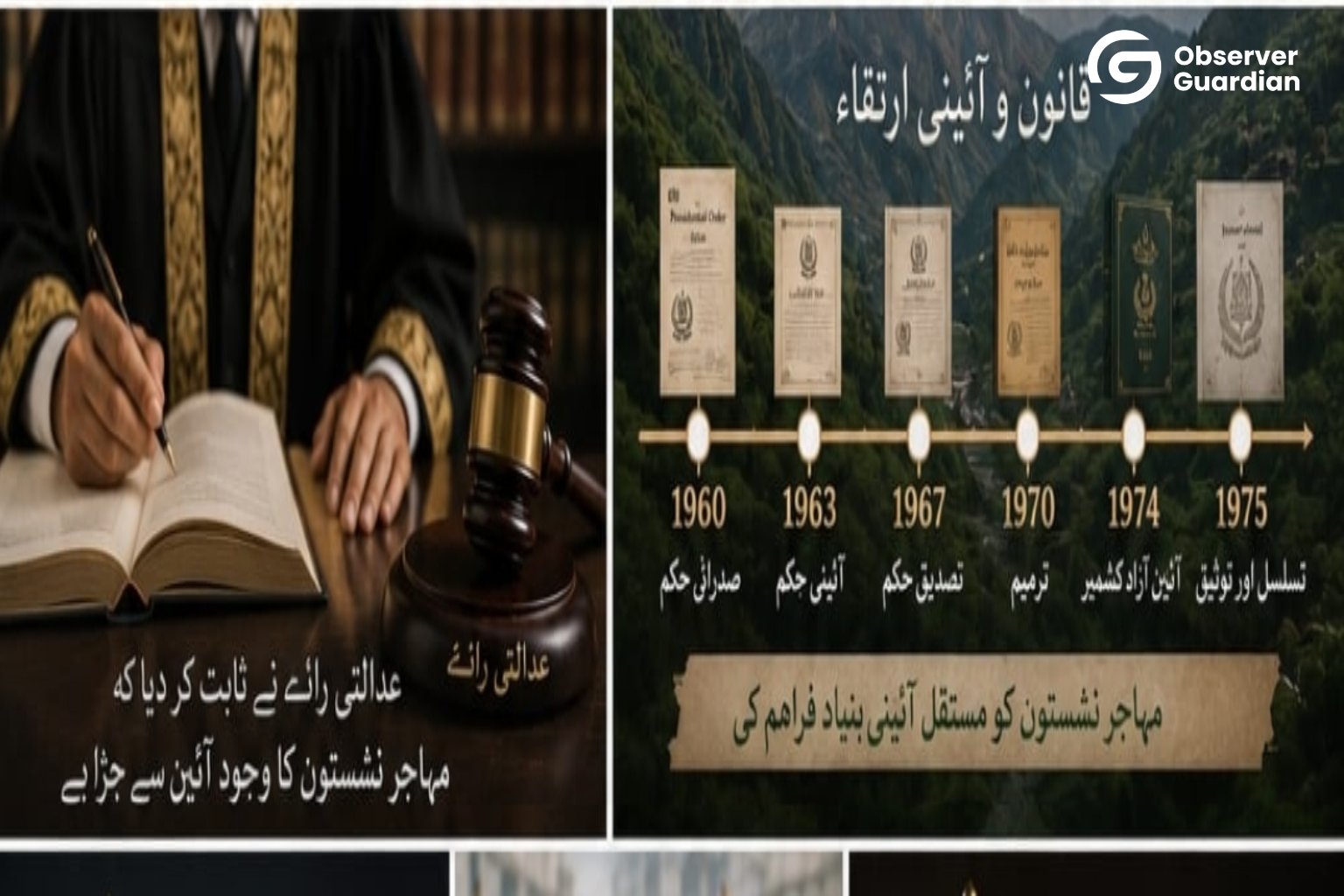
The Supreme Court in its detailed opinion reviewed the legal history of these seats, noting their foundation in the 1960 electoral arrangements, the 1964 constitutional order, the 1967 confirmation, the 1970 legal reforms, the 1974 Azad Kashmir Constitution, and the 1975 Act. The Court declared these seats as “a constitutional expression of a deep historical and legal truth” the truth embedded in the pain of millions of Kashmiris displaced by the partition of 1947 and subsequent conflicts.
Under Article 22, constitutional protection means that no administrative order, political agreement, or street protest can alter the status of these seats. Any change requires a formal constitutional amendment under Article 33, achievable only through public mandate, parliamentary debate, and constitutional procedure.
Principle of Constitutional Supremacy
The most significant aspect of this decision is the Court’s clear statement that decisive authority in Azad Kashmir lies not in street protests but in constitutional mechanisms. Referring to Article 22(4), the Court emphasized that timely elections are a constitutional duty and political disputes cannot obstruct the electoral process. Peaceful protest is a constitutional right, but blocking roads, harassing citizens, and disrupting daily life are not constitutionally protected.
This opinion sends a clear message to those seeking to pressure the electoral process. Legal experts note that the decision strengthens the path for legal action against interference in elections and government institutions.
Constitutional Dimension of the Kashmir Issue
Migrant seats are not merely about representation; they are part of the historical, legal, and constitutional identity of the Kashmir issue. As long as these seats exist in the Azad Kashmir Assembly, they proclaim that the pain of millions displaced from Jammu and Kashmir is remembered and constitutionally protected. Their existence is a reminder that the Kashmir issue is a living reality that cannot be buried by administrative decisions.
The timing of this decision is crucial, as the 2026 elections in Azad Kashmir are already scheduled and political activities are at their peak. At such a moment, the Court’s stance that elections are a constitutional responsibility and cannot be halted by political pressure reinforces the entire democratic process.
The Way Forward
After this historic judicial opinion, all political parties, civil society, and institutions must adopt constitutional supremacy as their guiding principle.
Representation of Kashmiri migrants is a constitutional trust, and protecting this trust is the duty of all institutions equally.
If reforms are needed in the future, they must occur on the floor of the Assembly, with public mandate, not through pressure, protest, or administrative orders.
The Supreme Court of Azad Jammu and Kashmir’s decision is a victory of the Constitution, a victory of law, and a victory of all Kashmiris who safeguarded their right to representation for decades.
Disclaimer: The views and opinions expressed in this article are exclusively those of the author and do not reflect the official stance, policies, or perspectives of the Platform.