
When an international watchdog chooses martyrs to ignore, its credibility and its agenda must be questioned
The events that unfolded in Azad Jammu and Kashmir (AJK) from June 5 onwards have triggered a familiar international reflex: Amnesty International rushing to issue a sweeping condemnation of Pakistani authorities while conveniently erasing the most inconvenient facts from its statement. This pattern of selective outrage is not just intellectually dishonest, it is dangerous, and Pakistan must respond to it with clarity and confidence.
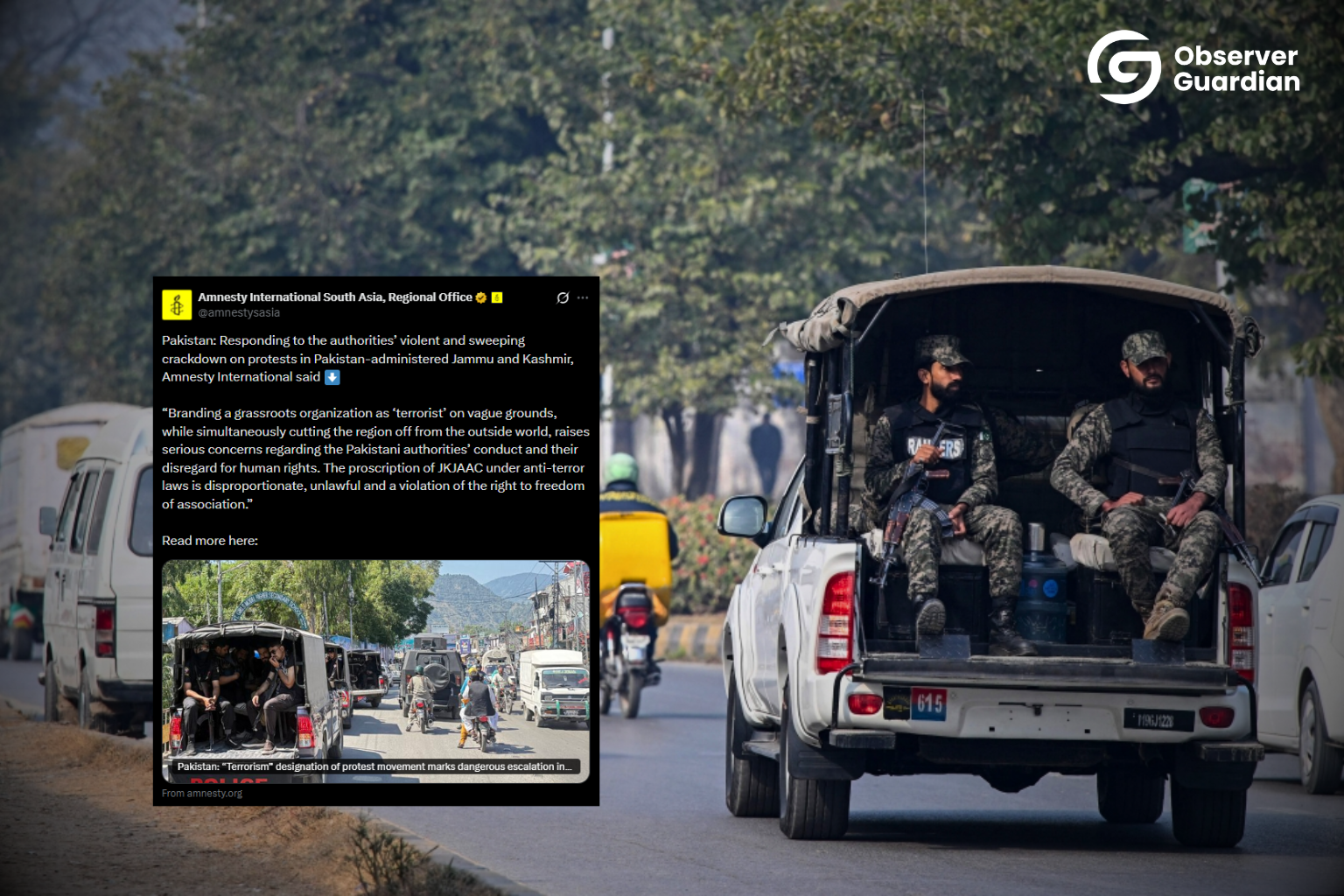
Let us begin with what Amnesty chose not to say. Four law enforcement personnel were martyred during the clashes in Rawalakot. Twenty three police officers were injured. Protesters blocked access to the Combined Military Hospital, causing doctors and paramedics to flee, obstructing treatment for injured law enforcement personnel. According to officials, the body of a martyred police constable was reportedly disrespected, an act of barbarity that no civilised society can condone. Amnesty International’s statement said nothing about any of this. Not a word. Not a sentence. The martyrdom of those who wore the uniform of the Pakistani state was, to Amnesty, apparently not a human rights concern at all.
This is the fundamental flaw at the heart of Amnesty’s intervention.
Human rights cannot be a one way street.
When an organisation presents itself as a neutral arbiter of justice and then systematically ignores the killing, injury, and humiliation of law enforcement personnel, it forfeits its claim to impartiality. The families of those four martyred officers deserve recognition too. Their grief is not less real. Their loss is not less human.
Authorities alleged that armed individuals, gathered under the banner of a protest, opened fire on law enforcement personnel, triggering a violent confrontation. This is the critical context that transforms the entire picture. This was not a straightforward case of peaceful protesters being mowed down by an authoritarian state. This was a deteriorating security situation in which elements within the protest movement made the deliberate choice to resort to violence. Pakistan, like every state on earth, has not only the right but the obligation to respond to such violence. The notion that a government must simply absorb armed attacks on its security forces in the name of “protest” is a standard applied to no other country on the planet.
The designation of the JKJAAC as a proscribed organisation has drawn Amnesty’s sharpest criticism. Amnesty called the proscription disproportionate, unlawful and a violation of the right to freedom of association. But consider the sequence of events carefully. The proscription came after the authorities stated the group was “engaged in terrorism” and had acted in a manner “prejudicial to peace and security” of the state. The government did not arbitrarily conjure this designation out of thin air. It came after a sustained escalation, after negotiations broke down, and after signals that a large scale mobilisation was being planned that the state assessed as a threat to public order. Whether one agrees with the designation or not, dismissing the state’s security assessment entirely, as Amnesty does, is not analysis. It is advocacy.
The protest movement expanded beyond Rawalakot, with demonstrations and shutter down strikes reported in Muzaffarabad, Mirpur, Tata Pani, and Plandari. This was a coordinated, region wide disruption, not a spontaneous outpouring of grief. Pakistan has every legitimate interest in preventing such coordinated action when it is accompanied by violence and when elements within it are firing on the police.
The historical pattern is also relevant here. This is not the first time these tensions have flared. In May 2024, clashes during the Kashmir Long March resulted in casualties on both sides. In October 2025, an agreement was reached between the Government of Pakistan and the JKJAAC, with most demands reportedly accepted, demonstrating that Islamabad has consistently shown willingness to negotiate and accommodate legitimate grievances. The government’s record is not one of blanket repression; it is one of repeated engagement, followed by frustration when those engagements break down and elements within protest movements turn to coercion and violence.
There are genuine and legitimate questions about governance, economic rights, and political representation in AJK. The JKJAAC’s core demands, around electricity pricing, flour subsidies, and the contested refugee seats in the legislature, deserve serious political attention. Pakistan’s government has acknowledged as much through previous rounds of dialogue. Peaceful dissent deserves protection. Legitimate grievances deserve redress. On these points, there is no argument.
But there is a profound difference between defending peaceful dissent and defending a movement that has, within its ranks, elements that shoot at police, block hospitals, and desecrate the bodies of martyred officers. Amnesty International has chosen to blur that distinction entirely.
More than 200 people had been detained across the region following the crackdown. A journalist was arrested. Communications were suspended. These are serious matters that warrant scrutiny. But scrutiny must be balanced. An organisation that examines only one side of a violent confrontation is not a human rights organisation, it is a political actor with a predetermined conclusion.
Pakistan’s security forces, who protect the lives of millions daily, deserve better than erasure.
The four officers who gave their lives in Rawalakot deserve to be named, honoured, and remembered, not sacrificed on the altar of a one sided international narrative.
Pakistan is a sovereign state, navigating a genuinely complex internal situation with all the imperfection that implies. What it does not need is a global organisation rendering judgment while deliberately averting its eyes from the blood of its defenders.
Amnesty International owes those four martyred officers and the Pakistani people a complete and honest account. Until it provides one, its credibility on this matter must be treated with the scepticism it has earned.
Disclaimer: The views and opinions expressed in this article are exclusively those of the author and do not reflect the official stance, policies, or perspectives of the Platform.