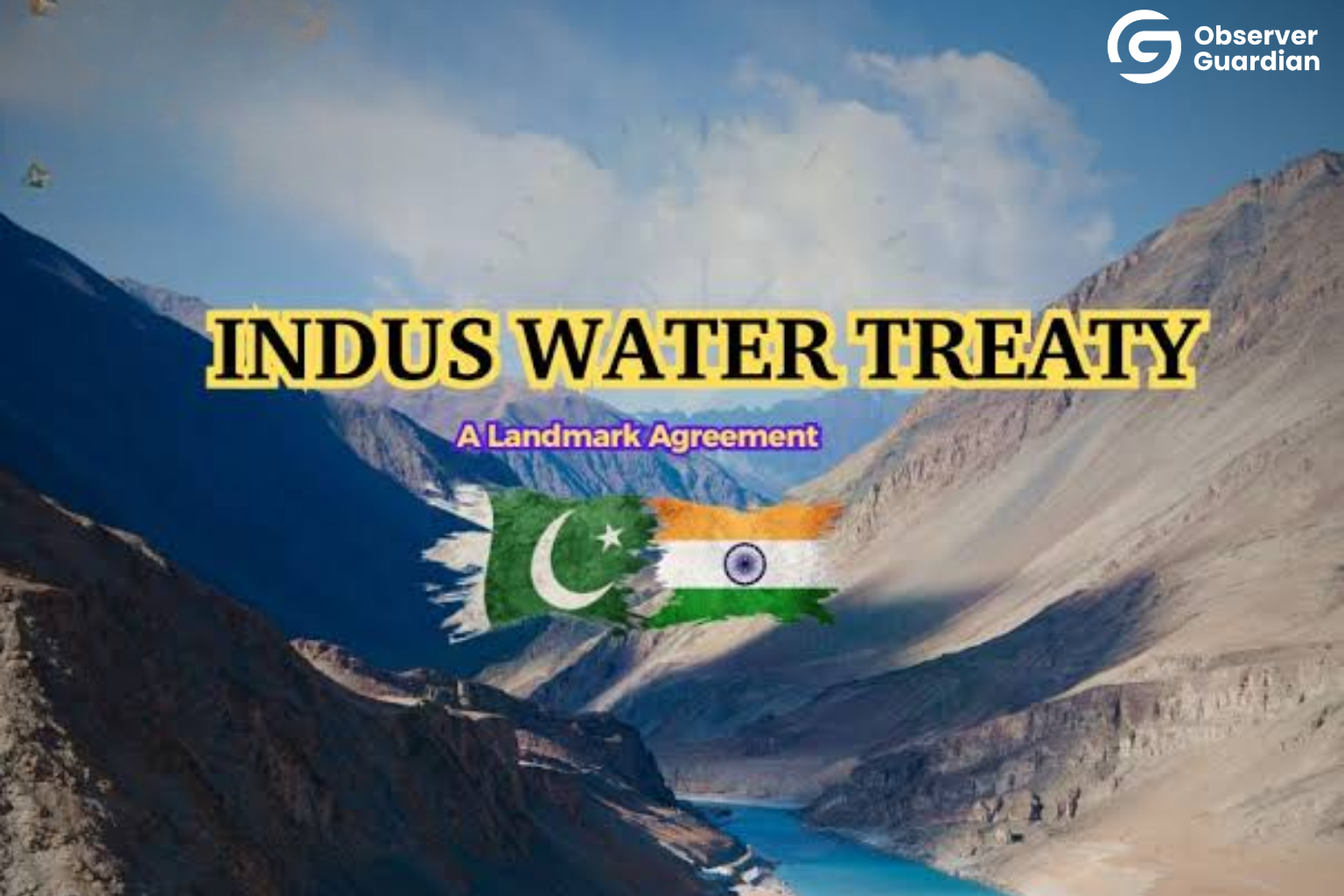
On the morning of August 31, 2026, the Permanent Court of Arbitration in The Hague delivered a verdict that carries weight far beyond its legal technicalities. The court ruled that the Indus Waters Treaty between Pakistan and India remains fully in force, rejecting India’s unilateral suspension of the agreement and reaffirming that New Delhi remains bound by its treaty obligations. India promptly rejected it. And in that rejection lies the heart of one of the most dangerous disputes in South Asia today.
To understand what is truly at stake, one must first grasp the almost incomprehensible scale of what the Indus basin represents for Pakistan. The Indus River basin supplies water to the largest contiguous irrigation system in the world, providing water for 90% of the food production in Pakistan, which contributes 25% of the country’s gross domestic product. These are not abstract statistics. The crops sustained by these rivers feed more than 240 million people and underpin a significant portion of the country’s economy. When a nation’s agriculture, energy, and livelihoods are this deeply embedded in a single river system, any threat to those waters is not merely a diplomatic irritant, it is an existential challenge.
The Indus Waters Treaty, signed in 1960, was built precisely around this reality. For over six decades, it survived wars, nuclear standoffs, terror attacks, and diplomatic ruptures. It stood as proof that international law could hold even when political goodwill could not. The treaty came under increasing tension as the conflict in the disputed territory of Jammu and Kashmir deepened, with ambiguities within the treaty enabling India to build infrastructure that Pakistan claims undermines its water security. That fragile equilibrium was shattered in April 2025.
Following a deadly terror attack on civilians in the India administered part of Kashmir, India announced that it would hold the treaty in abeyance, marking the first time tensions disrupted the treaty in its 65 year history. India subsequently tied the treaty’s restoration to Pakistan “credibly and irrevocably” abjuring support for cross border terrorism. The Hague court, however, was unambiguous, the treaty did not provide either party with the right to unilaterally suspend or terminate its operation, and it would remain in force unless India and Pakistan jointly modified or terminated it through a further treaty.
India’s response was to dismiss the court as an “illegally constituted” body with no jurisdiction. This is a deeply troubling posture. The panel also restricted construction at India’s Ratle hydroelectric plant in Kashmir pending a World Bank appointed expert’s decision expected in July 2027. Defying this ruling does not just harm Pakistan, it chips away at the architecture of international dispute resolution that governs transboundary rivers everywhere on Earth. When a major democracy refuses to appear before, and then simply dismisses, an internationally constituted arbitration body, every treaty becomes a little less reliable.
Geography has always placed India upstream. That is a fact of nature. But international law has long held that geography is not a license for coercion. India’s ability to influence downstream flows is not theoretical, it has been built through successive hydropower projects in Indian administered Jammu and Kashmir. From Baglihar and Kishanganga to Ratle, Pakal Dul, and Sawalkot, each project expands India’s operational capacity to regulate, time, and potentially constrain the flows on which Pakistan’s agriculture and water security depend. This is precisely why treaty compliance, data sharing, and institutional mechanisms are not optional courtesies, they are the load bearing pillars of regional stability.
The situation is made more urgent by climate change. India’s unilateral suspension of the treaty, combined with upstream glacial retreat, rising temperatures, and weather related shocks, increasingly threatens long term water availability for agriculture and livelihoods. Himalayan glaciers are receding. Seasonal flows are becoming erratic. The communities along the Jhelum and Chenab rivers already face mounting hydrological uncertainty. Dismantling the one legal framework that was designed to protect predictable water access in precisely these circumstances is not a security strategy, it is compounding a climate crisis with a legal one.
Pakistan’s position has been clear and consistent. As Deputy Prime Minister Dar stated,
“The Indus Basin is the lifeline of more than 250 million Pakistanis. Our agriculture, food security, energy production, livelihoods and economic development are deeply dependent upon the waters of the Indus River system. Water security for Pakistan is therefore inseparable from economic security, food security and ultimately national security.”
This is not alarmism. It is arithmetic. A country cannot absorb the loss of 90 percent of its food production base without consequences that cascade across every dimension of national life, hunger, economic collapse, social instability, and displacement. The world should not need reminding that Pakistan is also a nuclear armed state in a volatile neighbourhood. Pushing a nation of 250 million people toward water desperation while ignoring binding international rulings is not a formula for regional peace.
The international community particularly the World Bank, which brokered the original treaty, and the broader community of nations that depends on the rules based international order, must speak clearly. The court’s ruling was unanimous. It must carry weight.
History will judge how the subcontinent navigates this crisis. The rivers of the Indus basin have sustained civilisations for millennia. They do not belong to any one government’s geopolitical calculus.
Shared waters must never be weaponized. Cooperation, strict treaty compliance, transparent data sharing, and genuine respect for international law remain the only path that leads somewhere other than catastrophe.
The Indus Waters Treaty must be preserved, not as a favour to Pakistan, but as a commitment to the principle that even the most powerful upstream state is bound by the promises it has made to the world.
Disclaimer: The views and opinions expressed in this article are exclusively those of the author and do not reflect the official stance, policies, or perspectives of the Platform.