
Food Security and Biosecurity: Why Pakistan Needs Stronger Institutional Preparedness to Protect Its Agricultural Future
In the midway Pakistan must urgently work on strengthening institutional preparedness to safeguard its future agricultural interests against threats of food security and biosecurity. Meanwhile Pakistan needs to prepare its institutions to better protect Pakistan’s agricultural interests from food security and biosecurity challenges.
Food security and biosecurity have become global issues, especially in developing nations, where agricultural production, environmental sustainability and economic stability are increasingly at risk due to the impact of climate change and emerging trans-boundary pests and diseases of plants, as well as disruption of international trade. Developed economies have made significant investments in the areas of science for surveillance, risk assessment, diagnostic laboratories and coordinated regulatory systems, while many developing countries still struggle with institutional and operational challenges on how to manage these emerging threats. Pakistan is noteworthy, in which it is essential to study creating biosecurity for agriculture as a food security principle, and not as a technical issue for regulation.
World food security is a sign of the need for institutional readiness. The State of Food Security and Nutrition in the World 2025 written by FAO shows that food price inflation, economic shocks and vulnerabilities in agrifood systems persist in threatening food security with nutritious food. Meanwhile, globalization of agricultural trade provides avenues for trans-border movements of harmful organisms, invasive species, and plant pathogens. The Convention on International Trade in Endangered Species (CITES) consequently highlights plant health as an essential part of food security, environmental protection and safe international trade.
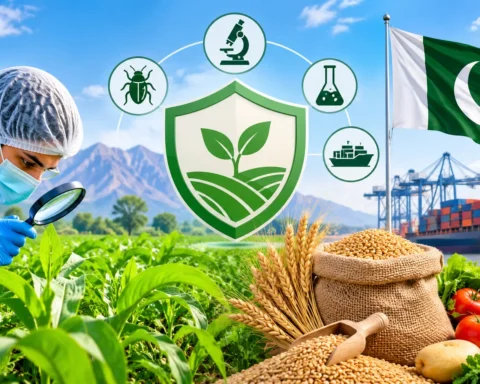
A regulatory framework is in place in Pakistan. The National Plant Protection Organization (NPPO) is the Department of Plant Protection (DPP), which is under the Ministry of National Food Security and Research. It is responsible for plant quarantine, phytosanitary certification, regulation and management of locust and other pest outbreaks and pesticides. The Pakistan Plant Quarantine Act, 1976 and regulations give legal bases towards the control of movement of potentially harmful plant materials. But laws and institutions are not sufficient to ensure that biosecurity measures will be in place and will work well.
The more immediate point to be asked is if the old institutional set-ups offer the necessary scientific inputs, operational competencies and inter-departmental synergy to confront the present-day agricultural risks? Imported agricultural commodities (seeds, grains and planting materials) must be subjected to scientifically justified inspection, pest risk analysis, scientifically documented and subjected to appropriate phytosanitary treatment if needed and documented, traceability. It is crucial to provide reliable diagnostic service, trained people and open enforcement methods for these procedures. Decisions on fumigation for example, should be made since the pest risk identified and commodity characteristics and internationally recognised phytosanitary requirements, and not based on assumptions. Likewise, seed viability cannot be a case of replacing sound scientific risk assessment.
In Pakistan, the integration of institutions needs to be reinforced. The plant protection authorities, the customs, the agricultural research institutes, the environmental authorities, the universities and the provincial agriculture departments often discuss various aspects of risks to agriculture. If information sharing is not well managed and informal responsibilities are not delineated, crucial linkages can exist on the one hand between the border inspections, on the other between the laboratory diagnoses, and on the third between pest surveillance on the border and within the country; and post-entry monitoring. These vulnerabilities may lead to a heightened risk of invasive pests being introduced, a loss in agricultural biodiversity, impact on local food systems and cultural landscapes, and loss of productivity in local farming.
Putting all this in place requires a workable idea that is to create a coordinated national agricultural biosecurity framework. This should involve a digital solution to score the imported agricultural commodities, phytosanitary certificates, inspection results and treatment/pest interceptions in a centralized manner. Border surveillance based on risks, accredited diagnostic labs, post-entry monitoring of high-risk planting material and frequent and independent institutional audits should be firmly integrated. In addition, the Phytosanitary Capacity Evaluation (PCE) of the IPPC should be implemented in Pakistan, which is a step-by-step process that involves identifying legislative, organizational and technical gaps, and formulating a national Capacity development plan.
Moreover, institutional responsibility should go hand in hand with scientific research investments, professional trainings, and cooperating with international organisations. Universities and research institutions should provide their help in molecular diagnostics, pest monitoring, invasive-species modelling and evidence-based risk assessment. Such investments would help Pakistan transition from reacting to pests to preventive and science-based biosecurity governance.
After all agricultural production alone is not sufficient to ensure food security. It also requires safeguarding the biological resources seed systems, ecosystems and supply chains that provide the basis for production. Pakistan has basic critical structures and rules, the coordination, scientific ability, transparency and accountability issues need to get enhanced. Agricultural biosecurity is critical, not only when it comes to protecting and securing Australian agricultural production in the future, but also for supporting both food security and confidence in the world trading system of agriculture and food products.