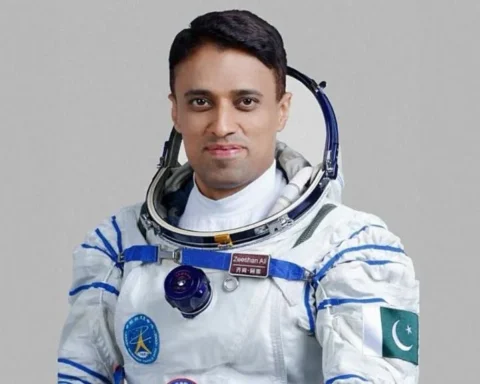
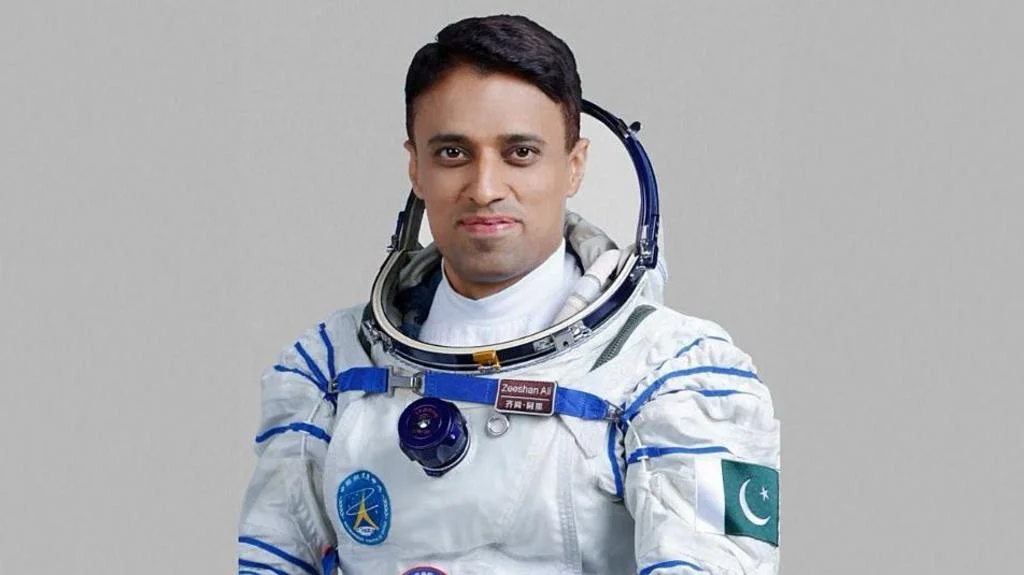

There are moments in history that transcend the merely technical and speak to something deeper, to ambition, to partnership, to the quiet but unmistakable shift of geopolitical weight. The launch of Shenzhou 24 from the Jiuquan Satellite Launch Center on the morning of November 25, 2026, was one such moment. China launched a new crew to the Tiangong Space Station this morning, and joining two Chinese taikonauts was Pakistan’s first astronaut, Muhammad Zeeshan Ali. With that, a chapter began, not just for Pakistan, but for how the world thinks about space diplomacy in the twenty first century.
On this particular flight, a Pakistani astronaut accompanied the pilot and commander, becoming the first foreigner to travel to Tiangong. Let that sink in for a moment. China’s space program, long regarded as the most self contained, most guarded space program among the major powers, opened its doors, and not to a European ally or a wealthy Gulf state, but to Pakistan. The Tiangong station, launched in 2021, had until now hosted only Chinese astronauts. Welcoming Pakistan into the program signals Beijing’s intent to internationalize its space presence and foster scientific collaboration with partner nations.
This didn’t happen overnight. It is the fruit of a partnership that stretches back decades and has only deepened with time. Space cooperation with China began in the early 1990s but remained limited for years, focusing mainly on training and infrastructure. Pakistan launched its first satellite, Badr I, only in 1990, with Chinese support. Since then, the relationship has grown steadily in scope and ambition. In 2024, the Pakistani satellite ICUBE Q, jointly developed by Pakistan’s Institute of Space Technology and China’s Shanghai Jiao Tong University, was launched into space as part of the Chang’e 6 mission and successfully captured images of the moon. Step by step, mission by mission, the two countries have been building something remarkable together.
Five more satellites reached orbit between January 2025 and April 2026, including PRSC EO3, the largest satellite Pakistan has ever developed at home. These are not vanity projects. The remote sensing satellite will support disaster management, agriculture, and infrastructure monitoring, and will also aid in regional planning, especially in relation to national projects such as the China Pakistan Economic Corridor. Space technology, in this partnership, is tangibly connected to the lives of ordinary people, farmers who need better crop data, disaster responders who need faster imagery, planners who need to see the country from above.
Chinese satellite firm Geespace has signed a cooperation agreement with Pakistan’s satellite communications operator Paksat International to support the rollout of satellite based connectivity services in Pakistan. PM Shehbaz Sharif has also expressed that the country is “keen to increase cooperation with China in the fields of space technology, space satellite and telecommunications.” There is a coherent, long term vision here, not just a symbolic astronaut flight, but a comprehensive space architecture being built brick by brick.
What makes the Shenzhou 24 mission so symbolically powerful is precisely what the News18 report found strategically alarming: China chose Pakistan first. China’s invitation to Pakistan is the first time it will transport a foreign astronaut. Among all the nations that might have been chosen, Russia’s longtime partners, the many African and Latin American nations in China’s diplomatic orbit, Southeast Asian neighbors, Beijing chose Islamabad. This is not coincidence. At the Seventh Round of their Foreign Ministers’ Strategic Dialogue in Beijing earlier this year, the two countries expressed satisfaction over expanding space cooperation, including the expected early entry of Pakistani astronauts into the China Space Station, and agreed to pursue peaceful and mutually beneficial space exploration. The diplomatic groundwork was careful and deliberate.
Under the mission plan, the Pakistani astronaut will travel alongside Chinese crew members to the Tiangong Space Station, where Pakistan’s representative will spend approximately seven days conducting scientific experiments and operating specialized equipment. This is a payload specialist role, scientific, purposeful, meaningful. It is not a tourist ride. It is the beginning of Pakistan building genuine human spaceflight capability, with hands on experience that no textbook can replicate.
The Indian commentary around this mission has focused heavily on its strategic implications, particularly regarding surveillance and satellite coverage. Those are legitimate discussions to have, space assets are dual use by nature, and no serious analyst dismisses that reality. But the framing sometimes obscures something important: with SUPARCO’s development allocation cut by more than 90 percent in 2025 26, China’s partnership is delivering capabilities that Pakistan could not otherwise afford for decades. This is the story of a developing nation finding a path to technological advancement through partnership, in an era when the established space powers have shown little interest in sharing that road.
For Pakistan, this represents an opportunity to send its first astronaut to space, edging out India by close to a year, as India’s first crewed Gaganyaan mission is expected to launch no sooner than Q2 2027. The comparison is not triumphalist, both nations are on remarkable journeys. But it does illustrate that Pakistan’s space ambitions, long dismissed or underestimated, are very much alive and accelerating.
From the Karakoram Highway to cooperation in outer space, the Pakistan China friendship continues to demonstrate how enduring strategic trust can be translated into meaningful progress and shared prosperity. That is not propaganda, it is a description of a partnership that has consistently delivered for Pakistan across infrastructure, energy, defense, and now the final frontier.
Muhammad Zeeshan Ali’s journey to Tiangong is Pakistan’s journey, a nation that has endured enormous hardships, internal strife, economic turbulence, and the relentless noise of geopolitical pressure, reaching nonetheless for the stars. That story deserves to be told on its own terms, not only through the prism of what it means for neighbors watching anxiously from the ground.
The cosmos has no borders. Pakistan has arrived.