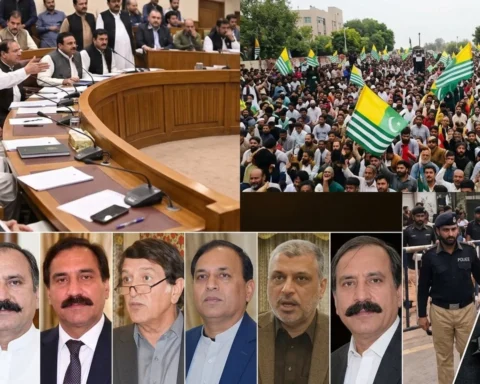
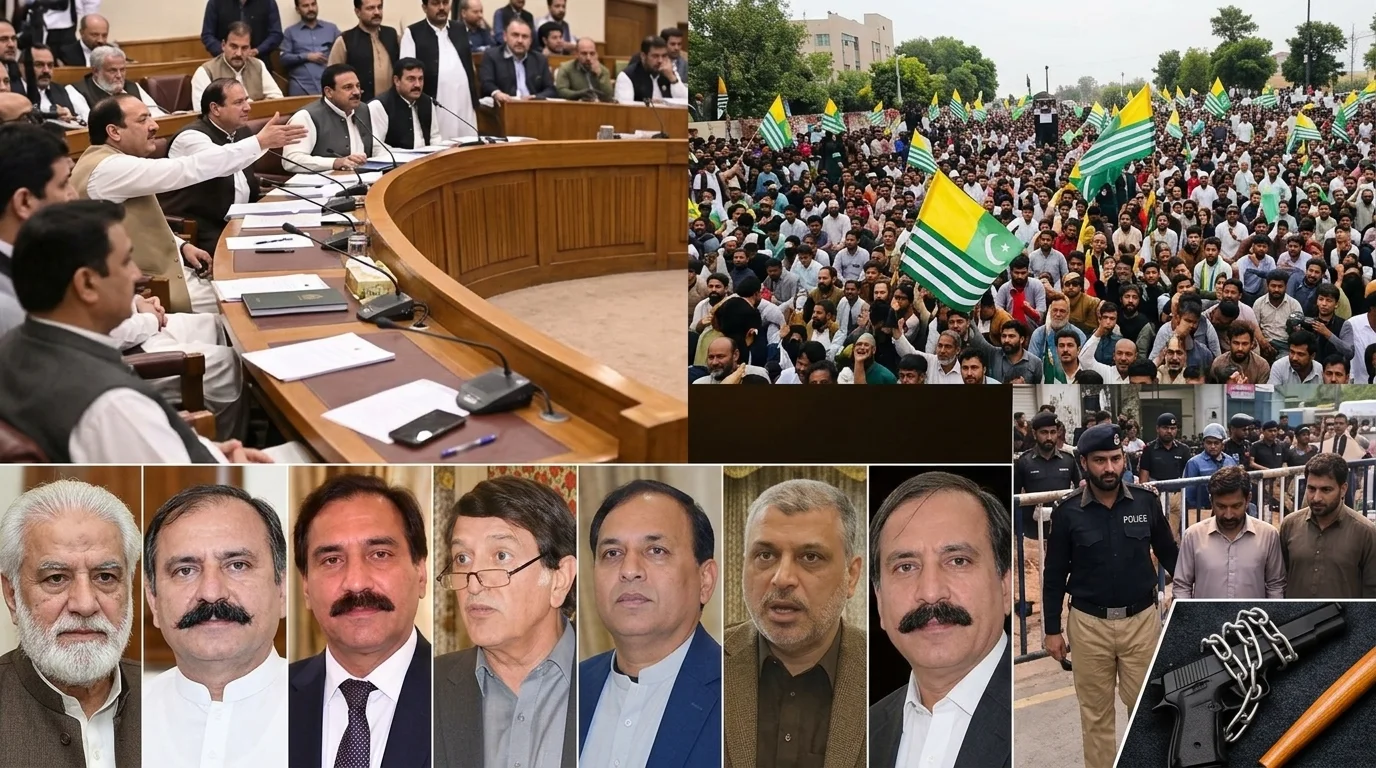

Azad Jammu and Kashmir’s Legislative Assembly on Wednesday extended an offer to resume talks with JAAC, but this offer came tied to seven stringent conditions. On the surface, this appears to be a political development, but when these conditions are viewed against their historical backdrop, the picture tells a different story.
Azad Kashmir has been at the center of a persistent political and social struggle for several years now. This struggle is not the product of some sudden emotional outburst; it was born from concrete economic and political grievances, electricity tariffs, wheat subsidies, and the question of refugee seats. The 2025 protests were significantly driven by opposition to the 12 seats reserved in the AJK Legislative Assembly for refugees who had settled after migrating from Indian administered Kashmir.
In June 2026, the government designated JAAC a proscribed organization under the Anti Terrorism Act, and this ban was imposed precisely when the organization had announced a protest for June 9, the very same date the AJK Election Commission had set as the deadline for filing nomination papers. The violence that followed and continued through mid July claimed nearly 30 lives, both security personnel and protesters, while Rawalakot remained under curfew for approximately six weeks.
Now that the Assembly has extended a conditional offer for dialogue, the question worth asking is: are these conditions merely legal and constitutional requirements, or are they a deliberately assembled burden designed to make negotiations impossible from the outset?
The resolution makes clear that the government is willing to engage in meaningful political dialogue under the Interim Constitution of 1974 and applicable laws, provided the committee fulfils the stipulated conditions. And if those conditions are not met, law enforcement agencies will be deployed to restore public order.
This tone says it all. This reads less like an invitation to negotiate and more like an ultimatum.
The resolution holds JAAC’s leadership directly responsible for the breakdown of previous negotiations, alleging that the committee persisted with unconstitutional demands despite government concessions. However, when one party unilaterally assigns blame and excludes the other from that very conversation, the resolution can hardly be called neutral.
The government’s position is that terrorist elements infiltrated the JAAC protests, and the AJK Information Secretary claimed that members of Fitna Al Khawarij were present among the demonstrators. This is a grave allegation, and if proven, the state must act, because Khawarij and terrorists cannot be permitted to shelter behind a legitimate public movement. However, leveling an accusation and proving one are two entirely different matters, and they must never be treated as one and the same.
The Assembly also affirmed that peaceful protest and political dissent are fundamental constitutional rights of citizens, while maintaining that violence and destruction of public property are unacceptable. This principle is sound, and no responsible voice can disagree with it. But when peaceful protesters and violent elements are bundled under a single umbrella and the entire organization is proscribed on that basis, that critical and crucial distinction disappears entirely.
The Assembly further expressed concern that JAAC was attempting to disrupt the July 2026 general elections, and that since June, armed groups and violent marches had been used to spread anarchy.
Now, if one takes a comprehensive look at the seven conditions, an end to protests, reopening of blocked routes, handing over accused individuals to the law, elimination of illegal weapons, acceptance of responsibility for damages, and a public apology for narratives against state institutions, none of these are wrong in principle. But demanding that all conditions be fulfilled first, and only then entering into dialogue, is a sequence that leaves the other party with no room to maneuver.
Successful negotiations have always begun without preconditions, or at the very least with mutually agreed terms from both sides. When one party demands surrender and an apology before it is willing to talk, that is not negotiation, that is capitulation.
The legitimate grievances of the people of Azad Kashmir, the cost of living, the question of representation, the fair distribution of resources, are real. And they cannot be resolved through force or legal pressure alone. The real solution lies in the state genuinely listening to the people’s voice, maintaining the distinction between violence and peaceful protest, and bringing those truly involved in violence, be they Khawarij or terrorists, before the law. But it must not use that violence as a pretext to suppress a broader public movement.
This resolution from the AJK Assembly is, without doubt, a step. But if it leads not toward dialogue but toward a justification for crackdown, then the wounds of this region will only deepen, and the weight of that consequence will be placed by history upon those who chose to keep their fist closed rather than extend an open hand.