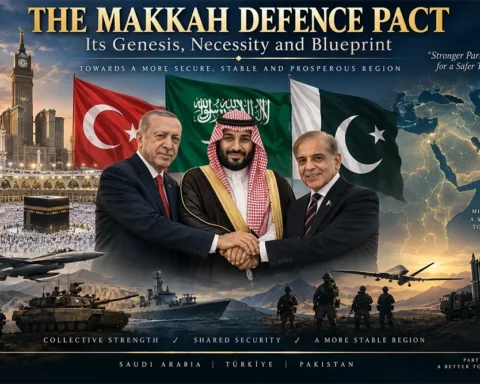

What happened in Islamabad today was not merely a diplomatic meeting. When the foreign ministers, defence ministers, and military chiefs of Pakistan, Saudi Arabia, and Türkiye sat around one table, that moment was in fact the opening of a new chapter in the collective thinking of the Muslim world. The session of the Strategic Political and Defence Committee under the Makkah Joint Defence Agreement was focused on giving practical shape to collective defence commitments, including addressing Houthi attacks on Saudi Arabia. These were not words. They were intentions.
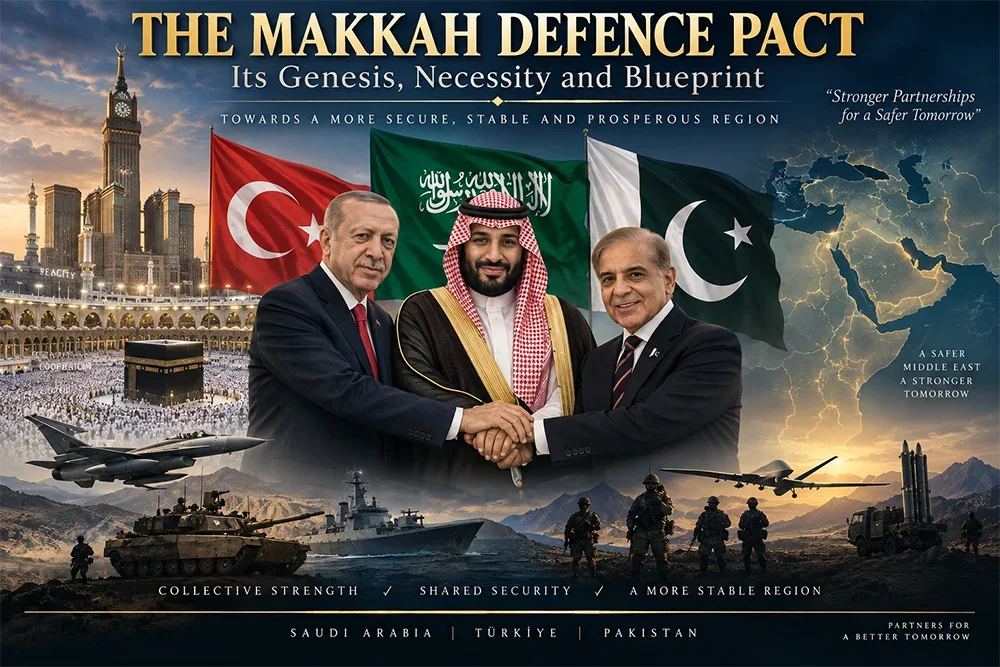
The three countries had signed the Makkah Joint Defence Agreement on August 7, under which an attack on any one member state is treated as an attack on all three. This means it is not merely a declaration but a clear message that the security of all three nations is now inseparably linked. Saudi Arabia is a major oil exporter, Türkiye is a NATO member, and Pakistan is a nuclear armed power. An alliance of three such nations carries the capacity to fundamentally reshape the regional political and defence landscape.
The Islamabad session is particularly significant because it is the third meeting, following Istanbul and Riyadh. The emergency session in Riyadh had been convened in the wake of Houthi attacks, and even then the alliance responded promptly. This is proof that the alliance is already establishing its identity as an active and responsive system. At the Riyadh session, measures to strengthen rapid response capability and military integration were also approved.
The most important point is that this alliance has not remained merely on paper. Türkiye’s Ministry of Defence had made clear that the three countries would conduct joint military exercises and deepen defence industry cooperation. Closer collaboration in joint production, research, and development in the defence industry, as well as cooperation in air defence, unmanned systems, and electronic warfare, is also on the agenda. These are the domains where Türkiye’s defence industry has achieved remarkable expertise over the past decade. From the Bayraktar drone to Turkish built combat aircraft, Türkiye today owns a defence industry to be proud of. Pakistan stands to benefit enormously from this partnership.
The agreement could also accelerate joint production of defence equipment, intelligence sharing, coordinated air and missile defence initiatives, and cybersecurity cooperation. This means it is not merely military cooperation but a comprehensive defence ecosystem that will strengthen the three nations from within.
On the matter of Houthi attacks, the alliance’s position is unambiguous. Attacks on civilian populations and civilian infrastructure are unacceptable. Saudi Arabia is not simply a brotherly nation. It is the land of the Haramain Sharifain. Ensuring its security is the responsibility of every Muslim, and the Makkah Alliance has given that responsibility an institutional form. Defence Minister Khawaja Asif also made clear that the ongoing tensions in southern Saudi Arabia are among the key items on the meeting’s agenda.
On the institutional dimension, the secretariat is to be established in Riyadh, and arrangements for the Secretary General’s office are still being finalised. This is a sign of the alliance’s growing maturity. When an alliance establishes its permanent secretariat, it steps out of the world of promises and into the world of action. That is precisely the message of today’s Islamabad session.
Even at the first Istanbul session, it was made clear that a roadmap is being developed for other countries to join the alliance. This is an open and broad based alliance. It is not directed against anyone. It exists for stability and peace in the region. Its target is neither any country nor any civilisation, but rather those dark forces that inflict suffering on civilian populations, spread terror, and seek to destroy the peace of the region.
For Pakistan, this alliance marks the beginning of a new era. An era in which Pakistan is no longer simply a part of someone else’s agenda, but stands on the foundation of its own values, alongside its brotherly nations, for its own security and for the stability of the region. Joint exercises, common communications procedures, intelligence sharing, shared logistics, and co production will, over time, strengthen operational sustainability on durable foundations.
Today’s Islamabad session carries a message. The Muslim world no longer waits. It makes its own security decisions, through its own institutions, with its own resources, and in partnership with its own allies. The Makkah Alliance is the practical expression of precisely that sovereign, responsible, and far sighted vision.