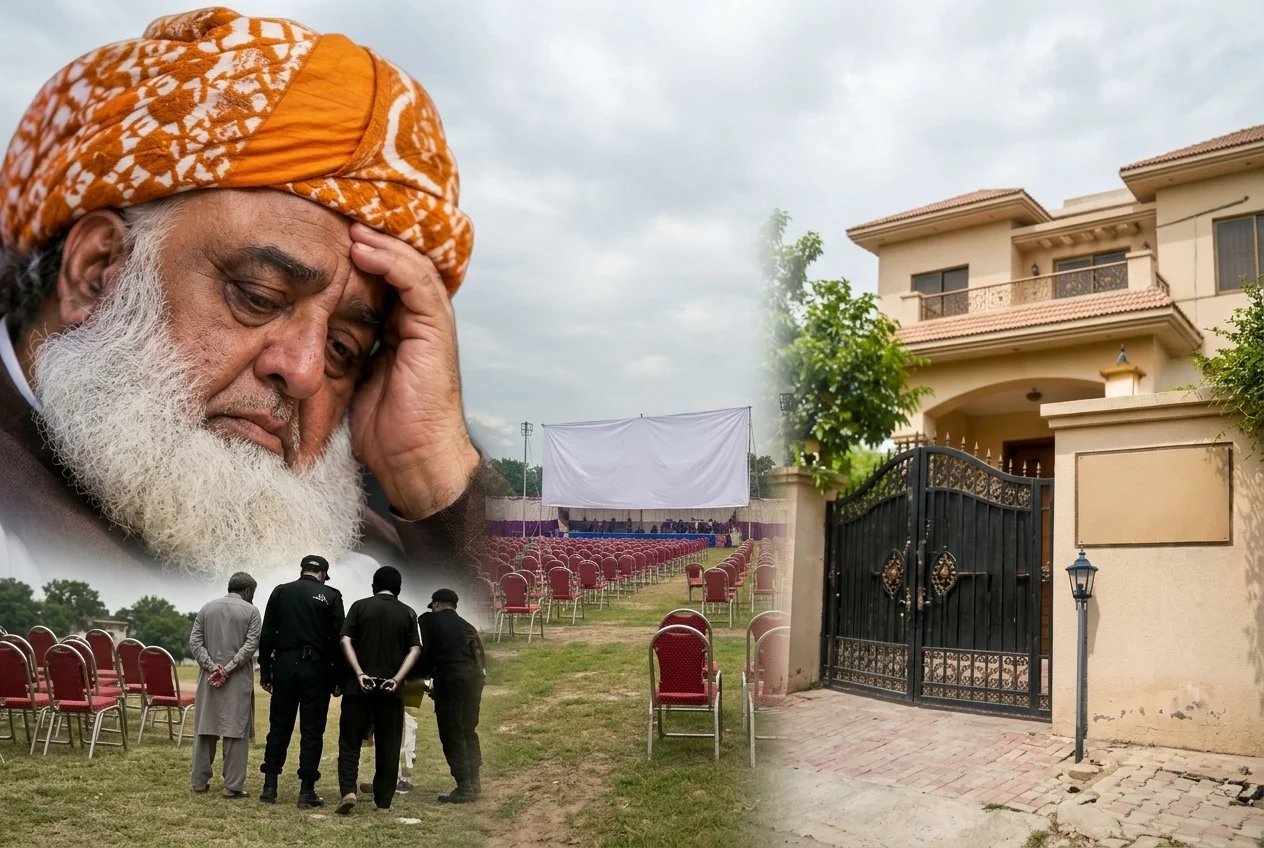

The victimhood narrative in Pakistani politics is nothing new. When public support begins to wane, rallies sit with empty chairs, and protest calls fall flat, Pakistan’s time tested recipe is to raise the cry of “state oppression” and paint oneself as the aggrieved party. The recent episode surrounding the alleged arrest of Jamiat Ulema e Islam (F) chief Maulana Fazlur Rehman appears to be yet another fresh chapter of this same tradition.
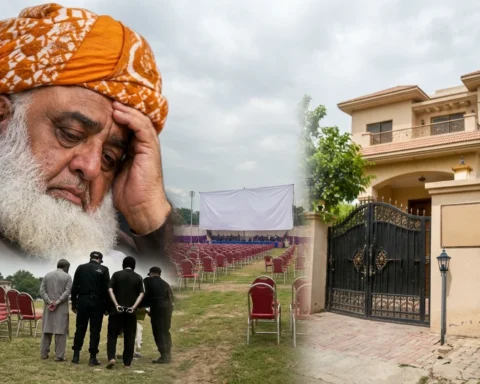
November 27, 2026 saw Pakistani social media flooded with headlines screaming “Maulana has been arrested.” JUI F’s Deputy Secretary of Information announced that Maulana Fazlur Rehman had surrendered himself for arrest and had departed from Thokar Niaz Baig in a police van, a statement that immediately triggered widespread speculation and a wave of breaking news reports. But what was the reality?
The CCPO Lahore submitted a written reply to the Lahore High Court stating that Maulana Fazlur Rehman had neither been arrested nor placed under house arrest. Lahore Police clarified that Maulana Fazlur Rehman had been at his residence in Park View Housing Society since 1:30am on Friday and had neither been arrested nor placed under house arrest. The Lahore Deputy Commissioner told the media that the administration had neither contacted Maulana Fazlur Rehman nor informed him of any threat, and that no orders had been issued to place him under house arrest.
So why all this commotion?
Finding the answer to that question requires going back only a few weeks. In mid November 2026, JUI F’s protest call failed to generate any significant public response across Khyber Pakhtunkhwa, with residents of Peshawar and other major cities rejecting the party’s call for demonstrations. No notable gathering or protest by JUI F workers was witnessed in Peshawar. A party that once gathered millions in its own stronghold of Khyber Pakhtunkhwa now finds the streets empty even there.
The party had also planned a public gathering in Sargodha on November 26. But when Maulana was stopped from travelling there, it was instantly repackaged as “arrest” and “state tyranny.”
The question is: had the rally gone ahead with half empty chairs, how costly would those photographs have been?
Maulana Fazlur Rehman’s political career is long and his experience considerable. He is a seasoned player in the ups and downs of Pakistani politics. But in recent years, a clear pattern has emerged in his political strategy, whenever public support dips, blame the institutions. The failure of the protest call raised serious questions about JUI F’s ability to mobilise public support even in its political strongholds, particularly as people increasingly want their political leaders to focus on inflation, unemployment, and real issues.
JUI F claimed that Fazlur Rehman had surrendered himself to police, while Lahore DIG Operations Faisal Kamran said he had left for his residence with his convoy and that reports of his arrest were incorrect. Two completely contradictory accounts, one crafted to stir public emotion, the other to state plain fact.
The Lahore High Court also warned that anyone found responsible for illegally detaining Maulana Fazlur Rehman would face consequences. In other words, the court held both sides accountable, the institutions on one hand, and the narrative itself on the other.
An important question also arises: if the leadership sits safely in one place while instructing workers to take to the streets, who ultimately pays the price of this political game? The ordinary worker who takes the baton, the citizen whose street is blocked, and the country whose economic activity grinds to a halt.
The office of religious leadership demands a special sense of responsibility. When a religious scholar enters politics, honesty and integrity are expected of him. Contradicting verified facts, or presenting unverified claims as truth, is unbecoming of that position’s dignity.
Pakistan today needs economic stability, educational progress, and political maturity. The public is not fooled every time by a victimhood narrative. People increasingly want political leaders to focus on inflation and unemployment, not to craft dramatic “arrest” stories to divert public attention.
In the end, politics built on narrative rather than reality does not last long. Political credibility is restored through truth, accountability, and public service, not through viral victimhood videos. The public knows everything.