
The dust has settled on what was perhaps one of the more ambitious and ultimately unsuccessful attempts to weaponise European institutional processes against Pakistan’s economic interests. The European Parliament’s Committee on Petitions has closed Petition No. 1730/2026 submitted by Paank over Pakistan’s GSP+ status, and with that closure, a carefully orchestrated campaign by the Baloch National Movement to disrupt one of Pakistan’s most strategically important trade relationships has come to an unceremonious end.
Let’s be clear about what actually happened here, because the spin from certain quarters has been rather creative. In a letter dated November 24, the Committee on Petitions confirmed that the petition had been referred to the European Parliament’s Committee on Foreign Affairs and the Subcommittee on Human Rights for information. The committee then stated plainly: it is unable to pursue the petition any further and has therefore decided to close the file. That is not a diplomatic victory for the petitioners. It is a closed door. Referred for information and then shelved is the institutional equivalent of being heard politely and then shown out.
The BNM framed the admissibility declaration as a triumph, which reveals more about their communication strategy than about the actual outcome. The admissibility decision marks a procedural step in the European Parliament’s consideration of the petition and does not, in itself, amount to a decision to suspend Pakistan’s GSP+ trade privileges. Any petition that falls within the EU’s fields of activity can be declared admissible. What matters is what follows, and what followed here was closure.
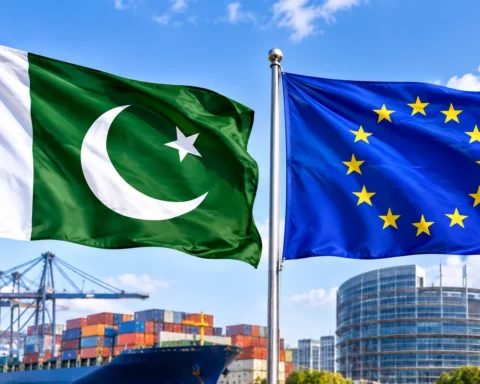
This outcome is entirely consistent with the trajectory of Pakistan EU relations in 2026, which has been one of deepening engagement, not distancing. EU foreign policy chief Kaja Kallas described Pakistan as a “major regional power” and an important partner for the EU during her visit to Pakistan in August 2026. That is not the language of a bloc contemplating punitive trade measures. Kallas noted that the EU remained by far Pakistan’s largest export destination, larger than China and the United States combined, and that Pakistan was the world’s leading beneficiary of EU trade preferences under GSP+.
The economic weight of this relationship cannot be overstated. Bilateral goods trade reached €12.2 billion in 2025, while over 85 percent of Pakistan’s exports currently enter the EU duty and quota free under GSP+. The latest EU GSP+ Report highlighted Pakistan’s 95.1 percent utilisation rate, reflecting the country’s effective use of the trade facility, and the European Union accounted for 28 percent of Pakistan’s total exports, underlining the strategic importance of bilateral trade. These are not numbers that describe a partnership under siege. These are numbers that describe an economic relationship both sides have strong structural reasons to protect and expand.
The BNM’s strategy was to use European platforms to internationalise a domestic separatist narrative, to transform internal grievances into external economic pressure on the Pakistani state. It is a familiar playbook, and one that has repeatedly failed to gain meaningful traction in serious institutional settings. The EU, as an institution guided by regulatory frameworks, formal assessments, and strategic partnership calculus, is not naturally receptive to advocacy campaigns that bypass those established mechanisms.
That said, it would be intellectually lazy to dismiss the EU’s own assessments entirely. The European Union’s latest assessment of Pakistan’s performance under the GSP+ preferential trade scheme presents a mixed picture. There is encouraging progress, but also areas of serious concern. The July 2026 GSP+ assessment, the same document the Committee on Petitions chair pointed the petitioners toward, does raise concerns about enforced disappearances, restrictions on expression, and the functioning of counter terrorism legislation. Pakistan’s Foreign Office has contested the balance of that assessment, and that dialogue is legitimate and ongoing.
Pakistan has since completed its 5th EU GSP review, and both sides have reaffirmed the importance of continued engagement.
This is the right way forward: institutional dialogue, bilateral meetings, reform commitments, and constructive engagement that characterises mature partnerships. Pakistan’s Deputy Prime Minister and Foreign Minister Ishaq Dar has chaired high level inter ministerial meetings to review measures aimed at strengthening Pakistan’s economic and trade cooperation with the EU, underscoring the importance of expanding trade and economic ties with the EU, noting that the bloc remains a key economic partner for Pakistan.
The EU Ambassador to Pakistan, Raimundas Karoblis, has reaffirmed the bloc’s commitment to supporting the continuation of Pakistan’s GSP+ trade preferences, saying the EU, as Pakistan’s largest trading partner and leading export destination, remained committed to deepening bilateral ties, creating jobs, driving innovation and supporting sustainable growth. That is partnership language. That is the vocabulary of two entities invested in a shared economic future.
The closure of BNM’s petition is not simply a procedural footnote. It reflects something more fundamental: European institutions, when engaging with Pakistan, are doing so through the lens of strategic economic partnership, not through the lens of separatist advocacy. The campaign to use the EU as a tool against Pakistan’s interests has not found fertile ground, and that is because the relationship between Islamabad and Brussels is built on €12 billion in trade, shared institutional frameworks, and decades of diplomatic investment, not on petitions drafted in the shadows of anti state agendas.
Pakistan’s GSP+ status is the product of real reform commitments, real trade relationships, and real diplomatic work. It will be defended through those same channels. And as the European Parliament’s committee has made clear, that file is closed.