
Pakistani politics has always been shaped by alliances, compromises and changing equations. Political parties that fiercely oppose one another today may find themselves sitting around the same cabinet table tomorrow. There is nothing inherently undemocratic about coalition politics. In a parliamentary system, negotiation is inevitable. The real test, however, begins when political positions appear to change according to whether a party is inside the government or standing outside it.
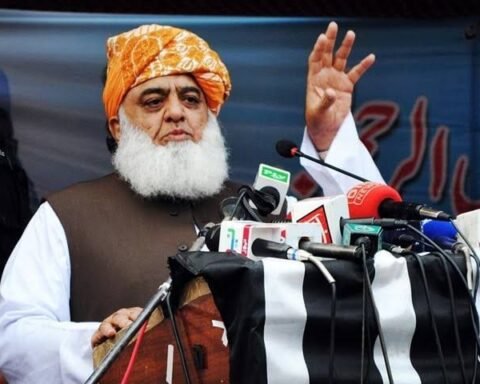
This question has increasingly followed Maulana Fazlur Rehman and the Jamiat Ulema-e-Islam Fazl. During the Pakistan Democratic Movement government formed after the removal of Imran Khan in 2022, JUI-F was not merely an outside supporter. It became an important component of the governing coalition and received substantial representation in the federal cabinet. Four JUI-F leaders initially entered the cabinet, holding important portfolios including Communications, Housing and Works, Religious Affairs and SAFRON.
There was nothing unusual about accepting ministries. Political parties contest elections precisely because they seek influence over public policy and government. The difficulty emerges when participation in one government is presented as legitimate coalition politics, while remaining outside another government is followed by increasingly sweeping criticism of the entire political arrangement.
During the PDM period, JUI-F stood firmly alongside the PML-N, PPP and other coalition partners. Maulana Fazlur Rehman was himself one of the most prominent political figures in the movement that campaigned against the PTI government. JUI-F ministers subsequently exercised executive authority within the coalition government. Yet even during that period, differences between coalition partners occasionally surfaced. In June 2022, for example, JUI-F publicly expressed dissatisfaction with some decisions of its own coalition government, demonstrating that participation did not eliminate internal disagreements.
Since the February 2024 elections, Maulana Fazlur Rehman has repeatedly questioned the legitimacy of the political order, criticised alleged electoral manipulation and challenged the government’s mandate. In June 2024, he argued that parliament should consist of genuine representatives of the electorate and continued to reject the election results. His criticism became sharper later that year when JUI-F opposed aspects of the government’s proposed constitutional package and questioned whether an administration lacking a genuine popular mandate should undertake major constitutional changes.
Some of these concerns deserve serious consideration. Questions about electoral credibility, parliamentary sovereignty, constitutional procedure and civilian authority cannot simply be dismissed because they come from an opposition politician. Maulana Fazlur Rehman has also raised substantive concerns about deteriorating security in Khyber Pakhtunkhwa and Balochistan and weaknesses in civilian decision making.
A politician cannot expect the public to judge his criticism only by the words being spoken today. Voters inevitably compare today’s speeches with yesterday’s choices. If coalition governments, compromises and institutional arrangements were acceptable while one’s party enjoyed ministerial representation, people are entitled to ask why similar arrangements suddenly become intolerable when political influence diminishes.
This is not a question limited to Maulana Fazlur Rehman. It reflects a broader weakness in Pakistan’s political culture. Almost every major political party has, at different moments, defended institutions, alliances or political arrangements when they benefited from them and attacked the same structures after losing influence. Governments describe opposition protests as destabilisation. The same parties, once in opposition, describe street mobilisation as democratic resistance. Coalition bargaining is called responsible politics when ministries are available and opportunism when rivals receive them.
For JUI-F, the challenge is particularly significant because the party presents itself as more than another electoral organisation competing for offices. Its political identity draws heavily upon ideology, religious values, constitutionalism and claims of principled leadership. The higher the moral claim, the greater the expectation of consistency.
If ministries are accepted as part of legitimate coalition bargaining, there should be no embarrassment about saying so. Political parties need executive authority to implement their programmes. But the same principle should apply when a party is outside government. Opposition should then be judged by policy differences, constitutional questions and public interest rather than by the availability or absence of positions.
The central issue, therefore, is not whether Maulana Fazlur Rehman should participate in government. He has every democratic right to negotiate political partnerships, demand representation or sit in opposition. The more important question is whether the political standards applied in each situation remain the same.
Pakistan needs an opposition capable of challenging governments on inflation, unemployment, security, governance, constitutionalism and institutional accountability. It also needs coalition parties prepared to take responsibility for decisions made while they occupy government offices.
The strongest political principle is consistency. If something is wrong outside government, it should also be wrong while sitting inside the cabinet. And if coalition bargaining is legitimate when one’s own party receives ministries, it cannot automatically become evidence of political corruption when another party receives the same opportunity.
That is ultimately the question surrounding Maulana Fazlur Rehman’s current politics. Is the disagreement fundamentally about constitutional principles and public interest, or has the loss of political space sharpened objections that appeared considerably less urgent when JUI-F held influential federal portfolios?
The answer will not be established through speeches alone. It will be determined by whether the same principles survive both power and opposition.