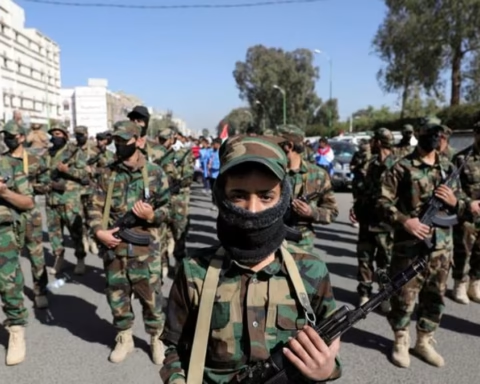
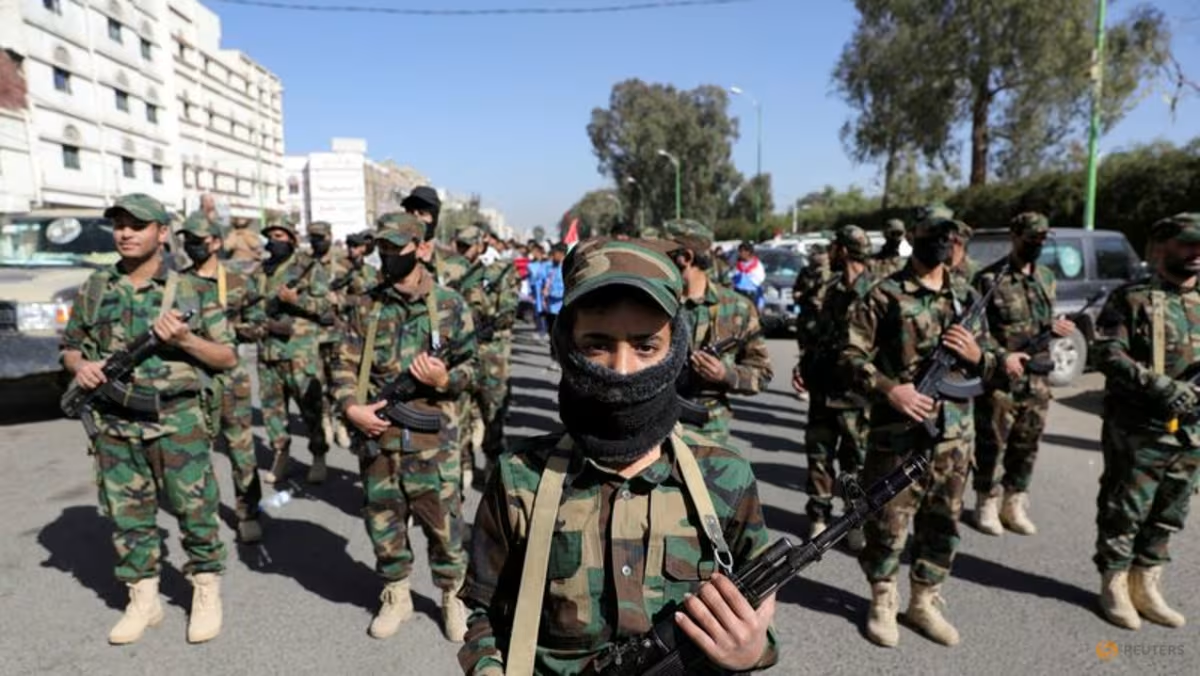

The renewed Houthi attacks on Saudi Arabia have pushed an already fragile regional security environment into a more dangerous phase. The targeting of King Khalid International Airport in Riyadh is particularly alarming because civilian airports are not abstract strategic assets. They are places through which millions of ordinary people travel, work and maintain connections with their families and livelihoods. The latest attack carried an especially painful consequence for Pakistan. Saudi Arabia’s General Authority of Civil Aviation confirmed that a Pakistani resident was killed and 11 other people were injured in the attack on the airport.
This loss gives Pakistan an immediate human stake in the crisis, but Islamabad’s concerns go far beyond the death of one of its citizens. Repeated attacks on civilian infrastructure threaten Saudi sovereignty, regional economic stability and the safety of millions of foreign residents who have made the Kingdom their home. They also create risks for international aviation, energy markets and commercial activity across the Gulf. Recent attacks have already disrupted air travel and heightened concern over the security of Saudi infrastructure.
There can be no legitimate justification for deliberately endangering passengers and civilian workers at an international airport. Whatever the political grievances surrounding the conflict in Yemen, taking hostilities to civilian facilities in Saudi cities crosses a dangerous threshold. International humanitarian law requires parties to armed conflict to distinguish between military objectives and civilian persons and objects. The continuing escalation therefore demands a clear international response rather than political ambiguity.
Pakistan has correctly adopted an unequivocal position. Alongside Saudi Arabia, Türkiye and Egypt, Islamabad joined the R4 statement strongly condemning the Houthi attacks. The group described the strikes as violations of Saudi sovereignty and territorial integrity, expressed solidarity with the Kingdom and demanded their immediate and unconditional cessation. It also held the Houthi militia accountable for the consequences of actions that could threaten wider regional and international peace.
This position reflects more than diplomatic courtesy. Pakistan and Saudi Arabia share a strategic relationship developed over decades of political, economic, religious and defence cooperation. Millions of Pakistanis have lived and worked in the Kingdom, while Saudi Arabia has repeatedly remained an important partner of Pakistan during difficult economic and strategic periods. When Saudi civilians, infrastructure and residents come under attack, Pakistan cannot regard the matter as distant from its own security interests.
The institutional framework of that solidarity has also become stronger. In August 2026, Pakistan, Saudi Arabia and Türkiye signed the Makkah Joint Defence Agreement. The accord states that an armed attack against any one of the three countries will be regarded as an attack against all and seeks to strengthen collective deterrence and defence cooperation. Pakistan’s Foreign Office has emphasised that the agreement is defensive in character and consistent with the inherent right of individual and collective self-defence under Article 51 of the United Nations Charter.
The significance of the Makkah Accord should therefore be understood carefully. It is not necessarily a mechanism for widening conflict. Its greater value lies in deterrence. Regional security becomes more credible when potential aggressors understand that attacks on one state can generate a coordinated response from its partners. Pakistan’s support for Saudi Arabia should consequently focus on strengthening defensive capabilities, intelligence cooperation, air and missile defence, counter-drone technologies, protection of critical infrastructure and wider coordination against threats to civilian populations.
Saudi Arabia also possesses the right to protect its population and territory. Article 51 of the UN Charter recognises the inherent right of individual or collective self-defence following an armed attack. That right does not eliminate the requirements of proportionality, international law or civilian protection, but neither can the international community expect a sovereign state to remain passive while missiles and drones repeatedly strike its cities and civilian facilities.
At the same time, Pakistan should continue supporting diplomacy aimed at preventing the confrontation from developing into a prolonged regional war. Islamabad has traditionally maintained relationships across different sides of the Middle Eastern geopolitical landscape. That diplomatic space gives Pakistan an opportunity to combine deterrence with de-escalation. Supporting Saudi security and encouraging a political settlement are not contradictory objectives. Credible deterrence can strengthen diplomacy when accompanied by clear communication and responsible statecraft.
The greatest danger now is normalization. If repeated attacks on airports, energy infrastructure and urban centres begin to be treated as another routine feature of Middle Eastern conflict, the threshold for violence will continue to fall. The consequences would not remain limited to Saudi Arabia and Yemen. Escalation could threaten Red Sea shipping, international aviation routes, energy supplies and commercial confidence across one of the world’s most strategically important regions.
The death of a Pakistani resident in Riyadh demonstrates that such conflicts rarely remain confined to the original parties. Pakistan therefore has both a moral and strategic reason to stand firmly with Saudi Arabia. Islamabad should express its deepest condolences to the bereaved family, extend sympathy to all those affected and wish the injured a swift recovery.
Pakistan’s message must remain clear. Attacks on civilians and civilian infrastructure are unacceptable. Saudi Arabia’s sovereignty and territorial integrity must be respected. The Houthi attacks should cease immediately, those responsible for violations must be held accountable, and regional actors must prevent further escalation. Through the R4 framework, the Makkah Joint Defence Agreement and its longstanding partnership with Riyadh, Pakistan should continue demonstrating that its solidarity with Saudi Arabia is not merely rhetorical. It is rooted in shared security, mutual responsibility and a broader commitment to stability in the region.