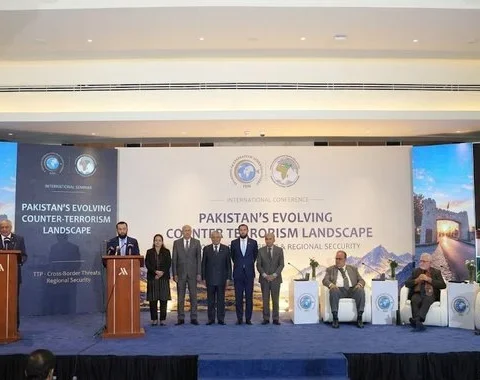
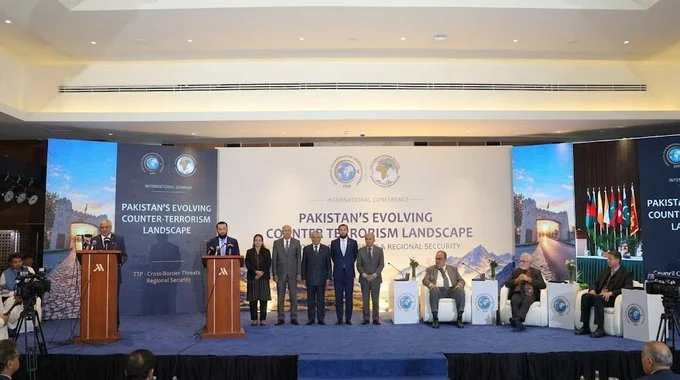

Pakistan stands at a defining crossroads in its decades long fight against terrorism. The one day International Seminar on Pakistan’s Evolving Counterterrorism Landscape, held in Islamabad this October, did not merely rehash old talking points. It delivered a sobering assessment of where the country stands, what it has sacrificed, and what the world still owes it in solidarity. The conclusions reached were clear, urgent, and grounded in a reality that too many international partners have been comfortable ignoring.
Let us begin with numbers that demand moral attention. Federal Information Minister confirmed at the seminar what statistics have long shown.
Pakistan has lost more than 90,000 lives and suffered economic losses exceeding $100 billion in its fight against terrorism.
These are not abstractions. They represent shattered families in Khyber Pakhtunkhwa, gutted markets in Balochistan, and a generation that has grown up knowing checkpoints and bomb blasts as ordinary features of life. Yet international attention, financial support, and genuine diplomatic solidarity have never matched the scale of Pakistan’s burden.
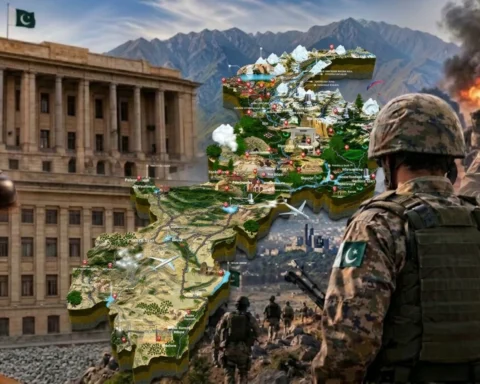
The security landscape in 2026 is not simply challenging. It is structurally complex in ways that defy simple solutions. Pakistan faces a synchronized four front pressure from Khawarij terrorists of the TTP, Afghan Taliban, BLA, and IS Khorasan, representing a calculated and coordinated encirclement rather than isolated incidents of violence. The seminar rightly underscored the distinct yet interconnected nature of the TTP threat in Khyber Pakhtunkhwa and the BLA’s campaign in Balochistan. Both are dangerous. Both are transnational. And crucially, both now operate with alarming levels of coordination.
Intelligence sources reveal that meetings arranged in July 2026 between BLA and TTP leadership in Kandahar, under the patronage of the Afghan Taliban regime, saw active financial transfers and commitments of manpower for coordinated terrorist operations inside Pakistan. This is not mere tactical opportunism. It is strategic convergence between terrorist networks that share a single objective: destabilising the Pakistani state. When terrorist organisations hold coordination meetings across the border and pool resources against a sovereign nation, the response required is equally coordinated and cannot rest on Pakistan’s shoulders alone.
The Afghan dimension remains the most persistent and painful variable. The seminar highlighted that the Afghan Taliban have failed to honour their commitments under the Doha Agreement, with over 20 terrorist organisations still operating from Afghan soil. After years of the Afghan Taliban’s failure to deny the TTP safe haven and contain cross border operations, tensions reached a turning point in February 2026, when Pakistan launched airstrikes targeting camps and hideouts used by TTP terrorists and ISIS fighters near the Pakistan Afghanistan border. That Pakistan was compelled to take such a step reflects not aggression but exhaustion. The exhaustion of a state that has knocked on every diplomatic door while watching its soldiers and civilians die from attacks launched across a border it cannot fully seal.
Pakistan’s Interior Minister has warned Afghanistan repeatedly that its territory continues to be exploited for attacks inside Pakistan, even as the Afghan Taliban government denies providing shelter to TTP or facilitating cross border activity. Denial, in the face of documented evidence and ground realities, is not a counterterrorism policy. It is complicity by another name.
On the technological front, the seminar drew critical attention to how terrorist networks are evolving their methods, exploiting digital platforms, encrypted communications, and advanced weaponry. KP police reportedly foiled 341 drone attacks in the first half of 2026 alone, with security officials confirming that leftover US weapons have expanded TTP’s operational capabilities, including access to night vision equipment unavailable to local police. This is a sobering reality. The weaponry left behind after NATO’s withdrawal has partly ended up in the hands of the very terrorists now targeting Pakistani security forces. The international community bears a direct responsibility here that has been insufficiently acknowledged.
Pakistan has not waited passively for others to act. The fourth round of US Pakistan Counterterrorism Dialogue in 2026 resulted in both sides affirming joint resolve against ISIS K, Al Qaeda, TTP, BLA, and its affiliates, reflecting meaningful improvement in bilateral counterterrorism cooperation. This is progress worth acknowledging, but progress must translate into operational outcomes, timely intelligence sharing, technological cooperation, and sustained diplomatic pressure on Afghanistan, not just joint statements.
The seminar’s most important contribution was its insistence that kinetic operations, while necessary, are insufficient. Sustainable counterterrorism requires functional governance, rule of law, political inclusion, and genuine public trust. Communities that feel abandoned by the state become vulnerable to recruitment. The state that substitutes military operations for development and justice will win battles while losing the longer war. Pakistan’s civil and military leadership recognises this, and the international community’s support must align with this comprehensive framework rather than offering narrow transactional assistance.
What the Islamabad seminar ultimately communicated, with both data and conviction, is that terrorism is not Pakistan’s problem to carry alone.
Pakistan’s security partnerships spanning China, the United States, Gulf states, and multilateral forums reflect a foreign policy that refuses to be defined by the violence being waged against it. That resolve deserves reciprocation.
The world must move beyond diplomatic declarations. Verifiable action to prevent Afghan territory from being used against Pakistan, real time intelligence cooperation, counter narrative investment, and technological support are not optional add ons. They are the minimum requirements of a serious collective response. Pakistan has paid an enormous price fighting a threat that, left unchecked, will not respect borders. The question is whether the international community will finally match its words with deeds, before the costs grow even higher.