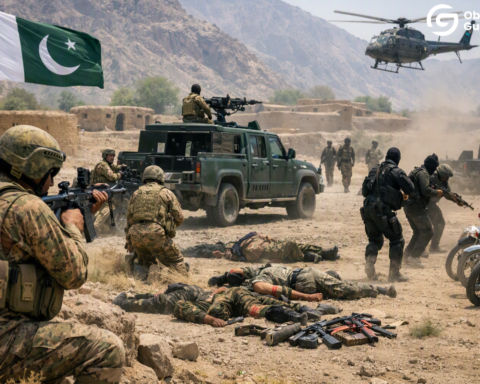
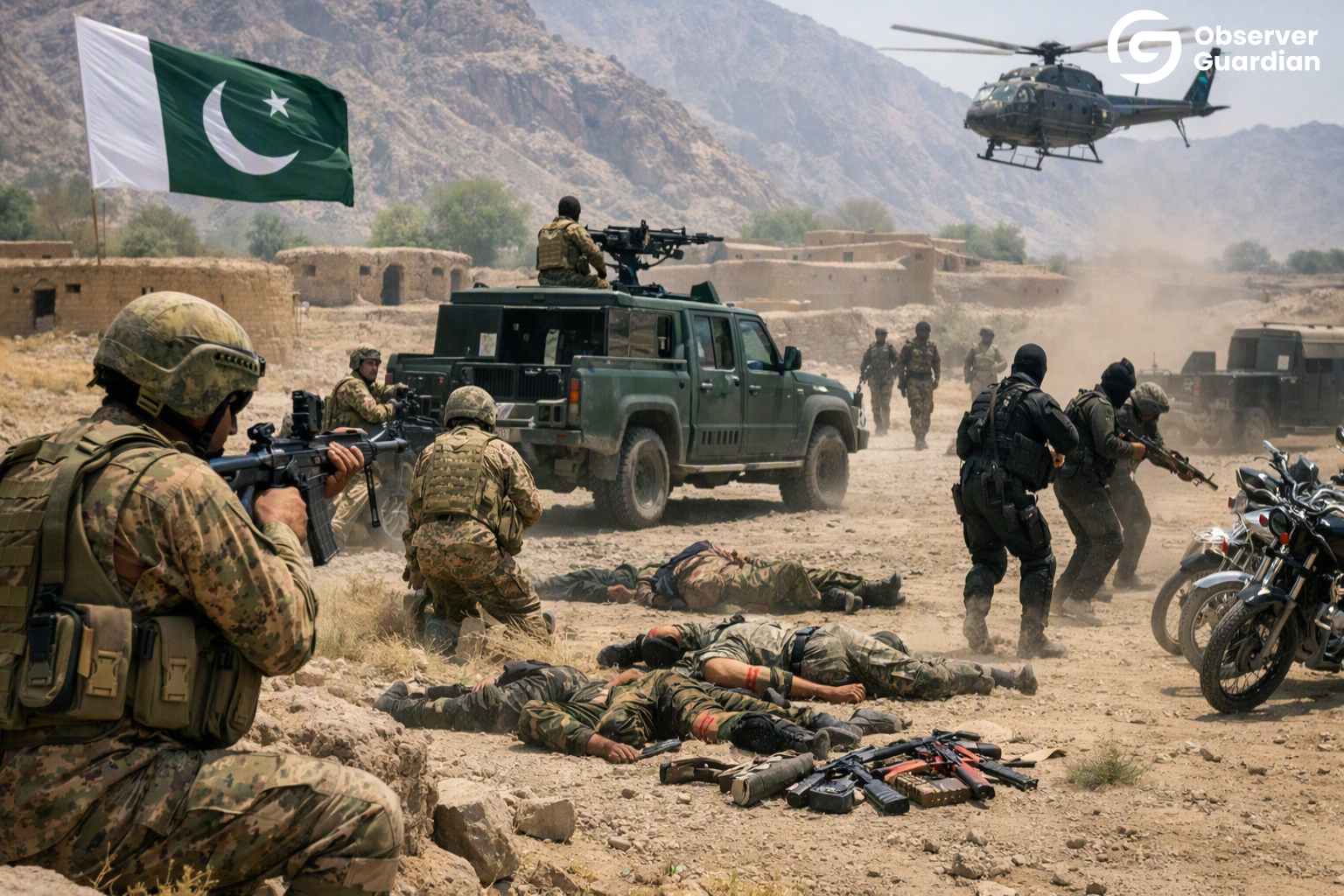

There is a pattern emerging from the rugged terrain of Balochistan, and it speaks louder than any press release ever could. When terrorists affiliated with Fitna al Hindustan (FAH) moved to strike the Khuni Talab Joint Check Post, they ran headlong into something they had clearly not expected, a security apparatus that was not only waiting, but ready to pursue. Nine FAH terrorists were eliminated during the initial engagement alone. Two more were neutralised in a separate intelligence based operation in Jousak, Turbat. That is 11 lives removed from the terror network in a single operational cycle under Operation Radd ul Fitna 3. The mathematics of disruption are beginning to add up.
To understand why this matters, you have to look beyond the body counts and read the operational logic embedded in these actions. The attack on Khuni Talab was not a spontaneous act of desperation, it was a deliberate attempt to strike a security installation, undermine confidence in state authority, and broadcast to local populations that the state could not protect them. It failed. Completely. And the subsequent pursuit of fleeing terrorists, resulting in additional eliminations and the recovery of arms, ammunition, and motorcycles, sent a message that is more powerful than any press briefing: these networks have nowhere to run.
That is a qualitative shift in the security environment of Balochistan, and it is backed by quantitative evidence. According to the Centre for Research and Security Studies (CRSS) Q2 2026 Security Report, Balochistan recorded over 40% fewer fatalities compared to the previous quarter, 265 deaths versus 443, representing one of the sharpest single quarter drops in recent memory. This decline did not happen by accident. It happened because sustained, intelligence driven pressure has been applied consistently across the province. Security operations are increasingly resulting in more conclusive engagements, with very few survivors among outlaws engaged. The hunt has become more precise.
Operation Radd ul Fitna 3 is not a standalone event, it is the third iteration of a deliberate counter terrorism campaign designed to deny FAH terrorists operational space across Balochistan. The high tempo intelligence driven operations are being conducted as part of the ongoing Radd ul Fitna 3 campaign, which the military’s media wing has described as a counterterrorism operation aimed at eliminating Indian proxies. The breadth of these operations across multiple districts, from Panjgur to Chagai, from Khuzdar to Turbat, reflects a coordinated theatre level strategy rather than reactive, localised responses. When security forces conducted a separate IBO in Jousak, Turbat, simultaneously with the Khuni Talab action, it signalled that intelligence networks are operating in concert, sharing information across geographical boundaries and acting before threats can consolidate.
The terrorist tactics themselves reveal a network under pressure. Killed terrorists in recent operations have been found to be involved in robbery, extortion, kidnapping, and terrorist activities targeting local traders and other civilians. This is the signature of an organisation that has lost the capacity to sustain itself through external support alone, it is feeding off the population it claims to represent. Networks that prey on local traders and civilians to fund operations are networks that are losing their ideological cover and reverting to criminality. It is a classic sign of strategic degradation.
Within a 48 to 72 hour window in early September alone, 48 terrorists affiliated with Indian proxy networks were eliminated by security forces in different parts of Balochistan across multiple intelligence based operations. Incidents like the premature detonation of a vehicle borne improvised explosive device in Surab in August, which killed eight FAH terrorists during its preparation, further illustrate that the operational environment has turned hostile for these networks. When terrorists cannot even arm their own weapons without killing themselves, the pressure being exerted by security forces is manifesting in field level errors.
The geographical spread of recent operations is equally telling. Sixty percent of all incidents in Balochistan took place in five districts: Quetta, Chagai, Washuk, Kech, and Gwadar. Security forces are not chasing ghosts across the entire province, they are concentrating force in identified hotspots and systematically degrading networks district by district. The fact that Jousak in Turbat district featured in this latest cycle of operations suggests that intelligence reaches are extending into areas that these khawarij previously considered safe ground.
One soldier sustained injuries in the Khuni Talab engagement and received treatment, a reminder that these operations carry real human cost. The men who move into contested terrain, absorb fire, and press forward to neutralise threats to civilians deserve acknowledgment that goes beyond ceremonial. Their restraint under fire, and their discipline in conducting follow up pursuits without collateral harm, reflects professional soldiering of a high order.
The CRSS Q1 2026 data had warned that while TTP driven violence in KP was receding, it was being offset by rising lethality in Balochistan, with concerning early signs of spillover into Punjab and the capital. That trajectory appears to have been interrupted in Balochistan by the sustained pressure of operations like Radd ul Fitna 3.
The country recorded a 5% marginal but encouraging quarter on quarter decline in overall violence, continuing a trend of declining violence reported by CRSS for consecutive quarters.
Balochistan is a province of extraordinary strategic significance, its coastline, its mineral wealth, its connectivity infrastructure including CPEC arteries all converge to make it a prize worth protecting. The khawarij and terrorists of FAH understand this. Their campaign of destabilisation is not random, it is aimed at exactly those development corridors, those connectivity nodes, those communities who stand to benefit most from investment and stability. Every time a check post attack is foiled, every time a terrorist commander is neutralised, and every time a cache of weapons is taken off the battlefield, the future of Balochistan’s people becomes a little more secure.
Operation Radd ul Fitna 3 is not just a military campaign, it is a statement of intent that the space for terrorism in Balochistan is shrinking, and it will continue to shrink until it disappears entirely.