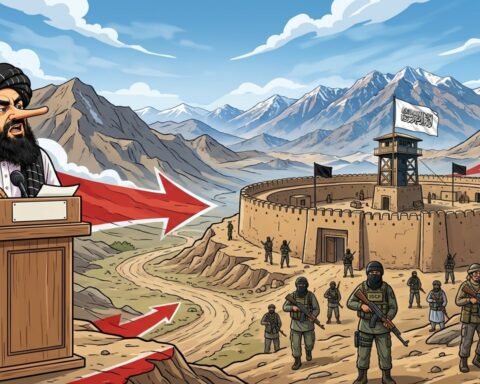
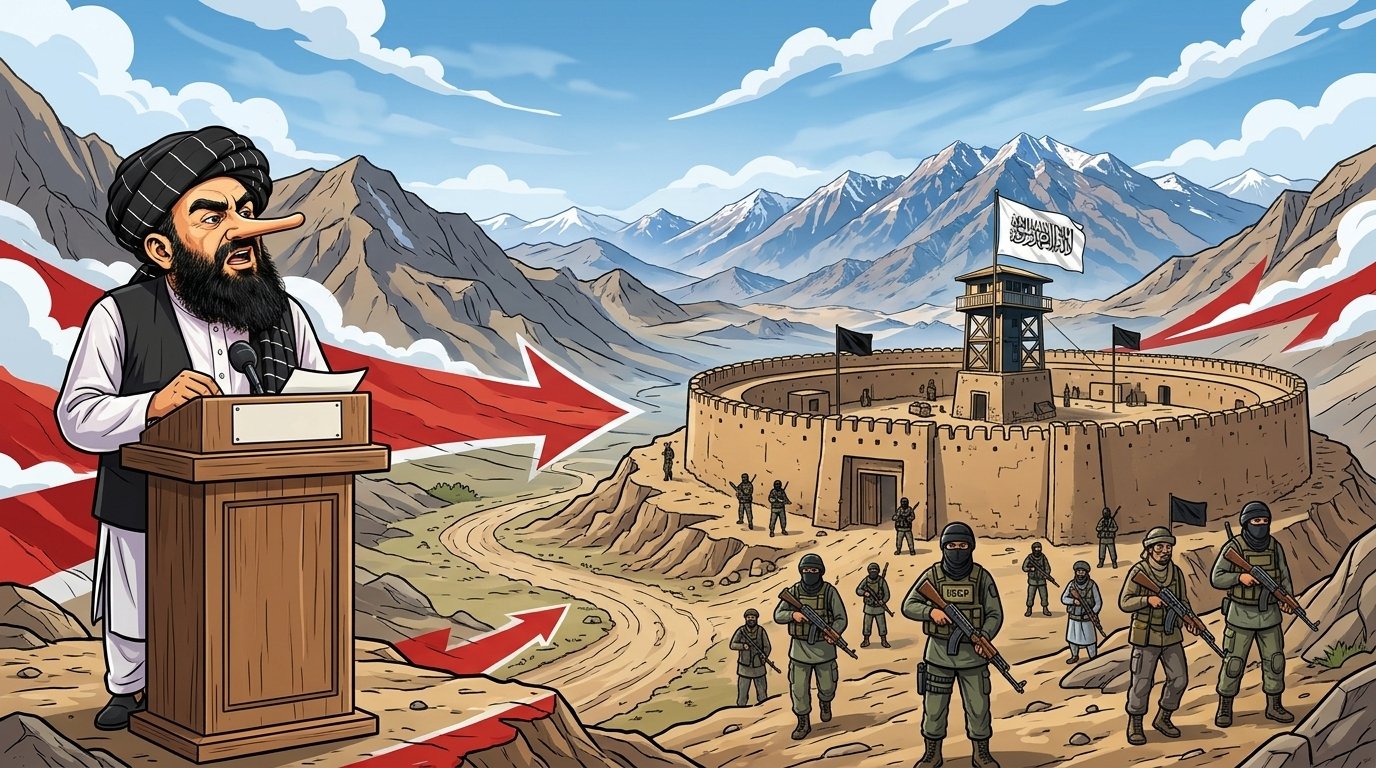

When Zabihullah Mujahid, the Taliban’s chief spokesman, stepped before his microphones to announce that Afghanistan had been “cleared” of the Khawarij, the terrorist outfit the world knows as ISKP or ISIS Khorasan, he wasn’t making a security assessment. He was performing a ritual. The same ritual he has performed dozens of times, to the same credulous silence, while the bodies pile up and the intelligence files grow thicker. The United Nations does not agree with him. The United States does not agree with him. Russia does not agree with him. The evidence doesn’t agree with him. But Mujahid keeps talking, and that in itself tells you something important about the regime he represents.
The UN Security Council’s monitoring team has consistently estimated the number of Khawarij fighters inside Afghanistan at around 2,000, confirming their continued presence and activity even as the Taliban flatly denies it. The same body has described ISKP as “the most serious threat, both regionally and internationally,” scattered across northern and northeastern provinces and actively recruiting fighters from Central Asia and the Russian North Caucasus. This is not a fringe view or a hostile framing. This is the considered judgment of the institution tasked with monitoring global terrorism, delivered repeatedly, updated consistently, and ignored systematically by Kabul.
The Taliban’s response to every new report follows the same script. When Washington assessed that the Khawarij presence in Afghanistan remained significant, Mujahid immediately dismissed it as “utterly fabricated.” When the US House of Representatives flagged the presence of foreign terrorist groups in Afghanistan, Mujahid went on record to “strongly reject” the claim. When UN officials briefed the Security Council on 20 militant groups operating from Afghan soil, Mujahid called it “baseless” and even accused the UN of boosting Khawarij morale. The pattern is consistent: deny everything, counter accuse everyone, and keep deflecting.
The UN’s own monitoring team addressed this directly, stating plainly that the Taliban’s claim, that no terrorist groups have a footprint in or operate from their territory, is “not credible.” That is diplomatic language, but the meaning is clear. The world body charged with tracking global threats has formally concluded that the Taliban is lying.
What makes Mujahid’s specific claim, that Afghanistan has been “cleared” of the Khawarij, particularly dishonest is how it conflicts with ground level reality. Khawarij terrorists carried out attacks on Afghanistan’s Shia minority as recently as April 2026 in Herat, part of a continuing anti Shia campaign that has claimed hundreds of civilian lives under Taliban rule. The Khawarij are not a ghost. They are killing people while Mujahid assures the world they don’t exist.
The 38th report of the UN monitoring team, submitted to the Security Council in August 2026, is explicit: despite Taliban counter terrorism operations, the authorities “were unable to suppress the terrorist problem,” and the threat to neighboring countries and the Central Asian region remains enduring. That same report notes the Khawarij are in a “rebuilding phase,” expanding their reach and adapting after setbacks, not vanishing as Mujahid claims. UN monitors say the group has renewed capability for occasional but high profile mass casualty attacks, and is now using AI tools to translate and circulate its propaganda in multiple languages, including Pashto and Kazakh.
The broader picture is even more damning. Member states have reported more than 20 international and regional terrorist groups currently operating inside Afghanistan. The UN’s monitoring assessments have confirmed that terrorist groups including TTP benefit from Taliban “tolerance or active support,” including access to safe houses such as guesthouses in Kabul for senior leaders, movement passes, and weapons permits. This is not a country fighting terrorism. This is a country managing it, selectively, strategically, and in ways that serve the Taliban’s own political interests.
ISKP has lost territorial presence compared to a decade ago, but it has adapted into a more resilient transnational threat with reach that now extends well beyond Afghanistan. UN monitoring has linked ISKP networks to external plotting, including the 2024 Crocus City Hall attack near Moscow, with operatives exploiting diaspora networks connected to Afghanistan and neighboring countries. The idea that this group has been “cleared” from Afghan soil is not just incorrect, it is dangerous, because it distracts from the urgent work of confronting what is genuinely one of the most capable terrorist franchises operating anywhere in the world today.
Mujahid’s blame shifting, pointing fingers at others while Afghanistan hosts a jihadist ecosystem of historic proportions, is the oldest trick in the handbook of failed states. Russia’s permanent representative to the UN warned at a Security Council meeting in September 2026 that the Khawarij in Afghanistan remain a serious security threat, noting the group’s demonstrated ability to organize operations beyond Afghanistan’s borders. When Russia, the United States, the United Nations, and multiple regional governments are all saying the same thing, the outlier is not the world. The outlier is Mujahid.
There is a word for someone who stands before cameras to deny what documented evidence, independent monitoring, and mass casualty attacks make undeniable. That word is propagandist. Mujahid is not a government spokesperson in any meaningful sense. He is the public relations apparatus of a regime that has turned Afghan territory into one of the world’s most permissive environments for terrorism, and he deploys denial not to inform but to insulate. His words are designed to shield the Taliban from accountability, not to reflect reality. And reality, as the UN’s 38th monitoring report makes clear, is not going away just because he chooses to ignore it.
The Khawarij are in Afghanistan. They are recruiting, rebuilding, and attacking. The data is unambiguous. Mujahid can keep claiming otherwise. But the world has stopped listening.