
There is something almost absurdist about a regime that sends a cricket team to international tournaments while simultaneously banning its own citizens from listening to cricket on the radio. Yet this is precisely where Afghanistan’s Taliban administration has arrived in November 2026, and the contradiction deserves to be examined with the seriousness it demands.
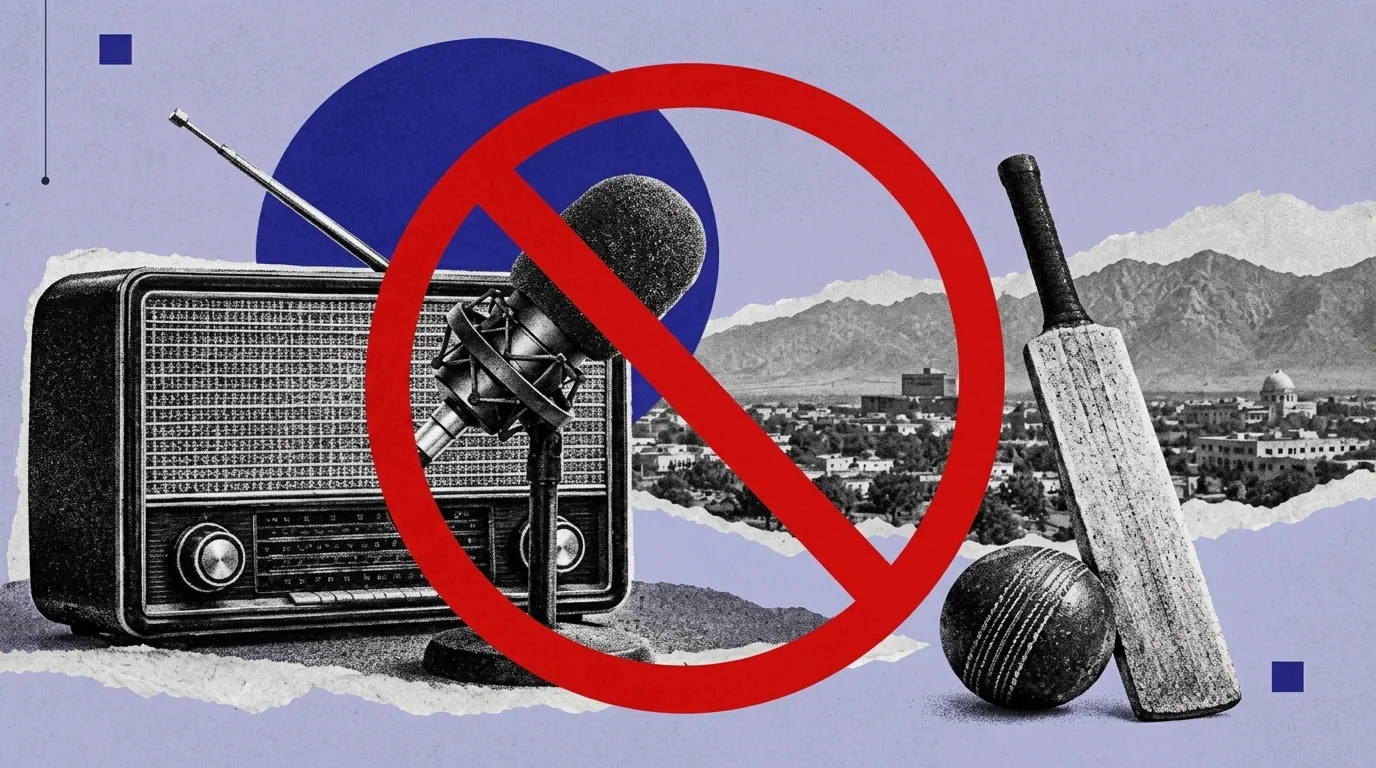
Taliban authorities in Kandahar province have ordered local radio stations to stop airing news and information about cricket, the country’s most popular sport. The provincial Department of Information and Culture issued the order on a Saturday, and the scope of the directive was sweeping: “Both commentary and news coverage, or even reporting about their winning results, is also banned,” according to a source within the department. The head of a local radio station confirmed receiving the call: “We were told that we can’t cover cricket on the radio anymore.”
Let that land for a moment. Not the game itself, not the bat, not the ball, not the pitch, but the act of listening to results has been designated a threat worthy of regulatory intervention.
The ban comes at a time when the Afghan men’s cricket team is playing a Test match against Zimbabwe in Sharjah. While Afghan players represent their country on international grounds, their countrymen in Kandahar cannot even tune in to hear whether their team won. This is not governance. This is a portrait of a regime pathologically allergic to the idea that ordinary people might feel joy on their own terms.
What makes this ban particularly revealing is its geography. An official in Afghanistan’s Cricket Board confirmed that “restrictions are limited to the Kandahar province” and that the board is in discussion with provincial authorities. Kabul and other provinces remain untouched. This is not a national policy. It is Kandahar’s clerical shura exercising its local muscle, policing culture in the Taliban’s heartland, the very power base from which this entire enterprise of control originally grew. It tells you everything about which faction inside this regime is most comfortable with ideological overreach.
The historical echo is impossible to ignore. During the Taliban’s first rule in the 1990s, football was banned because boys played in shorts. The logic then was identical to the logic now: the problem is not violence, not corruption, not the humanitarian catastrophe unfolding across the country. The problem is that the wrong things are being seen and heard. That a cricket commentary on a radio broadcast could disturb the ideological order of Kandahar’s clerics is not an isolated absurdity. It is the system working exactly as designed.
But here is where the story darkens considerably. Every appearance and success of Afghan athletes at major international sporting events is a political win for the Taliban, which seeks international recognition and legitimacy at home and abroad. Since regaining control, the Taliban have sought to help the national team thrive. Within days of regaining Kabul, Taliban officials met with the Afghanistan Cricket Board. The men’s team is nurtured, funded, and celebrated, because it performs a function. It earns international visibility, softens the regime’s global image, and keeps the door to diplomatic normalisation slightly ajar.
The ICC has stated its intention to use cricket as a tool to influence change in Afghanistan rather than imposing punitive measures. That is a generous interpretation of what has largely been institutional passivity. Under ICC rules, full member nations are required to have a national women’s team. Yet the ICC continues to recognise the Afghanistan Cricket Board under Taliban control. The Taliban banned women’s sport and completely shut down the women’s division of the Afghanistan Cricket Board, yet the ICC continues to recognise the board under Taliban control.
Human Rights Watch has called on the ICC to suspend Taliban run Afghanistan from membership until women and girls can once again participate in education and sport. Cricket Scotland has taken a more principled step, announcing that its men’s team will face Afghanistan only at ICC events, limiting bilateral ties owing to the Taliban government’s treatment of women.
The result of this international ambiguity is a regime that has learned precisely how to exploit cricket. Use the men’s team to generate goodwill abroad. Ban women entirely from the sport at home. And now, in Kandahar, ban even the radio broadcast, because the clerical establishment wants to remind everyone who holds the deeper power.
The Afghanistan Premier League is also due to return in December in the United Arab Emirates, marking a milestone in the revival of Afghan franchise cricket. So while Kandahar’s residents cannot hear cricket results on the radio, the Taliban sanctioned league will proceed in a Gulf state, watched internationally, reinforcing the image of a regime that “supports” the sport.
This is the contradiction that sits at the heart of the Taliban’s cricket strategy. The game is simultaneously a propaganda asset and a cultural threat, depending entirely on which faction of the regime is speaking, and in which province. The men’s team competes globally while women athletes remain in exile. After years of displacement and fleeing threats, Afghanistan’s refugee women’s cricket team travelled to Britain and, following a meeting with King Charles III, finally took to the field in Cambridge, nearly five years after the Taliban returned to power and barred Afghan women from education, work, and sport.
The Kandahar cricket ban will not end the Taliban. It will not provoke international sanctions on its own. But it functions as something important: a diagnostic. When a regime’s local clerics identify a cricket radio broadcast as an ideological hazard, they are revealing the depth of their compulsion to control information, leisure, public mood, and civic life itself. These are not the actions of a government trying to stabilise a country. These are the actions of an ideology that cannot tolerate the idea of people sitting around a radio, following a game, feeling something other than fear.
The ICC, the international community, and cricket’s global governing institutions must confront the question they have been evading since 2021: how long can cricket continue to serve as a reputational bridge for a regime that treats its own people’s enjoyment of the sport as a threat to public order? The game deserves better. The Afghan people certainly do.