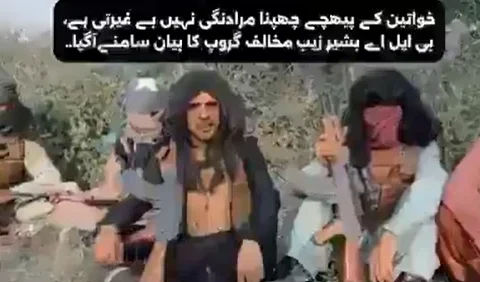
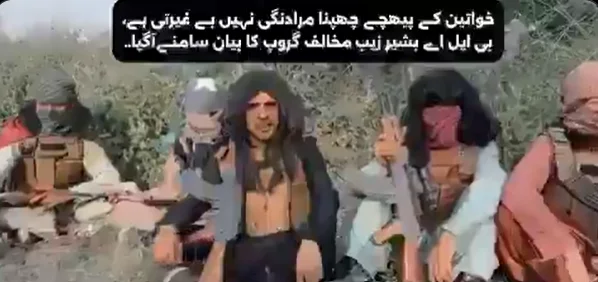

The press release issued by the Reform Command Council (RCC) of BLA Azad on November 19, 2026 is not just an internal organisational communiqué. It is an inadvertent confession. In detailing the alleged crimes of Bashir Zeb’s ousted leadership, the RCC has handed observers something rare: a candid, first person account of exactly what these foreign sponsored terrorist outfits actually are. Not liberation movements. Not nationalist vanguards. But criminal enterprises fighting over money, territory, and personal authority at the expense of the very people they claim to represent.
The document exposes a portrait of dysfunction that most analysts already suspected but rarely had documented so explicitly by the groups themselves. Commanders like Chakar Marri and Hooran Marri allegedly turned their weapons not on any declared enemy, but on the families of their own fallen comrades, harassing women and children in Bolan, pointing guns at fellow fighters. As recently as August 2026, the BLA’s factional violence had already claimed lives in what was described as an internal clash over control and influence. What the RCC has now documented from Bolan appears to be a continuation and escalation of that same destructive pattern.
The timing is not coincidental. In early November 2026, BLA chief Bashir Zeb was reportedly poisoned and moved to India for medical treatment, as internal disputes, factional rivalries, and allegations of financial corruption intensified within the organisation. Accounts circulating about the internal dispute refer to alleged financial transfers and assets linked to Bashir Zeb’s associates in Stockholm and Paris. The billions of rupees discrepancies cited by the RCC are not an isolated anomaly. They are the logical outcome of an organisation that runs on extortion, foreign patronage, and unaccountable command structures. Senior BLA financiers have previously managed funds collected through extortion from coal mining areas in Bolan, Quetta, and Dukki, with their control over financial distribution strengthening their position and helping the group hide financial routes across multiple regions.
This is what the “cause” looks like up close.
The RCC’s reference to the 2010 BLA UBA conflict deserves particular attention because it reveals something fundamental about this organisation’s nature. The BLA suffered a split in 2010, leading to deadly clashes between BLA fighters and the UBA, a conflict that erupted in June 2015 and exposed the fatal consequences of financial and strategic disputes between factions. That original fracture occurred after BLA fighters accused Mehran Marri of stealing three million dollars from their funds and 800 million rupees worth of weapons. Strip away the ideological language and the picture is consistent across decades: commanders stealing from each other, then shooting at each other. The 2026 crisis in Bolan is not a betrayal of the BLA’s founding ideals. It is the fulfilment of its structural logic.
As analysts have long noted, prolonged terrorist movements become susceptible to internal crises stemming from differences over ideology and finances, which then lead to disagreements about operational strategies. What makes the current fracture particularly revealing is that it has been documented by the terrorists themselves. The RCC’s press release essentially confirms what security analysts and Pakistani authorities have argued for years: that the gap between the BLA’s stated objectives and its actual conduct has become impossible to conceal.
The post Bashir Zeb transition has done nothing to paper over these cracks. Rehman Gul was appointed as the BLA’s new commander in chief on November 14, following a decision by the organisation’s Senior Command Council, with Gul having previously headed the Majeed Brigade, the unit associated with suicide attacks. Meanwhile, the BLA Azad faction, home to the RCC, operates under separate command entirely, with Hyrbyair Marri leading it as a less operational but distinct faction within the broader BLA structure. Competing command structures, parallel appointments, and conflicting claims to authority: this is not an organisation going through a healthy transition. It is one fracturing along multiple fault lines simultaneously.
The human cost of this internal war falls on those least able to bear it. The RCC’s own press release documents intimidation of bereaved families, harassment of women and children, and armed confrontations between commanders in Bolan. The rank and file fighter in Kahan or Nisau is not dying for Balochistan. He is dying for the personal ambitions of commanders who have enriched themselves with organisational funds and now refuse to yield their grip on power. Security analysts have noted that BLA’s internal evacuation of its leadership to foreign soil once again exposes the external state patronage provided to these banned groups. Those who arm, fund, and shelter these outfits from abroad are not investing in Balochistan’s future. They are exploiting Baloch fighters as disposable instruments of foreign policy, discarding them once they become inconvenient.
The RCC itself, in drawing the parallel with 2010, appears to understand that history is repeating itself. What it fails to acknowledge, perhaps cannot afford to acknowledge, is that these repetitions are not accidents of personality or leadership failure. They are structural. Organisations built on coercion, secrecy, and unaccountable command cannot produce accountability. Organisations funded through extortion cannot develop financial integrity. Organisations that treat human beings as operational assets cannot suddenly develop respect for the families of their own cadres. The rot is not in the leadership. The rot is in the enterprise itself.
Balochistan does not need armed factions consuming each other in Bolan while billing it as liberation. The province’s future lies in the constitutional process, economic development, and the many legitimate voices that advocate for Baloch rights without pointing guns at women and children. As one observer noted years ago, frustration, suspicion, infighting, and division are the common features of the end of a guerrilla fight. The events of November 2026 suggest that moment, for the BLA, may finally be approaching. What remains essential is ensuring that Balochistan’s genuine aspirations are not buried under the wreckage of these terrorist commanders’ personal ambitions, and that the people of this land are not made to pay the price for a power struggle that was never about them to begin with.