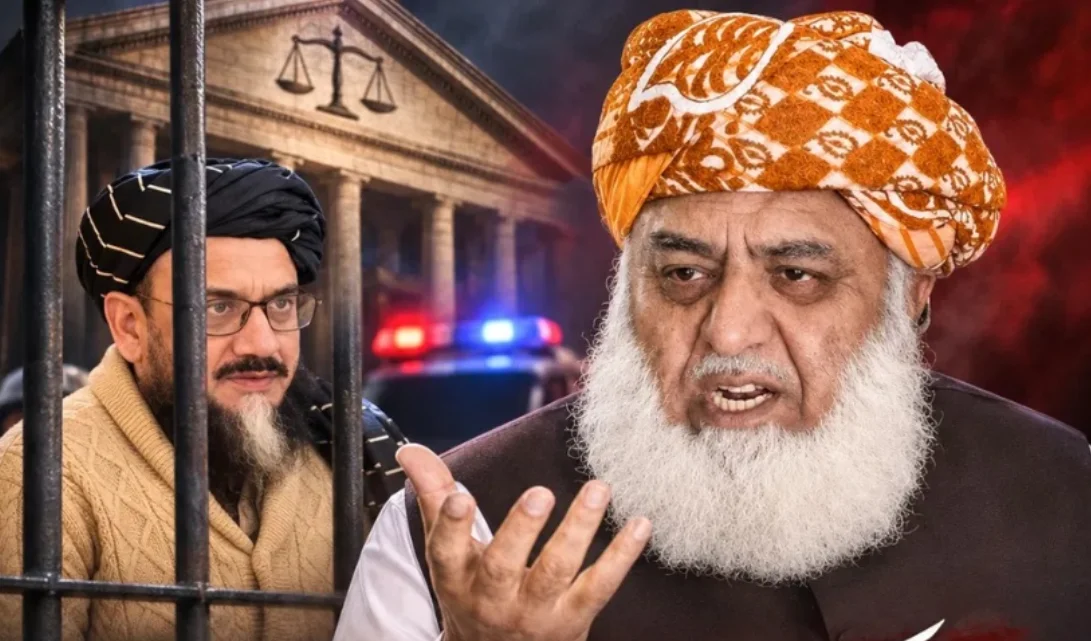

There is a certain irony that is impossible to ignore. For years, Maulana Fazlur Rehman and the Jamiat Ulema e Islam (F) have positioned themselves as guardians of Islamic law, constitutional order, and moral accountability. The party’s rhetoric, delivered from mosques, madaris, and television studios alike, has consistently demanded that everyone, politicians, generals, businessmen, be answerable to the law of the land. That principle is now being tested not against an adversary, but against someone sitting inside the JUI F’s own inner circle.
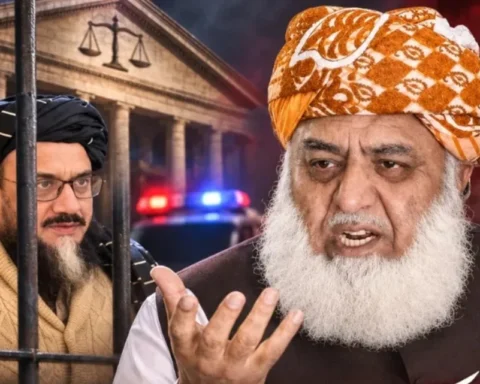
A terrorism case has been registered against Mufti Abrar Ahmed, secretary to JUI F chief Maulana Fazlur Rehman, with over 200 unidentified party workers also named in the case. The JUI F alleged that Mufti Abrar and the workers had been falsely accused of assaulting police personnel. As of November 19, 2026, non bailable arrest warrants have been issued against him, and according to FIR No. 1212/26, JUI F workers held a gathering without prior permission and, when stopped by police, allegedly threw stones at officers, vandalized government vehicles, and interfered with official duties.
The charges are not minor. The FIR includes violations of Section 144, illegal assembly, obstruction of law enforcement, damage to state property, and, most critically, Section 7 of the Anti Terrorism Act. This is not a traffic violation. This is the kind of charge sheet that, when filed against PTI workers or opposition figures from other parties, the JUI F itself has often cited as proof of lawlessness and the need for accountability.
The question that hangs uncomfortably in the air is simple: does the same standard apply when it is your own man?
This is not, to be clear, a question about guilt or innocence. Mufti Ibrar is entitled to a full legal defense, presumption of innocence, and fair trial, rights that belong to every Pakistani citizen regardless of their political affiliation or religious standing. If the allegations are fabricated or exaggerated, the proper arena to establish that is the courtroom, not the rally ground. The legal process exists precisely for situations like these.
What is worth examining, however, is the institutional response. When a non bailable warrant is issued by a court, it is not a political statement. It is a judicial instruction. Courts issue such warrants specifically when there is reason to believe the accused may not appear voluntarily. Treating that warrant as a political conspiracy rather than a legal obligation is a posture that undermines the very institutions that religious and political leaders routinely claim to defend.
Pakistan’s history is littered with examples of figures who preached accountability for others while shielding their own circles from scrutiny. The pattern is familiar regardless of which party is involved. What makes the Mufti Ibrar case worth writing about is precisely because it involves a party that has anchored its entire identity in the language of Islamic law and moral uprightness. The electorate that votes for JUI F does so, in large part, because they believe the party represents something more principled than ordinary political horse trading. That trust deserves an honest response.
Maulana Fazlur Rehman is an experienced political operator. He understands better than most that the credibility of a movement depends on how it handles its own when things go wrong. The choices here are not complicated. If the party believes the case is politically motivated, it should say so openly and fight it legally, through lawyers, through courts, through constitutional channels. That is the right way. What would be wrong is using the Friday sermon as a shield, mobilizing street pressure to intimidate the judicial process, or simply going silent while hoping the news cycle moves on.
The charges under ATA’s Section 7 deserve particular attention. Pakistan’s anti terrorism legislation has undeniably been misused in the past, stretched to cover protests, political dissent, and cases that bear little resemblance to actual terrorism. If that is happening here, it should be challenged vigorously in court, and civil society should be watching closely. But the existence of potential misuse does not mean every invocation of ATA is automatically illegitimate. The specific allegations, stone pelting on police officers, destruction of state vehicles, organized disruption in a city under Section 144, are the kind of conduct that, if proven, would satisfy the legal threshold regardless of who the accused is.
Religious identity is not a legal exemption. Mosque affiliation does not dissolve FIR charges. A turban and a beard, however sincerely worn, carry no weight in the evidence section of a courtroom. These are principles that Pakistan’s religious leadership itself acknowledges in the abstract. The test of genuine commitment to those principles comes when applying them to one’s own household.
There is a broader pattern worth noting. JUI F alleged that Mufti Abrar and party workers had been falsely accused of assaulting police personnel. That may well be true, such claims must be investigated thoroughly and impartially. But a denial is not the same as evidence, and the court has found sufficient reason to issue warrants. The right response is engagement with the legal process, not evasion of it.
Pakistan does not need more examples of powerful individuals, from any ideological corner, treating the judiciary as an instrument to be used against opponents while dodging it themselves. What the country needs, and what its citizens deserve, is the unremarkable but rare sight of a leader standing up and saying: my associate will face the court, the law will take its course, and we trust the process to deliver justice. No special pleading. No victim narrative. No street theatre. Just law, the same law that is preached every Friday from every pulpit in the country.
Maulana Fazlur Rehman has an opportunity here. How his party handles the next few weeks will say more about its actual values than a decade of sermons ever could. The pulpit demands much. The courtroom demands more. Both must be answered.